

Capital at risk

Investment strategy

Global Income Growth

Long-term dividend compounding is the eighth wonder of the world.  

We focus on companies that can compound earnings and dividends effectively over long periods. These are rare but can deliver attractive returns.

Three intrepid cyclists exploring scenic mountain trails on their high-performance bike.

For a lifetime of income, choose growth

Whether you require an income today and for years to come or are simply looking for attractive capital growth and total returns over the long term, dividend growth investing might be what you’re looking for. 

View transcript
<p data-start="182" data-end="943"><strong>Your capital is at risk. Past performance is not a guide to future returns. The following update is based on a representative portfolio. As such, stock examples may not be held in every client portfolio, and performance may differ.</strong></p> <p data-start="182" data-end="943"><strong>This transcript has been generated using AI.</strong></p> <div class="flex flex-col text-sm pb-25"> <div class="text-base my-auto mx-auto pb-10 [--thread-content-margin:var(--thread-content-margin-xs,calc(var(--spacing)*4))] @w-sm/main:[--thread-content-margin:var(--thread-content-margin-sm,calc(var(--spacing)*6))] @w-lg/main:[--thread-content-margin:var(--thread-content-margin-lg,calc(var(--spacing)*16))] px-(--thread-content-margin)"> <div class="[--thread-content-max-width:40rem] @w-lg/main:[--thread-content-max-width:48rem] mx-auto max-w-(--thread-content-max-width) flex-1 group/turn-messages focus-visible:outline-hidden relative flex w-full min-w-0 flex-col agent-turn"> <div class="flex max-w-full flex-col gap-4 grow"> <div class="min-h-8 text-message relative flex w-full flex-col items-end gap-2 text-start break-words whitespace-normal outline-none keyboard-focused:focus-ring [.text-message+&amp;]:mt-1" data-message-author-role="assistant" data-message-id="73040ef4-ba4c-4862-9a2b-80c85a04ff88" data-message-model-slug="gpt-5-4-thinking" data-turn-start-message="true"> <div class="flex w-full flex-col gap-1 empty:hidden"> <div class="markdown prose dark:prose-invert w-full wrap-break-word light markdown-new-styling"> <p data-start="176" data-end="866"><strong data-start="176" data-end="194">Thomas Hodges:</strong> This quarter felt like the title of the multi-Oscar-winning film, <em>“One Battle After Another”</em>. Markets moved rapidly from one concern to the next. First came a sharp sell-off in software and digital businesses, driven by fears that artificial intelligence could disrupt even the most well-established companies. And then, towards the end of the quarter, conflict in the Middle East triggered a surge in energy prices and a very different kind of market reaction. And your portfolio held up relatively well during the first phase, and that’s despite pressure on a number of software and data-related holdings. Performance was resilient and ahead of the index at that point.</p> <p data-start="868" data-end="1819">The second phase proved more challenging, as geopolitical tensions escalated and energy markets reacted, investors moved quickly and indiscriminately, and even areas of the market which have historically provided some degree of shelter, like consumer staples and healthcare, they came under pressure. But energy was the clear exception, benefiting from higher oil and gas prices. And because we had no direct exposure to that sector, this weighed on relative returns. And some of our European industrial holdings also struggled as the market began to worry about the effects of higher energy costs. And as a result, the weakness in March more than offset the relative strength earlier in the period, and the portfolio ended the quarter behind the index. And that’s a frustrating outcome, but it doesn’t change our confidence in the portfolio’s resilience in the face of future challenges, nor does it challenge our confidence in the process behind it.</p> <p data-start="1821" data-end="2465">So what I’m going to do now is touch on our thoughts regarding resilience and why we think we’re well positioned for the challenges ahead. And resilience is not just an accidental feature of how we invest, it’s actually something that we actively target. It’s reflected in our track record about performance in downturns. Of the 12 instances of greater than five percent market drawdowns in US dollar terms over the past decade, we’ve beaten the market in 10 of them. And our starting point is always deep fundamental research. We look closely at a company’s business model, its competitive position and its ability to endure through downturns.</p> <p data-start="2467" data-end="3430">We combine financial analysis with ESG inputs and work on corporate culture, and then assess each company through our GRIP framework, where we judge a company’s growth potential, its resilience, the sustainability of the income paid out and the total return potential. And that framework helps us judge whether a business can grow, but also whether that growth will be durable, and if the market is properly valuing it. And so when we find businesses that can grow earnings and income through the cycle, and where that resilience is underappreciated, we believe that creates opportunity. And that was particularly clear during the sell-off earlier in the quarter. When new AI tools were launched, the market quickly began to question the durability of many traditional software business models. Investors started worrying about pricing and could that come under pressure, customer churn could increase and the long-established competitive advantages might weaken.</p> <p data-start="3432" data-end="3913">And given the portfolio’s exposure to software and data-related companies, several holdings were caught up in the crossfire. But we believe that the market reaction was just too broad, too simplistic and also too harsh. Because the businesses that we own in this area aren’t easily displaced. Their products are deeply embedded in customer workflows. They control proprietary data, and they can’t simply be replicated by a new AI interface. And Microsoft’s a great example of this.</p> <p data-start="3915" data-end="4424">Its productivity tools and cloud services are woven into the daily operations of many businesses around the world, creating exceptionally high switching costs. And then there’s Experian, the credit data provider. Its data advantage rests on a consortium model where you have to give data to get data. And that’s really difficult to reproduce. And in our view, it’s highly resilient. And importantly, the operating results from many companies in this area have remained strong despite the share price reaction.</p> <p data-start="4426" data-end="5236">Amadeus, which provides the software backbone for much of the travel industry, continued to deliver solid growth in earnings, and it raised its dividend. Management recently spoke confidently about its competitive strength, including its role as a trusted system of record for its customers, its deep integration with them and the reliability of its global infrastructure. Intuit similarly reported strong results, the tax and accounting software company, despite a meaningful derating in its share price. And in both cases, we see companies which are delivering on the growth and income parts of the GRIP equation, but with valuations that no longer reflect the resilience of that growth. And so we saw an opportunity to generate strong total returns into the future. And so we added to both over the quarter.</p> <p data-start="5238" data-end="6023">But of course, when we’re thinking about resiliency, it’s not just about picking good companies one by one, it’s also about how they fit together. And we want different parts of the portfolio to work in different environments. So consumer staples, for example, generally perform well in downturns, and they remain a really important source of ballast. Businesses like L’Oréal and PepsiCo generate really strong cash flows, they’ve got pricing power and they continue to grow their dividends. And these are companies whose products remain relevant through changing economic conditions, and their scale and their financial strength give them the ability to reinvest for future growth. And similarly, our financial holdings provide some degree of balance as well, just in a different way.</p> <p data-start="6025" data-end="6793">We’re overweight financials, but that exposure is concentrated in exchange businesses, like Deutsche Börse and CME Group, rather than in banks. And these are highly profitable, cash-generative businesses with toll-road-like characteristics. They also tend to benefit when markets become more volatile as trading activity increases. And that was really reflected over the quarter with holdings like B3 and CME among the stronger contributors. And so these stabilising exposures sit alongside longer-term structural growth holdings, including the software companies, which I mentioned earlier, and also semiconductor companies like TSMC, MediaTek and others. But thinking about the more recent sell-off, it was certainly a different test of resilience for any portfolio.</p> <p data-start="6795" data-end="7627">And it was much less about company fundamentals and much more about sentiment and shifting perceptions around geopolitical risk. Markets were swinging sharply in response to the changing views on the conflict and what that might mean for energy suppliers. In that kind of environment, the market temporarily favours immediate, tangible value over future growth. But that’s exactly why we think this portfolio is really well positioned. The companies we own offer both value today and growth tomorrow, and that’s whether that comes from the traditional sources of balance, like Coca-Cola, or structural income-paying growers like Alphabet. These are companies which generate enormous levels of cash, and that supports attractive dividends and helps build fortress balance sheets, providing that value and resilience in the near term.</p> <p data-start="7629" data-end="8196">And then for the future, they reinvest a portion of those cash flows at high rates of return, meaningfully higher returns than the average company in the index. And that’s what provides the growth for tomorrow. So value today, growth tomorrow. Keeping steady in a changing environment is something we’d generally pay a meaningful premium for. But given the general derating of quality over the past 12 months, that premium is thinner than ever. But as complexity rises, we think this style of investing and this quality of portfolio will become much more appreciated.</p> <p data-start="8198" data-end="8576" data-is-last-node="" data-is-only-node="">And so while the quarter’s performance was disappointing, our broader perspective is unchanged. We continue to see a portfolio of resilient businesses, diverse growth drivers and valuations that in many cases have become much more attractive. Markets may continue to present one battle after another, but we believe the companies you own are well equipped for the battles ahead.</p> <p data-start="8198" data-end="8576" data-is-last-node="" data-is-only-node="">&nbsp;</p> </div> </div> </div> </div> </div> </div> </div> <h3 class="TABLEHEADER1212pt">Global Income Growth</h3> <p><strong>Annual past performance to 31 March each year (%)</strong></p> <table border="1" style="border-collapse: collapse; width: 100%; border-width: 0px; height: 111px;"> <tbody> <tr style="height: 18.5px;"> <td style="border-width: 1px 1px 2px; border-style: solid; border-color: rgb(204, 204, 204) rgb(204, 204, 204) rgb(0, 0, 0); border-image: initial; padding: 10px; height: 18.5px;">&nbsp;</td> <td style="border-width: 1px 1px 2px; border-style: solid; border-color: rgb(204, 204, 204) rgb(204, 204, 204) rgb(0, 0, 0); border-image: initial; padding: 10px; height: 18.5px;"><strong>2022</strong></td> <td style="border-width: 1px 1px 2px; border-style: solid; border-color: rgb(204, 204, 204) rgb(204, 204, 204) rgb(0, 0, 0); border-image: initial; padding: 10px; height: 18.5px;"><strong>2023</strong></td> <td style="border-width: 1px 1px 2px; border-style: solid; border-color: rgb(204, 204, 204) rgb(204, 204, 204) rgb(0, 0, 0); border-image: initial; padding: 10px; height: 18.5px;"><strong>2024</strong></td> <td style="border-width: 1px 1px 2px; border-style: solid; border-color: rgb(204, 204, 204) rgb(204, 204, 204) rgb(0, 0, 0); border-image: initial; padding: 10px; height: 18.5px;"><strong>2025</strong></td> <td style="border-width: 1px 1px 2px; border-style: solid; border-color: rgb(204, 204, 204) rgb(204, 204, 204) rgb(0, 0, 0); border-image: initial; padding: 10px; height: 18.5px;"><strong>2026</strong></td> </tr> <tr style="height: 18.5px;"> <td style="border: 1px solid rgb(204, 204, 204); padding: 10px; height: 18.5px;">Global Income Growth Composite (gross)</td> <td style="border: 1px solid rgb(204, 204, 204); padding: 10px; height: 18.5px;">8.2</td> <td style="border: 1px solid rgb(204, 204, 204); padding: 10px; height: 18.5px;">-0.5</td> <td style="border: 1px solid rgb(204, 204, 204); padding: 10px; height: 18.5px;">13.2</td> <td style="border: 1px solid rgb(204, 204, 204); padding: 10px; height: 18.5px;">2.5</td> <td style="border: 1px solid rgb(204, 204, 204); padding: 10px; height: 18.5px;">3.1</td> </tr> <tr style="height: 18.5px;"> <td style="border: 1px solid rgb(204, 204, 204); padding: 10px; height: 18.5px;">Global Income Growth Composite (net)</td> <td style="border: 1px solid rgb(204, 204, 204); padding: 10px; height: 18.5px;">7.7</td> <td style="border: 1px solid rgb(204, 204, 204); padding: 10px; height: 18.5px;">-1.1</td> <td style="border: 1px solid rgb(204, 204, 204); padding: 10px; height: 18.5px;">12.5</td> <td style="border: 1px solid rgb(204, 204, 204); padding: 10px; height: 18.5px;">1.9</td> <td style="border: 1px solid rgb(204, 204, 204); padding: 10px; height: 18.5px;">2.5</td> </tr> <tr style="height: 18.5px;"> <td style="border: 1px solid rgb(204, 204, 204); padding: 10px; height: 18.5px;">Responsible Global Equity Income Composite (gross)</td> <td style="border: 1px solid rgb(204, 204, 204); padding: 10px; height: 18.5px;">9.4</td> <td style="border: 1px solid rgb(204, 204, 204); padding: 10px; height: 18.5px;">-0.2</td> <td style="border: 1px solid rgb(204, 204, 204); padding: 10px; height: 18.5px;">15.1</td> <td style="border: 1px solid rgb(204, 204, 204); padding: 10px; height: 18.5px;">2.2</td> <td style="border: 1px solid rgb(204, 204, 204); padding: 10px; height: 18.5px;">3.7</td> </tr> <tr style="height: 18.5px;"> <td style="border: 1px solid rgb(204, 204, 204); padding: 10px; height: 18.5px;">Responsible Global Equity Income Composite (net)</td> <td style="border: 1px solid rgb(204, 204, 204); padding: 10px; height: 18.5px;">8.8</td> <td style="border: 1px solid rgb(204, 204, 204); padding: 10px; height: 18.5px;">-0.7</td> <td style="border: 1px solid rgb(204, 204, 204); padding: 10px; height: 18.5px;">14.4</td> <td style="border: 1px solid rgb(204, 204, 204); padding: 10px; height: 18.5px;">1.7</td> <td style="border: 1px solid rgb(204, 204, 204); padding: 10px; height: 18.5px;">3.2</td> </tr> <tr style="height: 18.5px;"> <td style="border: 1px solid rgb(204, 204, 204); padding: 10px; height: 18.5px;">MSCI ACWI Index</td> <td style="border: 1px solid rgb(204, 204, 204); padding: 10px; height: 18.5px;">7.7</td> <td style="border: 1px solid rgb(204, 204, 204); padding: 10px; height: 18.5px;">-7.0</td> <td style="border: 1px solid rgb(204, 204, 204); padding: 10px; height: 18.5px;">23.8</td> <td style="border: 1px solid rgb(204, 204, 204); padding: 10px; height: 18.5px;">7.6</td> <td style="border: 1px solid rgb(204, 204, 204); padding: 10px; height: 18.5px;">20.5</td> </tr> </tbody> </table> <p>&nbsp;</p> <p><strong>Annualised returns to 31 March 2026 (%)</strong></p> <table border="1" style="border-collapse: collapse; width: 99.9907%; border-width: 0px; height: 92.5px;"> <tbody> <tr style="height: 37px;"> <td style="border-width: 1px 1px 2px; border-style: solid; border-color: rgb(204, 204, 204) rgb(204, 204, 204) rgb(0, 0, 0); border-image: initial; padding: 10px; height: 37px; width: 49.2742%;">&nbsp;</td> <td style="border-width: 1px 1px 2px; border-style: solid; border-color: rgb(204, 204, 204) rgb(204, 204, 204) rgb(0, 0, 0); border-image: initial; padding: 10px; height: 37px; width: 11.3816%;"><strong>1 year</strong></td> <td style="border-width: 1px 1px 2px; border-style: solid; border-color: rgb(204, 204, 204) rgb(204, 204, 204) rgb(0, 0, 0); border-image: initial; padding: 10px; height: 37px; width: 11.798%;"><strong>5 years</strong></td> <td style="border-width: 1px 1px 2px; border-style: solid; border-color: rgb(204, 204, 204) rgb(204, 204, 204) rgb(0, 0, 0); border-image: initial; padding: 10px; height: 37px; width: 13.1862%;"><strong>10 years</strong></td> <td style="border-width: 1px 1px 2px; border-style: solid; border-color: rgb(204, 204, 204) rgb(204, 204, 204) rgb(0, 0, 0); border-image: initial; padding: 10px; width: 14.2963%;"><strong>Since inception*</strong></td> </tr> <tr style="height: 18.5px;"> <td style="border: 1px solid rgb(204, 204, 204); padding: 10px; height: 18.5px; width: 49.2742%;">Global Income Growth Composite (gross)</td> <td style="border: 1px solid rgb(204, 204, 204); padding: 10px; height: 18.5px; width: 11.3816%;">3.1</td> <td style="border: 1px solid rgb(204, 204, 204); padding: 10px; height: 18.5px; width: 11.798%;">5.2</td> <td style="border: 1px solid rgb(204, 204, 204); padding: 10px; height: 18.5px; width: 13.1862%;">9.2</td> <td style="border: 1px solid rgb(204, 204, 204); padding: 10px; width: 14.2963%;">N/A</td> </tr> <tr style="height: 18.5px;"> <td style="border: 1px solid rgb(204, 204, 204); padding: 10px; height: 18.5px; width: 49.2742%;">Global Income Growth Composite (net)</td> <td style="border: 1px solid rgb(204, 204, 204); padding: 10px; height: 18.5px; width: 11.3816%;">2.5</td> <td style="border: 1px solid rgb(204, 204, 204); padding: 10px; height: 18.5px; width: 11.798%;">4.6</td> <td style="border: 1px solid rgb(204, 204, 204); padding: 10px; height: 18.5px; width: 13.1862%;">8.5</td> <td style="border: 1px solid rgb(204, 204, 204); padding: 10px; width: 14.2963%;">N/A</td> </tr> <tr style="height: 18.5px;"> <td style="border: 1px solid rgb(204, 204, 204); padding: 10px; height: 18.5px; width: 49.2742%;">Responsible Global Equity Income Composite (gross)</td> <td style="border: 1px solid rgb(204, 204, 204); padding: 10px; height: 18.5px; width: 11.3816%;">3.7</td> <td style="border: 1px solid rgb(204, 204, 204); padding: 10px; height: 18.5px; width: 11.798%;">5.9</td> <td style="border: 1px solid rgb(204, 204, 204); padding: 10px; height: 18.5px; width: 13.1862%;">N/A</td> <td style="border: 1px solid rgb(204, 204, 204); padding: 10px; width: 14.2963%;">10.8</td> </tr> <tr> <td style="border: 1px solid rgb(204, 204, 204); padding: 10px; width: 49.2742%;">Responsible Global Equity Income Composite (net)</td> <td style="border: 1px solid rgb(204, 204, 204); padding: 10px; width: 11.3816%;">3.2</td> <td style="border: 1px solid rgb(204, 204, 204); padding: 10px; width: 11.798%;">5.3</td> <td style="border: 1px solid rgb(204, 204, 204); padding: 10px; width: 13.1862%;">N/A</td> <td style="border: 1px solid rgb(204, 204, 204); padding: 10px; width: 14.2963%;">10.2</td> </tr> <tr> <td style="border: 1px solid rgb(204, 204, 204); padding: 10px; width: 49.2742%;">MSCI ACWI Index</td> <td style="border: 1px solid rgb(204, 204, 204); padding: 10px; width: 11.3816%;">20.5</td> <td style="border: 1px solid rgb(204, 204, 204); padding: 10px; width: 11.798%;">10.0</td> <td style="border: 1px solid rgb(204, 204, 204); padding: 10px; width: 13.1862%;">11.9</td> <td style="border: 1px solid rgb(204, 204, 204); padding: 10px; width: 14.2963%;">13.5</td> </tr> </tbody> </table> <p><strong><br></strong>*Inception date for Responsible Global Equity Income: 31 December 2018.<br>Source: Revolution, MSCI. US dollars. Net returns have been calculated by reducing the gross return by the highest annual management fee for the composite. 1 year figures are not annualised.<br>&nbsp; &nbsp; &nbsp; &nbsp; &nbsp; &nbsp; &nbsp; &nbsp; &nbsp; &nbsp;&nbsp;<br><strong>Past performance is not a guide to future returns.</strong><br>&nbsp; &nbsp; &nbsp; &nbsp; &nbsp; &nbsp; &nbsp; &nbsp; &nbsp; &nbsp;&nbsp;<br>Legal notice: MSCI makes no express or implied warranties or representations and shall have no liability whatsoever with respect to any MSCI data contained herein. The MSCI data may not be further redistributed or used as a basis for other indexes or any securities or financial products. This report is not approved, endorsed, reviewed or produced by MSCI. None of the MSCI data is intended to constitute investment advice or a recommendation to make (or refrain from making) any kind of investment decision and may not be relied on as such.<br><strong><br></strong></p> <p><strong>Risk factors &nbsp; &nbsp;</strong><br>This communication was produced and approved in April 2026 and has not been updated subsequently. It represents views held at the time and may not reflect current thinking.</p> <p>The views expressed should not be considered as advice or a recommendation to buy, sell or hold a particular investment. They reflect opinion and should not be taken as statements of fact nor should any reliance be placed on them when making investment decisions.</p> <p>This communication contains information on investments which does not constitute independent research. Accordingly, it is not subject to the protections afforded to independent research, but is classified as advertising under Art 68 of the Financial Services Act (‘FinSA’) and Baillie Gifford and its staff may have dealt in the investments concerned.</p> <p>All information is sourced from Baillie Gifford &amp; Co and is current unless otherwise stated.&nbsp;</p> <p>The images used in this communication are for illustrative purposes only.</p> <p><strong>Important Information</strong><br>Baillie Gifford &amp; Co and Baillie Gifford &amp; Co Limited are authorised and regulated by the Financial Conduct Authority (FCA). Baillie Gifford &amp; Co Limited is an Authorised Corporate Director of OEICs.<br>Baillie Gifford Overseas Limited provides investment management and advisory services to non-UK Professional/Institutional clients only. Baillie Gifford Overseas Limited is wholly owned by Baillie Gifford &amp; Co. Baillie Gifford &amp; Co and Baillie Gifford Overseas Limited are authorised and regulated by the FCA in the UK.<br>Persons resident or domiciled outside the UK should consult with their professional advisers as to whether they require any governmental or other consents in order to enable them to invest, and with their tax advisers for advice relevant to their own particular circumstances.</p> <p><br><strong>Financial Intermediaries</strong><br>This communication is suitable for use of financial intermediaries. Financial intermediaries are solely responsible for any further distribution and Baillie Gifford takes no responsibility for the reliance on this document by any other person who did not receive this document directly from Baillie Gifford.</p>

Global Income Growth Q1 update

Investment specialist Alasdair McHugh reflects on recent performance, portfolio changes and market developments.

A truly long-term approach

We aim to deliver a dependable income and real growth in dividends and capital over the long term. 

We believe the best way to meet these objectives is to invest in companies that can pay dependable dividends across the cycle and have the prospect of real growth in profits, which will, in turn, lead to growth in dividends and capital.  

Such companies are rare and highly attractive to a client who needs income today and is also seeking capital appreciation well into the future. 

Resilient and dependable dividends

Our portfolio is a selection of carefully selected dividend-paying companies with attractive growth prospects and resilient businesses.

The strategy is managed with a growth mindset and a lengthy investment time horizon. We focus on dividend growth, not short-term yield.

The companies we hold support real growth in dividends, and they typically have resilient business models that provide stability at times of market volatility.

With many investors fixated on the short-term, our long-term focus gives us the opportunity to invest into mispriced dividend-growing companies.
Ross Mathison

Meet the managers

Documents

Philosophy and process

Explore our investment philosophy and the processes around how the team constructs the portfolio.

View PDF

Quarterly update

Get the latest investment commentary, portfolio overview, transactions and performance information alongside governance engagement and voting. 

View PDF

Explore further

Curious to learn more about our products and what we can offer you? Please get in touch.

Strategy portfolio holdings

A list of the top 10 holdings that the representative portfolio invests in.

All figures up to: 30 April 2026

#Holding% of total assets
1TSMC5.0%
2Apple3.7%
3Analog Devices3.0%
4Microsoft3.0%
5Atlas Copco3.0%
6Coca-Cola2.9%
7CME Group2.9%
8Procter & Gamble2.9%
9Roche2.7%
10Deutsche Börse2.5%

Sector

As at: 30 April 2026

#
Sector
Fund %
Index % *
Difference %
1
Information Technology
22.5
28.7
-6.2
2
Financials
20.1
16.4
3.7
3
Industrials
15.8
11.3
4.5
4
Consumer Staples
14.5
5.1
9.4
5
Consumer Discretionary
12.2
9.3
2.8
6
Health Care
6.8
8.1
-1.2
7
Communication Services
4.7
8.8
-4.1
8
Materials
1.5
3.8
-2.3
9
Energy
0.9
4.2
-3.2
10
Utilities
0.9
2.7
-1.8
11
Cash
0.2
0.0
0.2
Total
100.0
98.3

Top 10 geographical locations

As at: 30 April 2026

#
Top 10 locations
Fund %
Index % *
Difference %
1
United States
45.0
63.4
-18.4
2
Switzerland
6.4
2.0
4.4
3
France
6.1
2.2
3.9
4
Taiwan
6.0
2.9
3.1
5
UK
5.5
3.2
2.2
6
Sweden
5.3
0.8
4.5
7
China
3.6
2.7
0.9
8
Hong Kong
3.3
0.4
2.9
9
Germany
3.0
2.0
1.0
10
Denmark
2.1
0.4
1.7
Total
86.3
80.1

Region

As at: 30 April 2026

#
Region
Fund %
Index % *
Difference %
1
North America
45.0
66.5
-21.5
2
Europe (ex UK)
28.6
11.2
17.4
3
Emerging Markets
12.4
11.8
0.6
4
Developed Asia Pacific
8.3
7.3
1.0
5
UK
5.5
3.2
2.2
6
Cash
0.2
0.0
0.2
Total
100.0
100.0

Please note

The information contained on this page is intended as a guide only and should not be relied upon when making investment decisions. All holdings information is unaudited. Source Baillie Gifford & Co. Please note that totals may not add due to rounding.

Explore further

Curious to learn more about our products and what we can offer you? Please get in touch.

Insights

Key articles, videos and podcasts relating to the strategy:

Filters

Insights

Viewing 28 of 28
  1. Global Income Growth Q1 update

    Investment specialist Thomas Hodges reflects on recent performance, portfolio changes and market developments.
    April 2026
    Video9 minutes
  2. A chef carries two different plates of food out of a kitchen.

    What's your growth flavour?

    Three investment managers. Three different approaches to growth investing. But can all of them be right?
    January 2026
    Article5 minutes
  3. Global Income Growth Q4 investor letter

    The Global Income Growth Team reflects on recent performance, portfolio changes and market developments.
    January 2026
    ArticleLong read
  4. What’s your flavour of choice?

    Three investment managers debate growth strategies from tech disruption to steady compounders
    December 2025
    Video75 minutes
  5. TSMC: Stock Story

    Qian Zhang unwraps TSMC, the company powering modern life.
    November 2025
    Video3 minutes
  6. The science behind investing

    From nanotechnology to investing, Olivia Knapp explores the chemistry of good research.
    November 2025
    Video6 minutes
  7. Profile of a returning industry veteran

    After nearly 20 years leading global equity teams, explore why Alistair Way returns to Baillie Gifford.
    November 2025
    Video6 minutes
  8. Global Income Growth Q3 update

    Investment manager Alistair Way reflects on recent performance, portfolio changes and market developments.
    October 2025
    Video7 minutes
  9. Global Income Growth Q3 investor letter

    The Global Income Growth Team reflects on recent performance, portfolio changes and market developments.
    October 2025
    Article14 minutes
  10. Global Income Growth Q2 investor letter

    The Global Income Growth Team reflects on recent performance, portfolio changes and market developments.
    July 2025
    Article14 minutes
  11. Global Income Growth Q2 update

    Investment manager Ross Mathison reflects on recent performance, portfolio changes and market developments.
    July 2025
    Video7 minutes
  12. “”

    Actual investing revisited

    In this keynote paper Partner Stuart Dunbar reaffirms the importance of active management to healthy capitalism.
    May 2025
    ArticleLong read
  13. Profile of a sustainability researcher

    Explore how Ben Hart's sustainability research at Baillie Gifford integrates ESG into investment strategies.
    May 2025
    Video6 minutes
  14. Global Income Growth Q1 investor letter

    The Global Income Growth Team reflects on recent performance, portfolio changes and market developments.
    April 2025
    Article15 minutes
  15. Atlas Copco: Stock Story

    Ben Drury explores how a culture of innovation and decentralisation drives success in industrial technology.
    March 2025
    Video3 minutes
  16. L'Oréal: Stock Story

    Katie Muir discusses how innovation and a positive culture have fuelled the success of the world’s leading beauty enterprise.
    March 2025
    Video3 minutes
  17. Profile of an investigative researcher

    Explore how Hatty Oliver's unique research at Baillie Gifford shapes investor thinking and informs income growth strategies.
    February 2025
    Video6 minutes
  18. Global Income Growth Q4 investor letter

    The Global Income Growth Team reflects on recent performance, portfolio changes and market developments.
    January 2025
    Article17 minutes
  19. Eric Beinhocker: evolutionary economist

    How successful companies harness the power of adaptation.
    September 2024
    Article7 minutes
  20. Novo Nordisk: tipping the scales

    Charting how a century of innovation led to a game-changing weight-loss treatment.
    March 2024
    Article4 minutes
  21. How dividend growth signals compounding

    Investor James Dow explains why dividend growth indicates a company can compound its earnings.
    February 2024
    Article5 minutes
  22. A new recipe for weight loss

    The huge growth potential of Novo Nordisk’s anti-obesity medicines.
    February 2024
    Podcast27 minutes
  23. Albemarle: salt flats and social responsibility

    Why the lithium giant Albemarle engages in research and data monitoring.
    February 2024
    Article4 minutes
  24. Why growth, why now?

    Tough times play to the partnership’s strengths: analysing what enables us to adapt and thrive amid rapid change.
    December 2023
    Article17 minutes
  25. TSMC’s decarbonisation dilemmas

    TSMC’s progress in securing greener energy supplies in Taiwan.
    July 2023
    Article
  26. Resilient growth for the long term

    Why long-term growth firms such as battery-maker Albemarle and data aggregator Experian are the ones to watch.
    January 2023
    Video4 minutes
  27. Impact, Ambition and Trust

    If ESG scores are not the answer, how does Global Income Growth Team’s ESG approach measure up?
    May 2022
    Article
  28. Global Income Growth

    Some people look at life as sustaining the now, while sowing the seeds for a better tomorrow. Global Income Growth think the same way. In this film we explore their philosophy and how when searching for a lifetime of income, they choose growth.
    January 2022
    Video2 minutes
View transcript
<p data-start="182" data-end="943"><strong>Your capital is at risk. Past performance is not a guide to future returns. The following update is based on a representative portfolio. As such, stock examples may not be held in every client portfolio, and performance may differ.</strong></p> <p data-start="182" data-end="943"><strong>This transcript has been generated using AI.</strong></p> <div class="flex flex-col text-sm pb-25"> <div class="text-base my-auto mx-auto pb-10 [--thread-content-margin:var(--thread-content-margin-xs,calc(var(--spacing)*4))] @w-sm/main:[--thread-content-margin:var(--thread-content-margin-sm,calc(var(--spacing)*6))] @w-lg/main:[--thread-content-margin:var(--thread-content-margin-lg,calc(var(--spacing)*16))] px-(--thread-content-margin)"> <div class="[--thread-content-max-width:40rem] @w-lg/main:[--thread-content-max-width:48rem] mx-auto max-w-(--thread-content-max-width) flex-1 group/turn-messages focus-visible:outline-hidden relative flex w-full min-w-0 flex-col agent-turn"> <div class="flex max-w-full flex-col gap-4 grow"> <div class="min-h-8 text-message relative flex w-full flex-col items-end gap-2 text-start break-words whitespace-normal outline-none keyboard-focused:focus-ring [.text-message+&amp;]:mt-1" data-message-author-role="assistant" data-message-id="73040ef4-ba4c-4862-9a2b-80c85a04ff88" data-message-model-slug="gpt-5-4-thinking" data-turn-start-message="true"> <div class="flex w-full flex-col gap-1 empty:hidden"> <div class="markdown prose dark:prose-invert w-full wrap-break-word light markdown-new-styling"> <p data-start="176" data-end="866"><strong data-start="176" data-end="194">Thomas Hodges:</strong> This quarter felt like the title of the multi-Oscar-winning film, <em>“One Battle After Another”</em>. Markets moved rapidly from one concern to the next. First came a sharp sell-off in software and digital businesses, driven by fears that artificial intelligence could disrupt even the most well-established companies. And then, towards the end of the quarter, conflict in the Middle East triggered a surge in energy prices and a very different kind of market reaction. And your portfolio held up relatively well during the first phase, and that’s despite pressure on a number of software and data-related holdings. Performance was resilient and ahead of the index at that point.</p> <p data-start="868" data-end="1819">The second phase proved more challenging, as geopolitical tensions escalated and energy markets reacted, investors moved quickly and indiscriminately, and even areas of the market which have historically provided some degree of shelter, like consumer staples and healthcare, they came under pressure. But energy was the clear exception, benefiting from higher oil and gas prices. And because we had no direct exposure to that sector, this weighed on relative returns. And some of our European industrial holdings also struggled as the market began to worry about the effects of higher energy costs. And as a result, the weakness in March more than offset the relative strength earlier in the period, and the portfolio ended the quarter behind the index. And that’s a frustrating outcome, but it doesn’t change our confidence in the portfolio’s resilience in the face of future challenges, nor does it challenge our confidence in the process behind it.</p> <p data-start="1821" data-end="2465">So what I’m going to do now is touch on our thoughts regarding resilience and why we think we’re well positioned for the challenges ahead. And resilience is not just an accidental feature of how we invest, it’s actually something that we actively target. It’s reflected in our track record about performance in downturns. Of the 12 instances of greater than five percent market drawdowns in US dollar terms over the past decade, we’ve beaten the market in 10 of them. And our starting point is always deep fundamental research. We look closely at a company’s business model, its competitive position and its ability to endure through downturns.</p> <p data-start="2467" data-end="3430">We combine financial analysis with ESG inputs and work on corporate culture, and then assess each company through our GRIP framework, where we judge a company’s growth potential, its resilience, the sustainability of the income paid out and the total return potential. And that framework helps us judge whether a business can grow, but also whether that growth will be durable, and if the market is properly valuing it. And so when we find businesses that can grow earnings and income through the cycle, and where that resilience is underappreciated, we believe that creates opportunity. And that was particularly clear during the sell-off earlier in the quarter. When new AI tools were launched, the market quickly began to question the durability of many traditional software business models. Investors started worrying about pricing and could that come under pressure, customer churn could increase and the long-established competitive advantages might weaken.</p> <p data-start="3432" data-end="3913">And given the portfolio’s exposure to software and data-related companies, several holdings were caught up in the crossfire. But we believe that the market reaction was just too broad, too simplistic and also too harsh. Because the businesses that we own in this area aren’t easily displaced. Their products are deeply embedded in customer workflows. They control proprietary data, and they can’t simply be replicated by a new AI interface. And Microsoft’s a great example of this.</p> <p data-start="3915" data-end="4424">Its productivity tools and cloud services are woven into the daily operations of many businesses around the world, creating exceptionally high switching costs. And then there’s Experian, the credit data provider. Its data advantage rests on a consortium model where you have to give data to get data. And that’s really difficult to reproduce. And in our view, it’s highly resilient. And importantly, the operating results from many companies in this area have remained strong despite the share price reaction.</p> <p data-start="4426" data-end="5236">Amadeus, which provides the software backbone for much of the travel industry, continued to deliver solid growth in earnings, and it raised its dividend. Management recently spoke confidently about its competitive strength, including its role as a trusted system of record for its customers, its deep integration with them and the reliability of its global infrastructure. Intuit similarly reported strong results, the tax and accounting software company, despite a meaningful derating in its share price. And in both cases, we see companies which are delivering on the growth and income parts of the GRIP equation, but with valuations that no longer reflect the resilience of that growth. And so we saw an opportunity to generate strong total returns into the future. And so we added to both over the quarter.</p> <p data-start="5238" data-end="6023">But of course, when we’re thinking about resiliency, it’s not just about picking good companies one by one, it’s also about how they fit together. And we want different parts of the portfolio to work in different environments. So consumer staples, for example, generally perform well in downturns, and they remain a really important source of ballast. Businesses like L’Oréal and PepsiCo generate really strong cash flows, they’ve got pricing power and they continue to grow their dividends. And these are companies whose products remain relevant through changing economic conditions, and their scale and their financial strength give them the ability to reinvest for future growth. And similarly, our financial holdings provide some degree of balance as well, just in a different way.</p> <p data-start="6025" data-end="6793">We’re overweight financials, but that exposure is concentrated in exchange businesses, like Deutsche Börse and CME Group, rather than in banks. And these are highly profitable, cash-generative businesses with toll-road-like characteristics. They also tend to benefit when markets become more volatile as trading activity increases. And that was really reflected over the quarter with holdings like B3 and CME among the stronger contributors. And so these stabilising exposures sit alongside longer-term structural growth holdings, including the software companies, which I mentioned earlier, and also semiconductor companies like TSMC, MediaTek and others. But thinking about the more recent sell-off, it was certainly a different test of resilience for any portfolio.</p> <p data-start="6795" data-end="7627">And it was much less about company fundamentals and much more about sentiment and shifting perceptions around geopolitical risk. Markets were swinging sharply in response to the changing views on the conflict and what that might mean for energy suppliers. In that kind of environment, the market temporarily favours immediate, tangible value over future growth. But that’s exactly why we think this portfolio is really well positioned. The companies we own offer both value today and growth tomorrow, and that’s whether that comes from the traditional sources of balance, like Coca-Cola, or structural income-paying growers like Alphabet. These are companies which generate enormous levels of cash, and that supports attractive dividends and helps build fortress balance sheets, providing that value and resilience in the near term.</p> <p data-start="7629" data-end="8196">And then for the future, they reinvest a portion of those cash flows at high rates of return, meaningfully higher returns than the average company in the index. And that’s what provides the growth for tomorrow. So value today, growth tomorrow. Keeping steady in a changing environment is something we’d generally pay a meaningful premium for. But given the general derating of quality over the past 12 months, that premium is thinner than ever. But as complexity rises, we think this style of investing and this quality of portfolio will become much more appreciated.</p> <p data-start="8198" data-end="8576" data-is-last-node="" data-is-only-node="">And so while the quarter’s performance was disappointing, our broader perspective is unchanged. We continue to see a portfolio of resilient businesses, diverse growth drivers and valuations that in many cases have become much more attractive. Markets may continue to present one battle after another, but we believe the companies you own are well equipped for the battles ahead.</p> <p data-start="8198" data-end="8576" data-is-last-node="" data-is-only-node="">&nbsp;</p> </div> </div> </div> </div> </div> </div> </div> <h3 class="TABLEHEADER1212pt">Global Income Growth</h3> <p><strong>Annual past performance to 31 March each year (%)</strong></p> <table border="1" style="border-collapse: collapse; width: 100%; border-width: 0px; height: 111px;"> <tbody> <tr style="height: 18.5px;"> <td style="border-width: 1px 1px 2px; border-style: solid; border-color: rgb(204, 204, 204) rgb(204, 204, 204) rgb(0, 0, 0); border-image: initial; padding: 10px; height: 18.5px;">&nbsp;</td> <td style="border-width: 1px 1px 2px; border-style: solid; border-color: rgb(204, 204, 204) rgb(204, 204, 204) rgb(0, 0, 0); border-image: initial; padding: 10px; height: 18.5px;"><strong>2022</strong></td> <td style="border-width: 1px 1px 2px; border-style: solid; border-color: rgb(204, 204, 204) rgb(204, 204, 204) rgb(0, 0, 0); border-image: initial; padding: 10px; height: 18.5px;"><strong>2023</strong></td> <td style="border-width: 1px 1px 2px; border-style: solid; border-color: rgb(204, 204, 204) rgb(204, 204, 204) rgb(0, 0, 0); border-image: initial; padding: 10px; height: 18.5px;"><strong>2024</strong></td> <td style="border-width: 1px 1px 2px; border-style: solid; border-color: rgb(204, 204, 204) rgb(204, 204, 204) rgb(0, 0, 0); border-image: initial; padding: 10px; height: 18.5px;"><strong>2025</strong></td> <td style="border-width: 1px 1px 2px; border-style: solid; border-color: rgb(204, 204, 204) rgb(204, 204, 204) rgb(0, 0, 0); border-image: initial; padding: 10px; height: 18.5px;"><strong>2026</strong></td> </tr> <tr style="height: 18.5px;"> <td style="border: 1px solid rgb(204, 204, 204); padding: 10px; height: 18.5px;">Global Income Growth Composite (gross)</td> <td style="border: 1px solid rgb(204, 204, 204); padding: 10px; height: 18.5px;">8.2</td> <td style="border: 1px solid rgb(204, 204, 204); padding: 10px; height: 18.5px;">-0.5</td> <td style="border: 1px solid rgb(204, 204, 204); padding: 10px; height: 18.5px;">13.2</td> <td style="border: 1px solid rgb(204, 204, 204); padding: 10px; height: 18.5px;">2.5</td> <td style="border: 1px solid rgb(204, 204, 204); padding: 10px; height: 18.5px;">3.1</td> </tr> <tr style="height: 18.5px;"> <td style="border: 1px solid rgb(204, 204, 204); padding: 10px; height: 18.5px;">Global Income Growth Composite (net)</td> <td style="border: 1px solid rgb(204, 204, 204); padding: 10px; height: 18.5px;">7.7</td> <td style="border: 1px solid rgb(204, 204, 204); padding: 10px; height: 18.5px;">-1.1</td> <td style="border: 1px solid rgb(204, 204, 204); padding: 10px; height: 18.5px;">12.5</td> <td style="border: 1px solid rgb(204, 204, 204); padding: 10px; height: 18.5px;">1.9</td> <td style="border: 1px solid rgb(204, 204, 204); padding: 10px; height: 18.5px;">2.5</td> </tr> <tr style="height: 18.5px;"> <td style="border: 1px solid rgb(204, 204, 204); padding: 10px; height: 18.5px;">Responsible Global Equity Income Composite (gross)</td> <td style="border: 1px solid rgb(204, 204, 204); padding: 10px; height: 18.5px;">9.4</td> <td style="border: 1px solid rgb(204, 204, 204); padding: 10px; height: 18.5px;">-0.2</td> <td style="border: 1px solid rgb(204, 204, 204); padding: 10px; height: 18.5px;">15.1</td> <td style="border: 1px solid rgb(204, 204, 204); padding: 10px; height: 18.5px;">2.2</td> <td style="border: 1px solid rgb(204, 204, 204); padding: 10px; height: 18.5px;">3.7</td> </tr> <tr style="height: 18.5px;"> <td style="border: 1px solid rgb(204, 204, 204); padding: 10px; height: 18.5px;">Responsible Global Equity Income Composite (net)</td> <td style="border: 1px solid rgb(204, 204, 204); padding: 10px; height: 18.5px;">8.8</td> <td style="border: 1px solid rgb(204, 204, 204); padding: 10px; height: 18.5px;">-0.7</td> <td style="border: 1px solid rgb(204, 204, 204); padding: 10px; height: 18.5px;">14.4</td> <td style="border: 1px solid rgb(204, 204, 204); padding: 10px; height: 18.5px;">1.7</td> <td style="border: 1px solid rgb(204, 204, 204); padding: 10px; height: 18.5px;">3.2</td> </tr> <tr style="height: 18.5px;"> <td style="border: 1px solid rgb(204, 204, 204); padding: 10px; height: 18.5px;">MSCI ACWI Index</td> <td style="border: 1px solid rgb(204, 204, 204); padding: 10px; height: 18.5px;">7.7</td> <td style="border: 1px solid rgb(204, 204, 204); padding: 10px; height: 18.5px;">-7.0</td> <td style="border: 1px solid rgb(204, 204, 204); padding: 10px; height: 18.5px;">23.8</td> <td style="border: 1px solid rgb(204, 204, 204); padding: 10px; height: 18.5px;">7.6</td> <td style="border: 1px solid rgb(204, 204, 204); padding: 10px; height: 18.5px;">20.5</td> </tr> </tbody> </table> <p>&nbsp;</p> <p><strong>Annualised returns to 31 March 2026 (%)</strong></p> <table border="1" style="border-collapse: collapse; width: 99.9907%; border-width: 0px; height: 92.5px;"> <tbody> <tr style="height: 37px;"> <td style="border-width: 1px 1px 2px; border-style: solid; border-color: rgb(204, 204, 204) rgb(204, 204, 204) rgb(0, 0, 0); border-image: initial; padding: 10px; height: 37px; width: 49.2742%;">&nbsp;</td> <td style="border-width: 1px 1px 2px; border-style: solid; border-color: rgb(204, 204, 204) rgb(204, 204, 204) rgb(0, 0, 0); border-image: initial; padding: 10px; height: 37px; width: 11.3816%;"><strong>1 year</strong></td> <td style="border-width: 1px 1px 2px; border-style: solid; border-color: rgb(204, 204, 204) rgb(204, 204, 204) rgb(0, 0, 0); border-image: initial; padding: 10px; height: 37px; width: 11.798%;"><strong>5 years</strong></td> <td style="border-width: 1px 1px 2px; border-style: solid; border-color: rgb(204, 204, 204) rgb(204, 204, 204) rgb(0, 0, 0); border-image: initial; padding: 10px; height: 37px; width: 13.1862%;"><strong>10 years</strong></td> <td style="border-width: 1px 1px 2px; border-style: solid; border-color: rgb(204, 204, 204) rgb(204, 204, 204) rgb(0, 0, 0); border-image: initial; padding: 10px; width: 14.2963%;"><strong>Since inception*</strong></td> </tr> <tr style="height: 18.5px;"> <td style="border: 1px solid rgb(204, 204, 204); padding: 10px; height: 18.5px; width: 49.2742%;">Global Income Growth Composite (gross)</td> <td style="border: 1px solid rgb(204, 204, 204); padding: 10px; height: 18.5px; width: 11.3816%;">3.1</td> <td style="border: 1px solid rgb(204, 204, 204); padding: 10px; height: 18.5px; width: 11.798%;">5.2</td> <td style="border: 1px solid rgb(204, 204, 204); padding: 10px; height: 18.5px; width: 13.1862%;">9.2</td> <td style="border: 1px solid rgb(204, 204, 204); padding: 10px; width: 14.2963%;">N/A</td> </tr> <tr style="height: 18.5px;"> <td style="border: 1px solid rgb(204, 204, 204); padding: 10px; height: 18.5px; width: 49.2742%;">Global Income Growth Composite (net)</td> <td style="border: 1px solid rgb(204, 204, 204); padding: 10px; height: 18.5px; width: 11.3816%;">2.5</td> <td style="border: 1px solid rgb(204, 204, 204); padding: 10px; height: 18.5px; width: 11.798%;">4.6</td> <td style="border: 1px solid rgb(204, 204, 204); padding: 10px; height: 18.5px; width: 13.1862%;">8.5</td> <td style="border: 1px solid rgb(204, 204, 204); padding: 10px; width: 14.2963%;">N/A</td> </tr> <tr style="height: 18.5px;"> <td style="border: 1px solid rgb(204, 204, 204); padding: 10px; height: 18.5px; width: 49.2742%;">Responsible Global Equity Income Composite (gross)</td> <td style="border: 1px solid rgb(204, 204, 204); padding: 10px; height: 18.5px; width: 11.3816%;">3.7</td> <td style="border: 1px solid rgb(204, 204, 204); padding: 10px; height: 18.5px; width: 11.798%;">5.9</td> <td style="border: 1px solid rgb(204, 204, 204); padding: 10px; height: 18.5px; width: 13.1862%;">N/A</td> <td style="border: 1px solid rgb(204, 204, 204); padding: 10px; width: 14.2963%;">10.8</td> </tr> <tr> <td style="border: 1px solid rgb(204, 204, 204); padding: 10px; width: 49.2742%;">Responsible Global Equity Income Composite (net)</td> <td style="border: 1px solid rgb(204, 204, 204); padding: 10px; width: 11.3816%;">3.2</td> <td style="border: 1px solid rgb(204, 204, 204); padding: 10px; width: 11.798%;">5.3</td> <td style="border: 1px solid rgb(204, 204, 204); padding: 10px; width: 13.1862%;">N/A</td> <td style="border: 1px solid rgb(204, 204, 204); padding: 10px; width: 14.2963%;">10.2</td> </tr> <tr> <td style="border: 1px solid rgb(204, 204, 204); padding: 10px; width: 49.2742%;">MSCI ACWI Index</td> <td style="border: 1px solid rgb(204, 204, 204); padding: 10px; width: 11.3816%;">20.5</td> <td style="border: 1px solid rgb(204, 204, 204); padding: 10px; width: 11.798%;">10.0</td> <td style="border: 1px solid rgb(204, 204, 204); padding: 10px; width: 13.1862%;">11.9</td> <td style="border: 1px solid rgb(204, 204, 204); padding: 10px; width: 14.2963%;">13.5</td> </tr> </tbody> </table> <p><strong><br></strong>*Inception date for Responsible Global Equity Income: 31 December 2018.<br>Source: Revolution, MSCI. US dollars. Net returns have been calculated by reducing the gross return by the highest annual management fee for the composite. 1 year figures are not annualised.<br>&nbsp; &nbsp; &nbsp; &nbsp; &nbsp; &nbsp; &nbsp; &nbsp; &nbsp; &nbsp;&nbsp;<br><strong>Past performance is not a guide to future returns.</strong><br>&nbsp; &nbsp; &nbsp; &nbsp; &nbsp; &nbsp; &nbsp; &nbsp; &nbsp; &nbsp;&nbsp;<br>Legal notice: MSCI makes no express or implied warranties or representations and shall have no liability whatsoever with respect to any MSCI data contained herein. The MSCI data may not be further redistributed or used as a basis for other indexes or any securities or financial products. This report is not approved, endorsed, reviewed or produced by MSCI. None of the MSCI data is intended to constitute investment advice or a recommendation to make (or refrain from making) any kind of investment decision and may not be relied on as such.<br><strong><br></strong></p> <p><strong>Risk factors &nbsp; &nbsp;</strong><br>This communication was produced and approved in April 2026 and has not been updated subsequently. It represents views held at the time and may not reflect current thinking.</p> <p>The views expressed should not be considered as advice or a recommendation to buy, sell or hold a particular investment. They reflect opinion and should not be taken as statements of fact nor should any reliance be placed on them when making investment decisions.</p> <p>This communication contains information on investments which does not constitute independent research. Accordingly, it is not subject to the protections afforded to independent research, but is classified as advertising under Art 68 of the Financial Services Act (‘FinSA’) and Baillie Gifford and its staff may have dealt in the investments concerned.</p> <p>All information is sourced from Baillie Gifford &amp; Co and is current unless otherwise stated.&nbsp;</p> <p>The images used in this communication are for illustrative purposes only.</p> <p><strong>Important Information</strong><br>Baillie Gifford &amp; Co and Baillie Gifford &amp; Co Limited are authorised and regulated by the Financial Conduct Authority (FCA). Baillie Gifford &amp; Co Limited is an Authorised Corporate Director of OEICs.<br>Baillie Gifford Overseas Limited provides investment management and advisory services to non-UK Professional/Institutional clients only. Baillie Gifford Overseas Limited is wholly owned by Baillie Gifford &amp; Co. Baillie Gifford &amp; Co and Baillie Gifford Overseas Limited are authorised and regulated by the FCA in the UK.<br>Persons resident or domiciled outside the UK should consult with their professional advisers as to whether they require any governmental or other consents in order to enable them to invest, and with their tax advisers for advice relevant to their own particular circumstances.</p> <p><br><strong>Financial Intermediaries</strong><br>This communication is suitable for use of financial intermediaries. Financial intermediaries are solely responsible for any further distribution and Baillie Gifford takes no responsibility for the reliance on this document by any other person who did not receive this document directly from Baillie Gifford.</p>

Global Income Growth Q1 update

Investment specialist Alasdair McHugh reflects on recent performance, portfolio changes and market developments.

  1. Global Income Growth Q1 update

    Investment specialist Thomas Hodges reflects on recent performance, portfolio changes and market developments.

    April 2026
    Video9 minutes
  2. A chef carries two different plates of food out of a kitchen.

    What's your growth flavour?

    Three investment managers. Three different approaches to growth investing. But can all of them be right?
    January 2026
    Article5 minutes
  3. Global Income Growth Q4 investor letter

    The Global Income Growth Team reflects on recent performance, portfolio changes and market developments.

    January 2026
    ArticleLong read
  4. What’s your flavour of choice?

    Three investment managers debate growth strategies from tech disruption to steady compounders

    December 2025
    Video75 minutes
  5. TSMC: Stock Story

    Qian Zhang unwraps TSMC, the company powering modern life.

    November 2025
    Video3 minutes
  6. The science behind investing

    From nanotechnology to investing, Olivia Knapp explores the chemistry of good research.

    November 2025
    Video6 minutes
  7. Profile of a returning industry veteran

    After nearly 20 years leading global equity teams, explore why Alistair Way returns to Baillie Gifford.

    November 2025
    Video6 minutes
  8. Global Income Growth Q3 update

    Investment manager Alistair Way reflects on recent performance, portfolio changes and market developments.
    October 2025
    Video7 minutes
  9. Global Income Growth Q3 investor letter

    The Global Income Growth Team reflects on recent performance, portfolio changes and market developments.

    October 2025
    Article14 minutes
  10. Global Income Growth Q2 investor letter

    The Global Income Growth Team reflects on recent performance, portfolio changes and market developments.

    July 2025
    Article14 minutes
  11. Global Income Growth Q2 update

    Investment manager Ross Mathison reflects on recent performance, portfolio changes and market developments.
    July 2025
    Video7 minutes
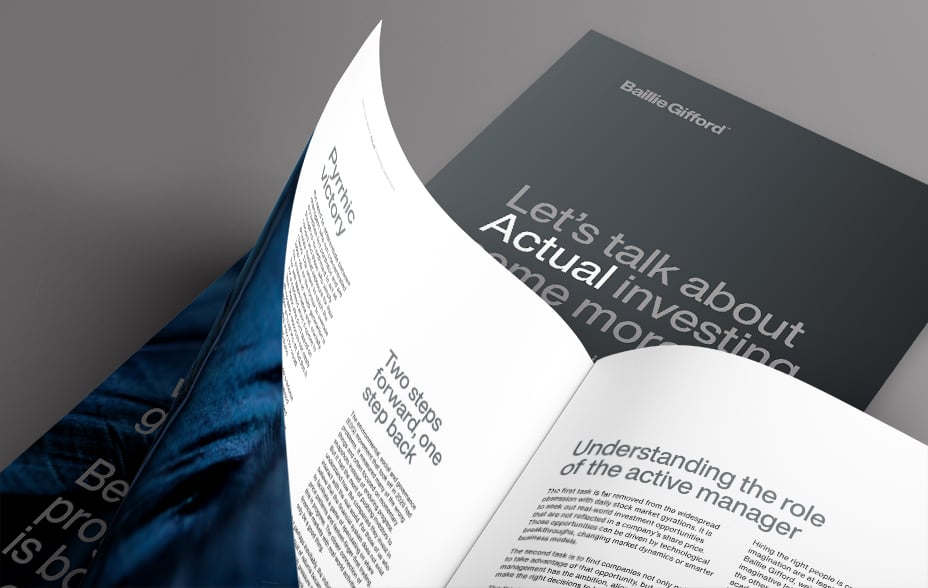
  12. “”

    Actual investing revisited

    In this keynote paper Partner Stuart Dunbar reaffirms the importance of active management to healthy capitalism.

    May 2025
    ArticleLong read
  13. Profile of a sustainability researcher

    Explore how Ben Hart's sustainability research at Baillie Gifford integrates ESG into investment strategies.

    May 2025
    Video6 minutes
  14. Global Income Growth Q1 investor letter

    The Global Income Growth Team reflects on recent performance, portfolio changes and market developments.

    April 2025
    Article15 minutes
  15. Atlas Copco: Stock Story

    Ben Drury explores how a culture of innovation and decentralisation drives success in industrial technology.

    March 2025
    Video3 minutes
  16. L'Oréal: Stock Story

    Katie Muir discusses how innovation and a positive culture have fuelled the success of the world’s leading beauty enterprise.

    March 2025
    Video3 minutes
  17. Profile of an investigative researcher

    Explore how Hatty Oliver's unique research at Baillie Gifford shapes investor thinking and informs income growth strategies.

    February 2025
    Video6 minutes
  18. Global Income Growth Q4 investor letter

    The Global Income Growth Team reflects on recent performance, portfolio changes and market developments.

    January 2025
    Article17 minutes
  19. Eric Beinhocker: evolutionary economist

    How successful companies harness the power of adaptation.

    September 2024
    Article7 minutes
  20. Novo Nordisk: tipping the scales

    Charting how a century of innovation led to a game-changing weight-loss treatment.

    March 2024
    Article4 minutes
  21. How dividend growth signals compounding

    Investor James Dow explains why dividend growth indicates a company can compound its earnings.

    February 2024
    Article5 minutes
  22. A new recipe for weight loss

    The huge growth potential of Novo Nordisk’s anti-obesity medicines.
    February 2024
    Podcast27 minutes
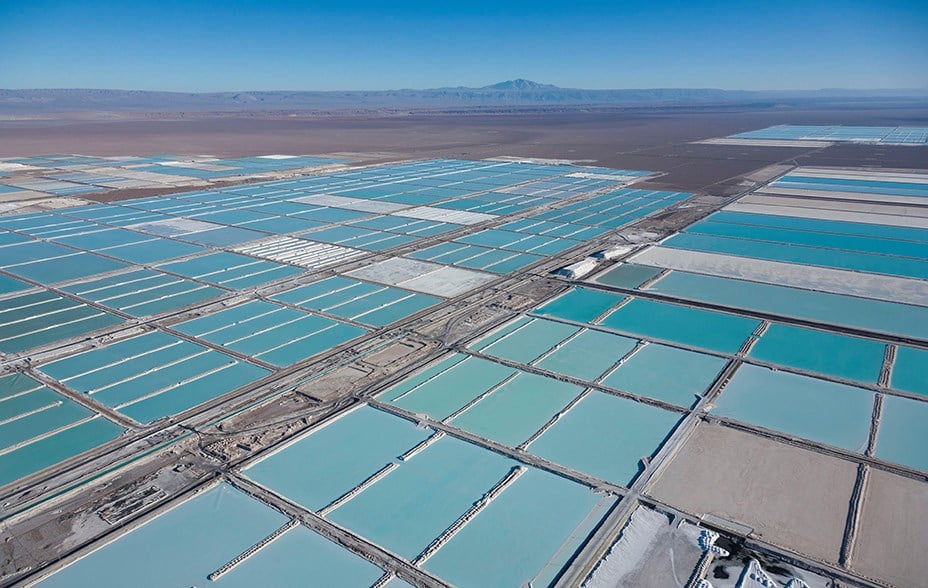
  23. Albemarle: salt flats and social responsibility

    Why the lithium giant Albemarle engages in research and data monitoring.

    February 2024
    Article4 minutes
  24. Why growth, why now?

    Tough times play to the partnership’s strengths: analysing what enables us to adapt and thrive amid rapid change.

    December 2023
    Article17 minutes
  25. TSMC’s decarbonisation dilemmas

    TSMC’s progress in securing greener energy supplies in Taiwan.

    July 2023
    Article
  26. Resilient growth for the long term

    Why long-term growth firms such as battery-maker Albemarle and data aggregator Experian are the ones to watch.

    January 2023
    Video4 minutes
  27. Impact, Ambition and Trust

    If ESG scores are not the answer, how does Global Income Growth Team’s ESG approach measure up?

    May 2022
    Article
  28. Global Income Growth

    Some people look at life as sustaining the now, while sowing the seeds for a better tomorrow. Global Income Growth think the same way. In this film we explore their philosophy and how when searching for a lifetime of income, they choose growth.
    January 2022
    Video2 minutes

Explore further

Curious to learn more about our products and what we can offer you? Please get in touch.

Explore further

Curious to learn more about our products and what we can offer you? Please get in touch.

Important information

The content of this website is intended exclusively for professional investors in accordance with MiFID legislation. ’Professional investors’ are potential investors who are deemed to have the status of “professional clients”, within the meaning of MiFID (2004/39/EC), as transposed in Ireland. It is not intended for retail investors.

Baillie Gifford Investment Management (Europe) Limited is authorised and regulated by the Central Bank of Ireland (Reference number C182354) as an Alternative Investment Fund Manager and UCITS Manager to Baillie Gifford Worldwide Funds plc. Its registered office is 4/5 School House Lane East, Dublin 2, D02 N279, Ireland.

Scottish Mortgage Investment Trust PLC (the “Company”) is an alternative investment fund for the purpose of Directive 2011/61/EU (the “AIFM Directive”). Baillie Gifford & Co Limited is the alternative investment fund manager (“AIFM”) of the Company and has been authorised for marketing to Professional Investors in this jurisdiction. This website is made available by Baillie Gifford Investment Management (Europe) Limited (“BGE”), which has been engaged by the AIFM to carry out promotional activities relating to the Company. BGE is authorised by the Central Bank of Ireland as an AIFM under the AIFM Regulations and as a UCITS management company under the UCITS Regulation. BGE also has regulatory permissions to perform promotional, advisory and Individual Portfolio Management activities. BGE has passported its authorisations under the mechanisms set out in the AIFM Directive.

This website is informative only and the information provided should not be considered as investment or other advice or a recommendation to buy, sell or hold a particular investment. Read our Legal and regulatory information for further details.