

Key points
- SpaceX turned rocket reuse from impossible to routine, lowering launch costs and opening new markets
- Starlink shows how cheaper space access can create entirely new global business models
- Conventional valuation models struggle with SpaceX because its largest opportunities may not yet exist
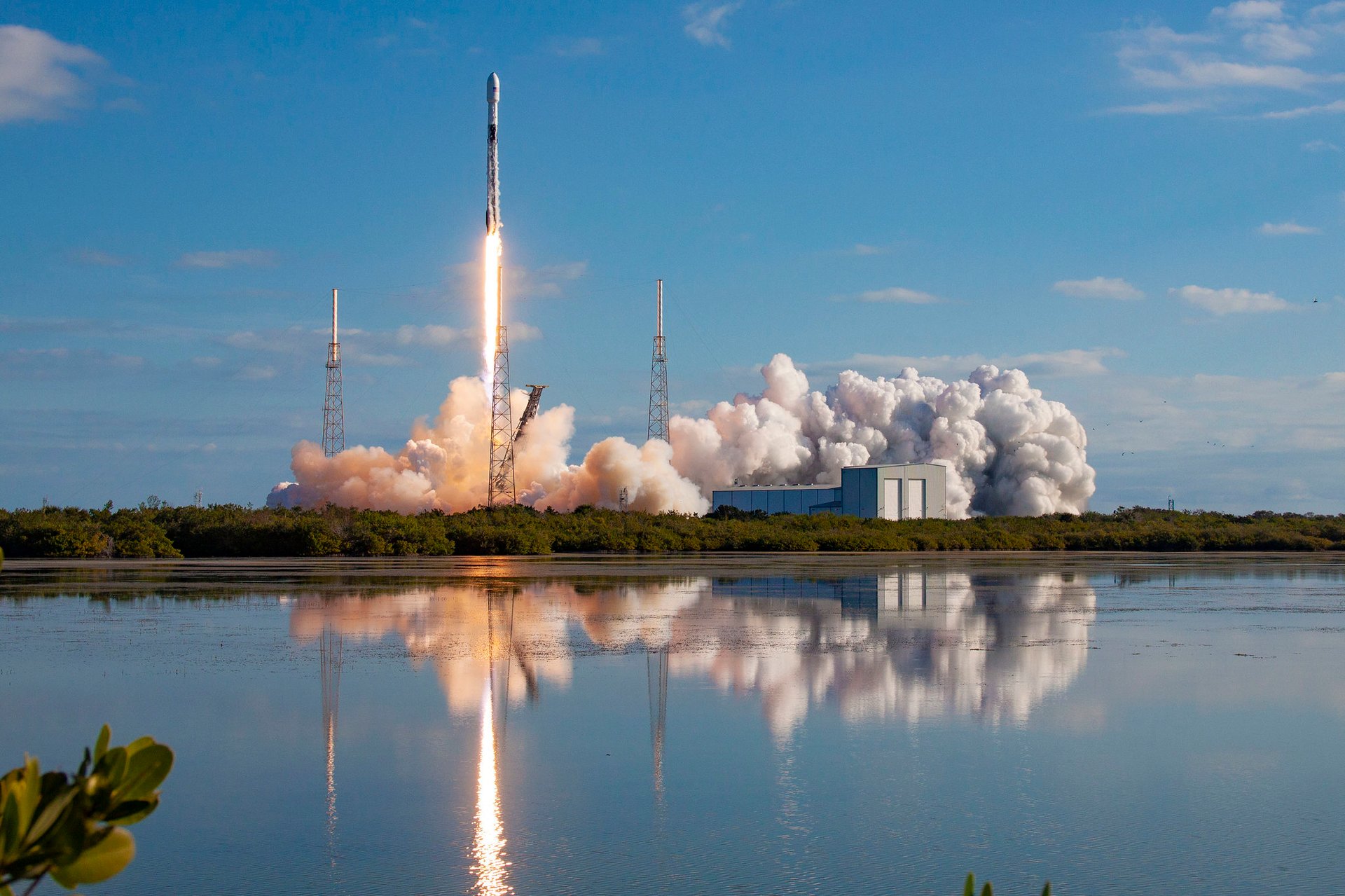
Image courtesy of SpaceX.
As with any investment, your capital is at risk.
Imagine standing on a sidewalk in Manhattan, in the shadow of the Empire State Building. You reach into your pocket, pull out a pencil, and throw it cleanly over the top of the tower – landing it perfectly in a shoebox on the other side.
That, according to SpaceX, is roughly the level of difficulty involved in launching a rocket into orbit and bringing it safely back to Earth, ready for reuse.
It was a feat that sounded like science fiction, until the company’s Falcon 9 rocket proved it to be science fact, on 21 December 2015. A day that changed what the industry thought was possible.
Making space affordable
Before this, spaceflight wasn’t expensive simply because it was difficult. It was expensive because it was organised around disposability.
Boosters are the most expensive part of rockets. Solving reusability for this component alone meant SpaceX achieved an 85 percent reduction in the average launch cost. And they aren’t finished yet. Starship, Falcon’s successor, promises to be fully reusable, with four times the capacity – reducing costs by a further 90 percent or more. Ultimately, Starship offers the prospect of getting cargo into space for roughly what it costs to send a parcel by post.
The question, then, is what becomes possible once the cost of reaching space falls by another order of magnitude? Things that today seem like the impossible preserve of science fiction may suddenly become economically rational. Manufacturing in orbit, space-based datacentres, or entirely new industries that we have yet to imagine all become more plausible as launch costs continue to fall.
This is why SpaceX is best understood as more than just a rocket company. It is reducing the cost of accessing an entirely new economic frontier. And it also stands to benefit directly from that expanding opportunity. SpaceX is not merely enabling the space economy – through businesses such as Starlink, it is becoming one of its largest participants. In other words, it is its own best customer.
Learning faster by failing cheaper
Lower launch costs create another advantage, too.
When launch is rare, expensive and disposable, experimentation is rationed. Rockets have to be designed through long development cycles, exhaustive modelling and extreme caution, because each flight is too costly to treat as part of the learning process. The industry becomes optimised for avoiding failure rather than experimentation and discovery.
By radically lowering the cost of each launch, SpaceX has lowered the cost of learning itself. More launches generate more data. More data enables faster iteration. Faster iteration produces better rockets, which lower launch costs still further. A powerful flywheel that drives SpaceX’s competitive advantage and perfectly encapsulates the kind of unbounded upside that Long Term Global Growth (LTGG) seeks.
There will undoubtedly be failures along the way. Indeed, they are almost inevitable. But those setbacks should not automatically be interpreted as signs that SpaceX is moving further from its long-term ambitions. In many cases they may simply represent another turn of the flywheel.
As a firm, Baillie Gifford first researched SpaceX back in 2016, shortly after that first successful launch and return of Falcon 9. We then invested in 2018 while it was still a private company. Over those eight years of ownership, we have built a deep proprietary understanding of the business through repeated engagement with the company and close observation of its execution. That perspective has been invaluable in informing LTGG's decision to invest today.
Valuing tomorrow's markets
We should also be frank. At first glance, it isn't just SpaceX's rockets that appear to defy the laws of gravity. A business valued at approximately 100 times its current revenues is, to say the least, difficult to reconcile with conventional valuation metrics.
But perhaps that is precisely the point. Traditional discounted cash flow models are built to value existing businesses. They are much less comfortable with companies whose greatest opportunities may lie in entirely new markets that have yet to emerge. We have little interest in trying to calculate a discounted cash flow for a colony on Mars. Instead, our task is to judge how far SpaceX's opportunity might plausibly expand.
That does not mean abandoning valuation discipline. LTGG's investment process requires us to articulate a credible path to a fivefold increase in value from first purchase. So, with that in mind, let us lay down some initial assumptions for the coming decade.
As it stands, SpaceX has three main business segments: launch, connectivity and AI. If Starship reaches its planned daily launch cadence and fourfold increase in launch capacity; if Starlink grows subscriptions at about 25 percent per annum (versus about 100 percent per annum at present); and if Grok maintains a roughly 5 percent share of a rapidly expanding AI inference market, then 10-year compound annual revenue growth of 35 percent becomes plausible, taking revenues to about $380bn by 2036.
If that sounds stretching, it is far from unprecedented. Several companies held by LTGG in recent years have achieved at least that level of growth over a 10-year period, including NVIDIA, Shopify and Tesla. Given SpaceX’s vertical integration, and assuming falling launch costs, we can also model structurally higher margins, at 12 percent – approximately what a company such as Lockheed Martin earns today.
Image courtesy of SpaceX.
Now what sort of multiple might the market ascribe to the world’s leading enabler of the vast and nascent space economy? Even assuming a substantial derating to a low-20s price-to-sales ratio (akin to NVIDIA today), the route to a fivefold return is plausible. And that is without ascribing any value to the likes of orbital datacentres, which could ultimately dwarf all else.
Plausible, yes, but SpaceX is a company with a wide range of possible outcomes. One of the 10 questions we ask of every holding is: What societal considerations are most likely to prove material to the company's long-term growth? For SpaceX, that list is unusually long, spanning issues from AI safety, to corporate governance, to climate change.
Such considerations, as ever, are reflected in our process, and factored into the position size. Some we accept are part of the nature of this investment. Others we are monitoring, and will attempt to engage on. Either way, we do not dismiss them, and enter this investment with our eyes wide open. Our willingness to invest doesn’t mean we’re comfortable with all aspects of the case.
SpaceX is anything but an ordinary company. Time and again, it has proven the impossible possible. Should it succeed in delivering further outlier returns from here, the prize is not simply a share of today’s space industry; it is a share of the economic activity that emerges when space becomes cheap enough to use.
If that future unfolds, it may ultimately prove that the market was not impossibly optimistic about SpaceX, but insufficiently imaginative.
Glossary
Price-to-sales ratio: an investment metric used to determine a company's valuation by comparing its stock price to its revenue.
Risk factors and important information
The views expressed should not be considered as advice or a recommendation to buy, sell or hold a particular investment. They reflect opinion and should not be taken as statements of fact nor should any reliance be placed on them when making investment decisions.
This communication was produced and approved in July 2026 and has not been updated subsequently. It represents views held at the time of writing and may not reflect current thinking.
Potential for Profit and Loss
All investment strategies have the potential for profit and loss, your or your clients’ capital may be at risk. Past performance is not a guide to future returns.
This communication contains information on investments which does not constitute independent research. Accordingly, it is not subject to the protections afforded to independent research, but is classified as advertising under Art 68 of the Financial Services Act (‘FinSA’) and Baillie Gifford and its staff may have dealt in the investments concerned.
All information is sourced from Baillie Gifford & Co and is current unless otherwise stated.
The images used in this communication are for illustrative purposes only.