Key points
- Asia ex Japan equities remain significantly underrepresented in global portfolios despite their outsized contribution to global economic growth
- Companies like TSMC, SK Hynix and Samsung form the backbone of AI infrastructure, while Vietnam emerges as a compelling growth market
- Active stock picking is essential in this undervalued region where domestic consumption, not just exports, drives substantial opportunities for long-term investors
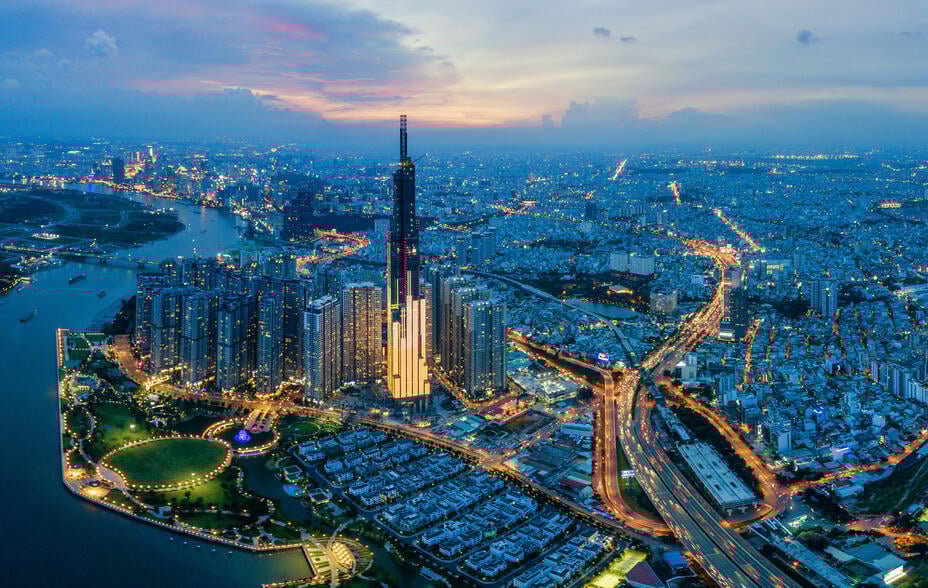
The rising skyline of Ho Chi Minh City reflects Vietnam’s emergence as a compelling growth market
As with any investment, your capital is at risk.
Most global portfolios remain structurally light on Asia ex Japan equities. Despite contributing a far larger share of global GDP and producing many of the world’s fastest-growing companies, the region accounts for only 8 per cent of the MSCI All Country World Index. The gap translates into missed growth, diversification, and active return opportunities.
Two forces make the timing particularly compelling. First, China’s domestic policies have pivoted decisively towards supporting growth and the private sector after three years of extreme market pessimism. Second, the US dollar has fallen by about 10 per cent on a trade-weighted basis in 2025; a weaker dollar has historically turbocharged returns in Asian markets.
Valuations provide another layer of support. Asia ex Japan equities trade at a clear discount to developed markets. For investors, that means access to compelling growth at reasonable prices.
What to own?
- Homegrown champions
Contrary to the media narratives, domestic policies and activities matter more to businesses in large Asian markets like China and India than their trade with the US. China’s retail sales are 10 times larger than its US exports, and 75 per cent of listed Indian companies’ revenue comes from domestic demand.
The colossal-sized domestic markets create a direct opportunity for companies with scale advantages. Around 80 per cent of the world’s new middle class comes from Asia. Domestic banks extending credit to first-time borrowers, regional ecommerce and digital platforms capturing rising income, and consumer brands catering to local preferences are all examples of Asia’s homegrown champions.
- AI’s critical supply chain
Artificial intelligence is often cast as a Silicon Valley story, but its core infrastructure sits in Asia. Taiwan’s TSMC controls the majority of the world’s advanced foundry capacity. Korea’s SK Hynix and Samsung Electronics dominate the high-bandwidth memory chips essential for AI training. They are the irreplaceable “picks and shovels” of the new digital economy, whose expertise and scale are almost impossible to replicate.
Beyond the flagship names, Asia’s broad semiconductor ecosystem also offers a fertile hunting ground for stock pickers - optical transceiver producers, testing and laser equipment makers, and datacentre switch manufacturers – these ‘hidden gems’ dominate niche but critical nodes of the complex supply chain, representing strong investment potential.
- Vietnam’s emergence
While tariffs grab headlines, it is the developments within Vietnam – from its structural reforms to a shifting consumer landscape – that command our attention. A bold pro-growth policy shift under new leadership is reigniting domestic economic momentum. A 20 per cent tariff by the US is unlikely to derail Vietnam’s trajectory toward becoming a strategic global production base. It’s still a less-known and off-index market, but we believe Vietnam has all the ingredients to become one of Asia’s growth leaders and merits a long-term allocation.
- Winners in a multi-polar world
As the US and China decouple, supply chains and capital are being rerouted to other winners in Asia. Trade between Asian countries is rising, and both the US and China will continue to rely on Korea’s memory chips, India’s IT services, Indonesia’s critical minerals and Vietnam’s competitive labour and production costs. Many Asian companies are world leaders in industries shaping the future: batteries, metals and mining, semiconductors, gaming, digital platforms and more. Their customers are both regional and global, and they are increasingly evolving into suppliers of necessity, not just suppliers of choice.
Active patience in practice
Capturing these evolving opportunities requires more than passive exposure. Asia is a market where news flows can turn weekly, research coverage is often thin, and risks and inefficiencies coexist. To benefit, investors need patience, rigorous due diligence, and active selection.
This is the foundation of the approach taken for Pacific Horizon, which is an actively managed portfolio of 40-120 of the region’s best growth companies, with an investment horizon of 5 years or longer. The portfolio deliberately targets diverse growth drivers to harness Asia’s scale, speed and secular trends; it is genuinely differentiated from the index, with a large allocation to Vietnam and typically more than double the index weight in small- and mid-cap companies. Backed by a well-resourced, experienced and stable team, the portfolio offers direct access to Asia’s structural growth through carefully selected businesses.
For investors seeking long-term rewards, now is the time to look east again: undervalued, under-owned, and too often underestimated.
Important information
Investments with exposure to overseas securities can be affected by changing stock market conditions and currency exchange rates. Pacific Horizon Investment Trust invests in emerging markets where difficulties in dealing, settlement and custody could arise, resulting in a negative impact on the value of your investment.
The views expressed in this article should not be considered as advice or a recommendation to buy, sell or hold a particular investment. The article contains information and opinion on investments that does not constitute independent investment research, and is therefore not subject to the protections afforded to independent research.
Some of the views expressed are not necessarily those of Baillie Gifford. Investment markets and conditions can change rapidly, therefore the views expressed should not be taken as statements of fact nor should reliance be placed on them when making investment decisions.
Baillie Gifford & Co Limited is wholly owned by Baillie Gifford & Co. Both companies are authorised and regulated by the Financial Conduct Authority and are based at: Calton Square, 1 Greenside Row, Edinburgh EH1 3AN.
The investment trusts managed by Baillie Gifford & Co Limited are listed on the London Stock Exchange and are not authorised or regulated by the Financial Conduct Authority.
A Key Information Document is available by visiting bailliegifford.com
172611 10057649