Key points
- EHang has turned flying cars from fantasy to reality with the first approved autonomous passenger-carrying eVTOL
- Edinburgh Worldwide has invested as the company transitions from prototype to commercial scale
- The urban air mobility revolution could transform city transport globally, with EHang taking the lead
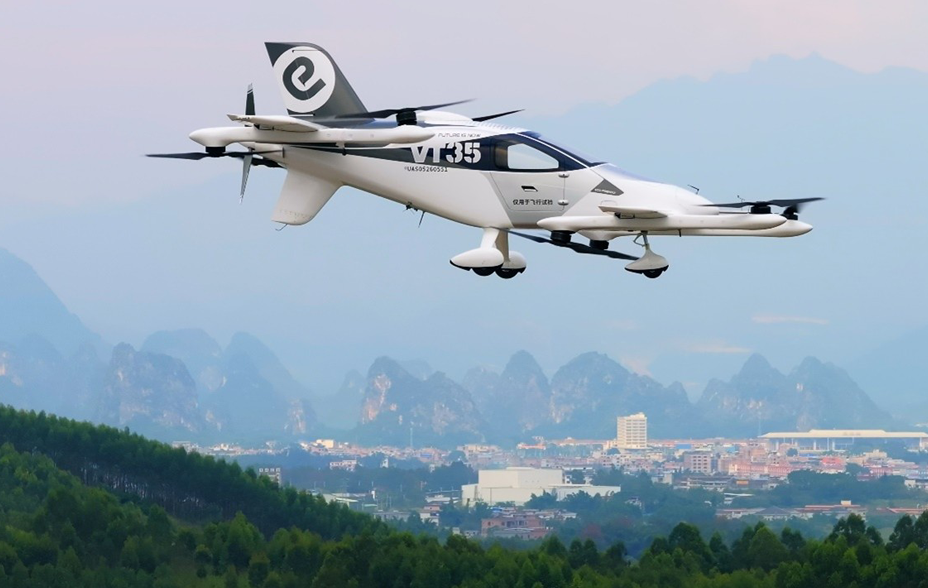
China’s EHang has made pilotless flying cars a reality. © AircraftEHang Holdings Limited
As with any investment, your capital is at risk.
The idea of flying cars has long hovered between fantasy and futuristic reality. Yet in 2025, EHang has made it tangible. Its EH216-S – a fully autonomous, two-seat, battery-powered multi-copter eVTOL (electric vertical take-off and landing aircraft), capable of flying 30km in under 15 minutes – now transports real passengers in multiple cities.
EHang is the first company worldwide to secure regulatory approval for both manufacturing and operating autonomous eVTOLs. That marks a profound inflection: this is no longer a concept stock but a functioning business leading an emerging mobility revolution.
Deliveries have grown from 25 aircraft in 2021 to 216 in 2024 and are on track to exceed 400 this year. Revenue has risen fifteenfold to $125m, supported by more than 40,000 successful flights across 17 countries – a validation loop driving further regulatory momentum.
This transition from prototype to product signals a shift from narrative to numbers – an evolution the market appears to have missed amid scepticism toward small-cap tech and Chinese equities.
On the back of a compelling investment case, we bought shares in EHang in October.
Why now – and why EHang?
EHang’s technological edge stems from early, forward-thinking design decisions. Its commitment to full autonomy – eliminating the need for a pilot – reduces weight, complexity and costs, while boosting payload efficiency. In contrast, western rivals like Joby and Archer depend on piloted models, lengthening their regulatory timelines and increasing expenses.
Furthermore, China’s regulatory environment accelerates rather than constrains innovation. Rapid approvals and dense supply ecosystems create a feedback loop western competitors struggle to match. While supported by China’s vast electric vehicle (EV) supply chain, the company achieves roughly 60 per cent gross margins while selling aircraft for $350,000–400,000 – nearly one-tenth the price of western counterparts.
A new ‘low-altitude economy’ has become a national priority in China, featured prominently in Xi Jinping’s 2024 Government Work Report. More than 60 cities – including Shenzhen and Guangzhou – are rolling out eVTOL integration plans, with hundreds of take-off pads under construction.
This regulatory and infrastructure push is mirrored globally: countries across the Middle East, Southeast Asia, and Latin America are racing to adopt aerial mobility creating an international competition for dominance. EHang, the lowest-cost and most operationally advanced player, is uniquely positioned to supply this demand.
Backed by Beijing’s drive to maintain leadership in this strategic technology, it enjoys a rare mix of state support, regulatory acceleration, and cost advantages unmatched worldwide.
Founder alignment
Founder and chief executive Huazhi Hu remains the driving force – a visionary shaped by personal tragedy and technical mastery in autonomous drones. Like Elon Musk, Hu combines deep engineering expertise with an uncompromising ambition to commercialise frontier technology, though his style is more understated and methodical.
He holds 29 per cent economic ownership and 79 per cent of voting rights, ensuring strategic continuity. His leadership has attracted top engineers despite modest pay, fostering a culture of purpose and belief.
Sizing the opportunity
The size of the urban air mobility market remains uncertain, yet its growth potential is considerable.
The first commercial use cases are short round-trip sightseeing flights, such as those run by Sunriver, a Chinese company that operates many popular tourist attractions. With 15,000 rated scenic spots across China, the domestic market alone could absorb tens of thousands of vehicles.
The next step, expected within 12–18 months, is direct corridor flights linking airports, resorts and city centres. Capturing even a small share could underpin years of multi-fold growth.
Operating leverage is still developing, with research and development (R&D) consuming roughly half of sales, yet state-backed support enables positive cash flow through free land and facilities from local governments.
A cash balance of $100m and minimal capital expenditure gives the company runway to scale towards producing 800 aircraft annually. Broader advances in batteries and AI flow into EHang’s platform without equivalent R&D cost, reinforcing efficiency.
Under a plausible base case, EHang could scale from 400 units in 2025 to 1,600 in 2030, generating around $625m in revenue and around $95m in earnings.
At that point, a 10x sales multiple implies a $6.5bn market cap – about half that of Joby Aviation today. Given EHang’s first-mover status, 60 per cent margins, and regulatory tailwinds, that valuation looks reasonable.
Conclusion
EHang may represent the next inflection point in transport innovation – akin to Tesla’s early EV phase or SpaceX’s Falcon milestones.
It combines technological credibility, regulatory endorsement, commercial traction, and geopolitical relevance in one story. While competition, execution, and geopolitical risks remain, the asymmetric potential is significant.
For Edinburgh Worldwide Investment Trust’s long-term shareholders, EHang offers exposure to a future where autonomous aerial mobility evolves from curiosity to infrastructure – and where, for once, the sky might truly be the limit.
Important information
This article does not constitute, and is not subject to the protections afforded to, independent research. Baillie Gifford and its staff may have dealt in the investments concerned. The views expressed are not statements of fact and should not be considered as advice or a recommendation to buy, sell or hold a particular investment.
Baillie Gifford & Co and Baillie Gifford & Co Limited are authorised and regulated by the Financial Conduct Authority (FCA).
Some of the views expressed are not necessarily those of Baillie Gifford. Investment markets and conditions can change rapidly, therefore the views expressed should not be taken as statements of fact nor should reliance be placed on them when making investment decisions.
Baillie Gifford & Co and Baillie Gifford & Co Limited are authorised and regulated by the Financial Conduct Authority (FCA). The investment trusts managed by Baillie Gifford & Co Limited are listed on the London Stock Exchange and are not authorised or regulated by the FCA.
A Key Information Document is available at bailliegifford.com.