

Key points
- Financial inclusion-focused companies help the world’s poorest become more resilient and represent a huge growth opportunity
- Nubank, Grab and Remitly provide digital-focused services that help them undercut older rivals
- However, face-to-face education remains important for the financially vulnerable, which is why HDFC Bank is opening new branches in rural India
Listen to the podcast on Spotify and Apple Podcasts
As with any investment, your capital is at risk.
Most of us take our ability to borrow, send funds to loved ones and safely save for granted. But 1.4 billion adults lack access to even basic banking services. That’s more than one in five of the world’s population. And they could represent banking’s biggest growth opportunity.
Increasing these people’s resilience to adversity would transform their prospects, whether it be smoothing a tuk-tuk driver’s income to help them through slow periods, providing insurance to a corn farmer to give them the confidence to grow higher-value crops or making it cheaper for families to receive money from relations who have found work abroad.
Moreover, the scale of this challenge creates a win-win scenario: companies can profit by serving these markets today and benefit long-term as many customers escape poverty, build businesses and develop their personal wealth.
“The goal is to provide a full service to people who were previously invisible to the banks, lack credit histories and are often living on relatively low incomes,” Ed Whitten, an impact director in Baillie Gifford’s Positive Change Strategy, tells our Short Briefings on Long Term Thinking podcast.
“The world’s made a huge amount of progress in financial inclusion, but not necessarily in financial health. We want companies to design products that are highly specific to their customers’ needs. And there are many ways you can now personalise financial services thanks to smartphones and greater access to data.”
Positive Change is a dual-objective strategy that aims to provide our clients with attractive returns while contributing to a more inclusive, healthy world. Whitten’s role is to ensure the companies in its portfolio fulfil the second part of that pledge.
That involves speaking directly to the leaders of those businesses, as well as regulators, researchers and sometimes users of the products themselves.
“We commissioned a study that highlighted a terrifying level of financial vulnerability across Brazil, and I visited an area of São Paulo called Jardim Ângela to contextualise it,” Whitten says.
“There, I met a 27-year-old community worker who had recently gained access to Nubank’s Caixinhas.” The ‘moneybox’ service lets users set aside savings for different goals, such as a car, a trip or a wedding. Such products have helped the Brazilian digital bank grow revenue by 653 per cent since it floated on the stock exchange in 2021.
“Caixinhas is a free service,” Whitten adds, “and historically, accounts in Brazil weren’t. And it was amazing to see the excitement he’d gained from using it.”

Nubank launched its Caixinhas in Brazil in 2022 and recently expanded the service to its Colombian customers. © Nubank.
When Positive Change first invested in 2021, about 28 per cent of Brazil’s adults were Nubank customers. That’s now more than doubled to nearly 60 per cent of the population. It also operates in Colombia and Mexico, and, in the latter case, recently won the local regulator’s approval to secure a banking licence.
“That would let Mexican customers get their salaries sent directly to their Nubank accounts and would remove other limits on deposits and savings, which is something we want to encourage both from an investment and an impact perspective,” Whitten adds.
Grab’s data-driven loans
Another holding, Grab, represents an example of an ‘embedded financial service’. The firm has been described as south-east Asia’s Uber, but in addition to running a ride-hailing and delivery app, it also provides financial services to the gig workers that make it possible.
“For drivers, that includes auto loans and insurance for their vehicles and also small loans to help them over quiet periods,” Whitten explains. “For merchants, many of whom are women running corner stores or small restaurants, it’s access to working capital loans.”
The firm draws on data it gathers from these service providers’ use of its platform to model their risk profiles and tailor its offerings. For example, it sets a borrowing cap to ensure a user’s debt does not exceed their expected income and can also automatically deduct repayments from their daily earnings.
These efforts encourage responsible borrowing, but Whitten would like the firm to make further progress in promoting digital literacy.
“We recently raised the topic in its Jakarta office,” he says. “Grab provides some excellent online tools. But we’ve seen other companies like Bank Rakyat Indonesia do a good job of educating people and supporting them at a local level, and Grab can learn from the microfinance world.”
Remitly’s fast, lower-cost remittances
Remittances represent another expanding sector of the financial inclusion economy. In 2024, according to the World Bank, migrants and others transferred about $905bn to families, friends and others – a gain of nearly 5 per cent on the previous year. Low- and middle-income countries received three-quarters of that sum.
“Remittances are a lifeline,” Whitten says. “The average amount is something like $200 per month, and the cost is typically about 6 per cent. So customers are losing $12 with each transaction, and that might be for a medical expense, energy bill or whatever. In the digital world, it should be possible to lower that.”
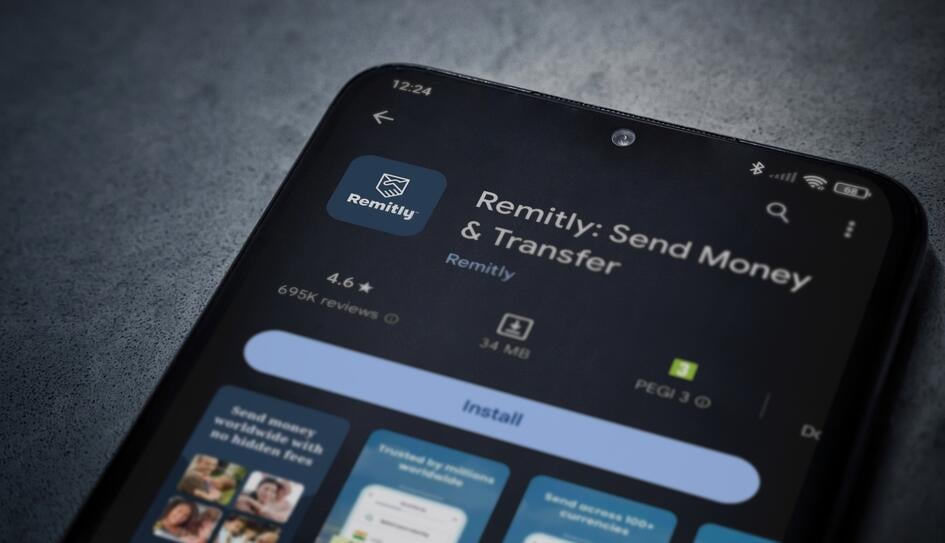
Remitly’s active global customer base grew by 29 per cent over the past year. © 2023 Maor_Winetrob/Shutterstock
Remitly charges about 3 per cent for the same service. Moreover, it provides rapid transfers and has partnered with convenience stores and mobile money services worldwide, making it easy for recipients without a formal bank account to accept payments.
“It serves around eight million customers today, and obviously, the number of beneficiaries is more than that,” says Whitten. “And the bigger it gets, the cheaper it should be able to provide its service. That will help it take market share from Western Union and other rivals, which is important to our investors.”
HDFC Bank’s growing rural network
Nubank, Grab and Remitly all derive an advantage by focusing on digital offerings, avoiding many of the legacy costs that many of their longer-established counterparts face.
Our Indian holding HDFC is, by contrast, expanding its branch network into the country’s lower-tier cities and the countryside. One of financial inclusion’s critical insights, reinforced by Positive Change’s commitment to on-the-ground research, is that one size doesn’t fit all. What works well with one region or demographic may require a different approach elsewhere.
“There’s still a large proportion of the Indian population that is unfamiliar with these services, so it’s beneficial for staff to start these vulnerable customers on their financial journey,” says Whitten.
“Ultimately, most things will still move digital, but in this case, it’s great to have the presence of people who speak the local language and can explain things. And it’s helping HDFC raise its profile in areas it hadn’t penetrated before.”
These and other companies Baillie Gifford has invested in can both alleviate poverty and provide our clients with a way to tap into a fast-growing sector. While many of the individual sums are small, the number of potential customers is vast, and many will climb the wealth ladder.
“These firms are thinking of those on lower incomes as the more lucrative customers of the future,” Whitten says. “So, bringing them to a more financially healthy place makes great business sense.”
Words by Leo Kelion
Edward Whitten
Impact Director
Edward is an impact director and decision maker in the Positive Change Team. He joined Baillie Gifford in 2018. Edward started his career as an officer in the British Army, latterly working in a cross-government role on the UK government. Edward graduated BA (Hons) in History from Newcastle University in 2008 and MSc in Sustainable Development from London’s School of Oriental and African Studies in 2020.
Risk factors
The views expressed should not be considered as advice or a recommendation to buy, sell or hold a particular investment. They reflect opinion and should not be taken as statements of fact nor should any reliance be placed on them when making investment decisions.
This communication was produced and approved in July 2025 and has not been updated subsequently. It represents views held at the time of writing and may not reflect current thinking.
Potential for profit and loss
All investment strategies have the potential for profit and loss, your or your clients’ capital may be at risk. Past performance is not a guide to future returns.
This communication contains information on investments which does not constitute independent research. Accordingly, it is not subject to the protections afforded to independent research, but is classified as advertising under Art 68 of the Financial Services Act (‘FinSA’) and Baillie Gifford and its staff may have dealt in the investments concerned.
All information is sourced from Baillie Gifford & Co and is current unless otherwise stated.
The images used in this communication are for illustrative purposes only.
Important Information
Baillie Gifford & Co and Baillie Gifford & Co Limited are authorised and regulated by the Financial Conduct Authority (FCA). Baillie Gifford & Co Limited is an Authorised Corporate Director of OEICs.
Baillie Gifford Overseas Limited provides investment management and advisory services to non-UK Professional/Institutional clients only. Baillie Gifford Overseas Limited is wholly owned by Baillie Gifford & Co. Baillie Gifford & Co and Baillie Gifford Overseas Limited are authorised and regulated by the FCA in the UK.
Persons resident or domiciled outside the UK should consult with their professional advisers as to whether they require any governmental or other consents in order to enable them to invest, and with their tax advisers for advice relevant to their own particular circumstances.
Financial Intermediaries
This communication is suitable for use of financial intermediaries. Financial intermediaries are solely responsible for any further distribution and Baillie Gifford takes no responsibility for the reliance on this document by any other person who did not receive this document directly from Baillie Gifford.
Europe
Baillie Gifford Investment Management (Europe) Ltd (BGE) is authorised by the Central Bank of Ireland as an AIFM under the AIFM Regulations and as a UCITS management company under the UCITS Regulation. BGE also has regulatory permissions to perform Individual Portfolio Management activities. BGE provides investment management and advisory services to European (excluding UK) segregated clients. BGE has been appointed as UCITS management company to the following UCITS umbrella company; Baillie Gifford Worldwide Funds plc. BGE is a wholly owned subsidiary of Baillie Gifford Overseas Limited, which is wholly owned by Baillie Gifford & Co. Baillie Gifford Overseas Limited and Baillie Gifford & Co are authorised and regulated in the UK by the Financial Conduct Authority.
Hong Kong
Baillie Gifford Asia (Hong Kong) Limited 柏基亞洲(香港)有限公司 is wholly owned by Baillie Gifford Overseas Limited and holds a Type 1 licence from the Securities & Futures Commission of Hong Kong to market and distribute Baillie Gifford’s range of collective investment schemes to professional investors in Hong Kong. Baillie Gifford Asia (Hong Kong) Limited 柏基亞洲(香港)有限公司 can be contacted at Suites 2713-2715, Two International Finance Centre, 8 Finance Street, Central, Hong Kong. Telephone +852 3756 5700.
South Korea
Baillie Gifford Overseas Limited is licensed with the Financial Services Commission in South Korea as a cross border Discretionary Investment Manager and Non-discretionary Investment Adviser.
Japan
Mitsubishi UFJ Baillie Gifford Asset Management Limited (‘MUBGAM’) is a joint venture company between Mitsubishi UFJ Trust & Banking Corporation and Baillie Gifford Overseas Limited. MUBGAM is authorised and regulated by the Financial Conduct Authority.
Australia
Baillie Gifford Overseas Limited (ARBN 118 567 178) is registered as a foreign company under the Corporations Act 2001 (Cth) and holds Foreign Australian Financial Services Licence No 528911. This material is provided to you on the basis that you are a “wholesale client” within the meaning of section 761G of the Corporations Act 2001 (Cth) (“Corporations Act”). Please advise Baillie Gifford Overseas Limited immediately if you are not a wholesale client. In no circumstances may this material be made available to a “retail client” within the meaning of section 761G of the Corporations Act.
This material contains general information only. It does not take into account any person’s objectives, financial situation or needs.
South Africa
Baillie Gifford Overseas Limited is registered as a Foreign Financial Services Provider with the Financial Sector Conduct Authority in South Africa.
North America
Baillie Gifford International LLC is wholly owned by Baillie Gifford Overseas Limited; it was formed in Delaware in 2005 and is registered with the SEC. It is the legal entity through which Baillie Gifford Overseas Limited provides client service and marketing functions in North America. Baillie Gifford Overseas Limited is registered with the SEC in the United States of America.
The Manager is not resident in Canada, its head office and principal place of business is in Edinburgh, Scotland. Baillie Gifford Overseas Limited is regulated in Canada as a portfolio manager and exempt market dealer with the Ontario Securities Commission (‘OSC’). Its portfolio manager licence is currently passported into Alberta, Quebec, Saskatchewan, Manitoba and Newfoundland & Labrador whereas the exempt market dealer licence is passported across all Canadian provinces and territories. Baillie Gifford International LLC is regulated by the OSC as an exempt market and its licence is passported across all Canadian provinces and territories. Baillie Gifford Investment Management (Europe) Limited (‘BGE’) relies on the International Investment Fund Manager Exemption in the provinces of Ontario and Quebec.
Israel
Baillie Gifford Overseas Limited is not licensed under Israel’s Regulation of Investment Advising, Investment Marketing and Portfolio Management Law, 5755-1995 (the Advice Law) and does not carry insurance pursuant to the Advice Law. This material is only intended for those categories of Israeli residents who are qualified clients listed on the First Addendum to the Advice Law.
Singapore
Baillie Gifford Asia (Singapore) Private Limited is wholly owned by Baillie Gifford Overseas Limited and is regulated by the Monetary Authority of Singapore as a holder of a capital markets services licence to conduct fund management activities for institutional investors and accredited investors in Singapore. Baillie Gifford Overseas Limited, as a foreign related corporation of Baillie Gifford Asia (Singapore) Private Limited, has entered into a cross-border business arrangement with Baillie Gifford Asia (Singapore) Private Limited, and shall be relying upon the exemption under regulation 4 of the Securities and Futures (Exemption for Cross-Border Arrangements) (Foreign Related Corporations) Regulations 2021 which enables both Baillie Gifford Overseas Limited and Baillie Gifford Asia (Singapore) Private Limited to market the full range of segregated mandate services to institutional investors and accredited investors in Singapore.