
Key points
- History shows that once technologies get cheaper, ‘impossible’ transitions can move surprisingly fast
- Energy infrastructure leaders CATL, BYD and Prysmian are building the batteries, vehicles and cables hastening the shift from fossil fuels
- The International Growth strategy aims to invest in companies whose growth compounds as new energy systems scale

As with all investments, your capital is at risk
In February 1942, the world’s rubber supply was suddenly cut by the invasion of Malaya, threatening the Allies’ ability to wage war.
Less than a year later, the US had found a way to mass-produce synthetic rubber tyres at the scale needed to keep its military planes and vehicles in operation.
Prof J Doyne Farmer cites this example in an influential 2022 paper on the energy transition. His point: when forecasting technological transformations, don’t focus on the size and variety of potential blockages, focus on how people have tended to find ways around them.
For Farmer, the Baillie Gifford Professor of Complex Systems Science at the University of Oxford, the “empirical record [shows]… not only how… barriers have slowed down the pace of progress, but also the pace at which social, institutional, material and political barriers have been overcome or sidestepped.”
In other words, supply chains, factories, standards and institutions can look immovable – until they aren’t. When the stakes are high enough, societies can quickly scale new solutions. In the ‘fourth energy transition’ to renewables, that learning-by-doing could pull costs down faster than expected.
Farmer and his co-authors apply Wright's Law – the observation that every doubling of cumulative production tends to bring about a fixed percentage drop in cost. That can create a 'flywheel' whereby demand rises, manufacturing scales up, and costs fall again. There’s no reason new clean energy technologies won't tip from niche to mainstream as quickly as solar photovoltaic cells, wind turbines and batteries over the last few decades.
For Baillie Gifford's International Growth Strategy, these dynamics point to clear investment logic: back the companies building the infrastructure that the transition depends on. Our focus is on finding companies at the technological cutting edge of the movement towards cleaner, more sustainable energy sources. This shift is both environmentally necessary and economically advantageous. That’s the backdrop to how we think about the opportunity, and why we spend our time with companies building the kit on which the transition depends.
‘Picks and shovels’ for the fourth energy transition
We see the likely winners as those doing the most to enable the clean energy surge that Farmer and others predict. Our holdings, in other words, are the ‘picks and shovels’ of this potential gold rush. China’s CATL helps turn electricity into a form that’s easily storable and readily available. Its compatriot company BYD turns that stored power into everyday transport, from cars to fleets. And Italy’s Prysmian supplies the wiring that stops cheap, low-carbon electrons from being stranded.
CATL is the world's largest producer of electric vehicle (EV) batteries. With a global market share approaching 40 per cent, it combines massive scale with deep integration of design, supply and manufacturing. It has a record of relentless innovation.
We see CATL as front and centre of the transition. Its batteries don't just power cars, they also make renewable electricity more useful by storing it for when people need it, often when the wind doesn’t blow and the sun doesn’t shine. It's part of the little-noticed plumbing that turns clean generation into dependable power. CATL is constantly pushing at the tech frontier, for example, exploring next-generation chemistries such as sodium-ion — a 'salt-based' battery already in production, that could improve supply resilience. CATL isn't a passive beneficiary of the accelerating pace of the energy transition, it's a major accelerant.
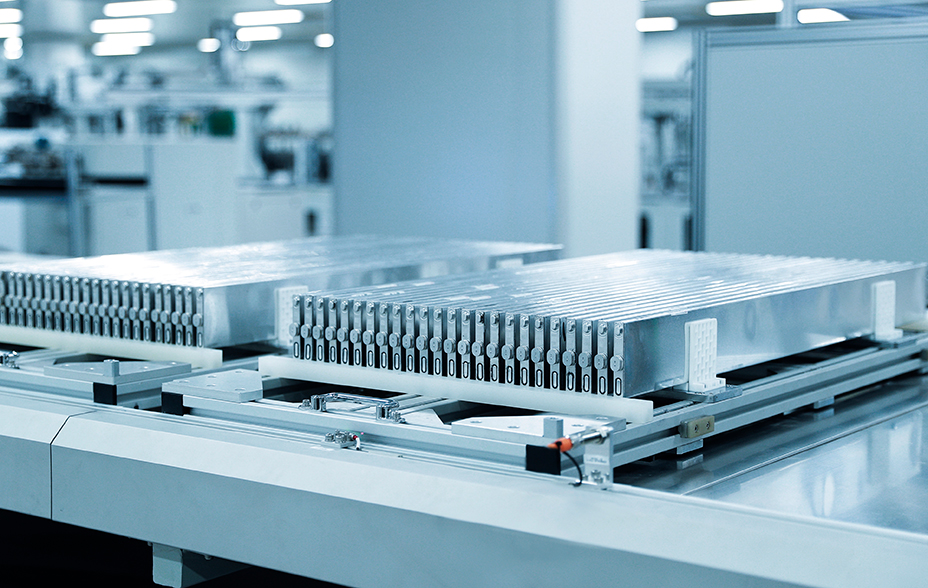
BYD's ‘blade battery’ in production.
© BYD
Another Chinese holding BYD, founded in 1995, has helped turn electrification from a niche choice into a mass-market phenomenon. Its founder, Wang Chuanfu, started as a battery-maker for consumer electronics. He then applied this know-how to vehicles and was building prototypes years before Tesla taught the world to take EVs seriously.
Riding out various crises of overexpansion and surviving China's ferocious competition, BYD doubled down on research and development. The results have been engineering triumphs such as the ‘blade battery’, designed for safety and durability, and big leaps forward in plug-in hybrid efficiency.
Today's BYD is a three-part flywheel combining technology, cost control, and fast execution. It employs a bench of extraordinary engineering talent, has pushed into ultra-fast charging and has made driver-assistance features standard.
Crucially, BYD builds much of what goes into its vehicles: motors, power electronics, chips and software. Its logistics give it more control over supply, margins and delivery. It has plans for global expansion, but even on domestic momentum alone, BYD shows how quickly electrified transport can scale if the product is good enough and affordable enough.
Powering up: BYD's total vehicle production
Italian cable firm Prysmian has turned its old-world pedigree into a hi-tech lead. It was spun out of Pirelli's cables business in 2005 and has now positioned itself at a key chokepoint of the energy transition, and been strategically acquisitive, for example buying the US’s Encore Wire in 2024. A global leader in high-voltage transmission cable, it’s poised to play a critical role in facilitating electrification as demand rises.
Offshore wind doesn't help consumers or the climate without efficient connections to the mainland. Prysmian's extra-high-voltage submarine and underground cabling is a classic ‘pick-and-shovel’ utility that makes electrification possible at scale. Prysmian operates specialist cable-laying ships: its newest vessel, Leonardo da Vinci, is 171 metres long and can lay power cables in waters up to three kilometres deep. Its vast carousels hold cable weighing up to 10,000 tonnes, almost the same weight as the Eiffel Tower. Prysmian isn't so much selling wire as building the electric motorways that give the energy transition mass and momentum.
That is the basis of Farmer’s optimism. Technological transitions aren't won by ‘eureka’ breakthroughs, but by interlocking systems that reinforce one another, what he and colleagues call "positive feedbacks" between deployment, learning and cost reduction.
From ‘impossible’ to inevitable
Our hopes for the energy transition delivering for clients rest on companies such as CATL, BYD and Prysmian widening the market for the others, and steadily undermining the formidable barriers to the energy transition. Just as the wartime scramble for synthetic rubber didn't just solve an acute shortage of tyres, it unlocked an entire petrochemical industry that reshaped the post-war economy in unpredictable ways.
There are real risks. Regulation shifts, disruptors get disrupted and geopolitics regularly delivers unpleasant surprises. But if Prof Farmer is right, and the empirical record says he often is, the companies building the infrastructure of the transition are the ones shaping what comes next.
Risk factors
The views expressed should not be considered as advice or a recommendation to buy, sell or hold a particular investment. They reflect opinion and should not be taken as statements of fact nor should any reliance be placed on them when making investment decisions.
This communication was produced and approved in March 2026 and has not been updated subsequently. It represents views held at the time of writing and may not reflect current thinking.
Potential for Profit and Loss
All investment strategies have the potential for profit and loss, your or your clients’ capital may be at risk. Past performance is not a guide to future returns.
This communication contains information on investments which does not constitute independent research. Accordingly, it is not subject to the protections afforded to independent research, but is classified as advertising under Art 68 of the Financial Services Act (‘FinSA’) and Baillie Gifford and its staff may have dealt in the investments concerned.
All information is sourced from Baillie Gifford & Co and is current unless otherwise stated.
The images used in this communication are for illustrative purposes only.
189710 10061451