

Key points
- Software valuations have fallen, but the market is missing crucial nuances. This creates opportunities for investors
- AI threatens software companies: customers can now build their own tools, and AI agents can orchestrate work across existing systems
- Embedded relationships and adaptive cultures will separate winners from losers – quality businesses could now be undervalued

As with any investment, your capital is at risk.
“Software is dead, long live AI” (The Market, 2025).
Software valuations have fallen sharply. The market's diagnosis is blunt: AI infrastructure wins; application software loses.
We think the reality is messier. While AI is changing the balance of power for Software as a Service (SaaS) businesses, the impact will be unevenly distributed. This indiscriminate derating creates opportunities for patient investors to turn nuance into alpha.
Two threats to the SaaS moat
Software's business model has traditionally built its moat around code. Building robust, scalable systems required specialist teams and long development cycles. Enterprises paid premium prices because they couldn't build what they needed themselves.
AI changes this. Using Large Language Models (LLMs), end users can now build applications tailored to their needs. Previously, translating domain knowledge into functioning software was prohibitively expensive. Generic products won by default because custom development couldn't justify its cost.
AI collapses that constraint.
The second threat is agentic AI. Instead of an employee logging into multiple systems to process an invoice, an AI agent can now do this automatically. The agent sits above each system, pulling data and ‘orchestrating’ work.
This is bad news for platforms built on being the golden source of data. Understanding customer requirements and how AI can be used to improve workflows is the new source of competitive advantage.
The power shifts from whoever holds the records to whoever controls how AI agents execute work.
Who is at risk?
Horizontal software faces attacks from two sides: bottom-up, from hyper-specialised tools customers build themselves, and top-down, from orchestration layers that sit above existing systems.
Vertical market software (VMS) faces a different risk: if domain experts can build tailored alternatives with AI, why pay for generic products? For acquisitive roll-up models, the risk compounds – if underlying assets are worth less, the flywheel breaks down.
For both, the more immediate threat is pricing power.
Seat-based models look exposed. When similar functionality can be recreated in-house with AI, customers question why standardised workflows should command premium pricing.
Where impact will vary
The bear case may prove directionally correct, but the market's error is assuming uniform impact. A handful of structural factors will determine which businesses face genuine disruption and which retain pricing power. There will undoubtedly be winners and losers.
Agents and workflows
The threat from AI agents orchestrating tasks across systems cuts both ways.
It can disrupt slow-moving incumbents, but platforms that already capture workflow context can position themselves as the intelligence layer and remain entrenched.
Collaborative software development specialists Monday.com and Atlassian already know how teams define dependencies and navigate approvals. It is much easier for them to instruct AI agents than for LLMs to export them without context.
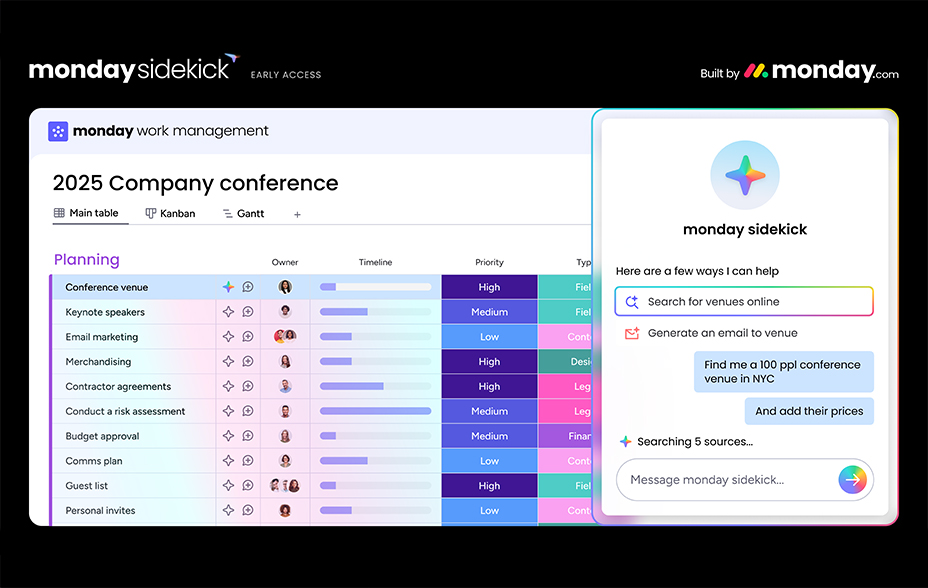
Monday AI Sidekick panel beside Monday.com board for planning tasks.
© Monday.com
Even though owning the data may no longer be the moat it once was, system-of-record businesses may still be able to defend their position.
Many mission-critical systems require deterministic behaviour that AI alone struggles to provide. Tax calculations must be auditable years later; healthcare billing cannot afford to hallucinate procedure codes.
It is possible that most enterprises will remain reluctant to replace certified systems with probabilistic agents, prone to error. Companies that control both the deterministic core and the workflow context are better positioned.
The market is pricing as if this shift has already happened.
Distribution versus capability
AI commoditises some technical capability but increases the value of distribution and embedded relationships.
An AI startup may replicate functionality faster, but VMS businesses have spent decades building trust. Customers require overwhelming value improvement to justify migrating mission-critical systems.

As specialist media VMS software acquirer Lumine's CEO put it: "95 per cent of our business is with very conservative large telcos who won't rip out a billing system that took 20 years to install just because some AI startup knocks on the door."
Many conservative customers lack the infrastructure prerequisites to deploy agentic alternatives. Full general-purpose AI adoption requires prior digitalisation, cloud migration, and workflow automation – steps that most enterprises in regulated industries are still working through. This compounds organisational and trust barriers.
At the same time, distribution through professional networks – accountants recommending software to small businesses, consultants steering enterprise clients – remains prohibitively difficult for new entrants to access at scale.
For acquisitive roll-ups like Canadian business Constellation Software, and one of its recently spun-off success stories, Lumine, depressed Mergers and Acquisitions (M&A) multiples allow them to acquire quality assets cheaply while AI enables those companies to operate more efficiently.
Culture and adaptation
Not all incumbents are equally vulnerable.
Fast-moving cultures with founder leadership can adapt quickly. Monday.com paused its entire tech organisation for a month to force wholesale adoption of AI workflows.
This produced tangible results: an internal multi-agent system compressed an eight-year effort into six months. Leadership removed the option to abandon the project even as teams cycled through optimism and scepticism.
Being on the front foot with change, being persistent in the face of uncertainty, and being open to experimentation can prove crucial.
Canadian internet infrastructure business, Shopify, shows the same willingness to reshape its product rather than defend what exists. The company built Sidekick, an AI assistant for merchants, and made it central to the user experience.
When Sidekick went down during a recent outage, merchants complained about its absence more than about checkout or inventory. The value was so obvious that Shopify never had to justify its price.
The companies most at risk are those stuck in the middle: large enough to be slow, not embedded enough to be irreplaceable, and heavily exposed to commoditised cognitive work that AI can automate away.
The opportunity
The market is right to question the old SaaS M&A playbook. But it's wrong to assume all enterprise software shares the same fate.
The debate is not 'AI winners versus AI losers' but where power sits in each value chain.
Software valuations have cratered indiscriminately. We are finding opportunity in the rubble.
Risk factors
The views expressed should not be considered as advice or a recommendation to buy, sell or hold a particular investment. They reflect opinion and should not be taken as statements of fact nor should any reliance be placed on them when making investment decisions.
This communication was produced and approved in January 2026 and has not been updated subsequently. It represents views held at the time of writing and may not reflect current thinking.
Potential for Profit and Loss
All investment strategies have the potential for profit and loss, your or your clients’ capital may be at risk. Past performance is not a guide to future returns.
This communication contains information on investments which does not constitute independent research. Accordingly, it is not subject to the protections afforded to independent research, but is classified as advertising under Art 68 of the Financial Services Act (‘FinSA’) and Baillie Gifford and its staff may have dealt in the investments concerned.
All information is sourced from Baillie Gifford & Co and is current unless otherwise stated.
The images used in this communication are for illustrative purposes only.
187607 10060558