

Key points
- Axon builds software-style safeguards for policing, combining less-lethal tools with body cameras that create audit trails
- The company's mission to make bullets obsolete has attracted law enforcement agencies across the globe
- Continuous innovation from AI software to VR training positions Axon for substantial long-term growth

Image courtesy of Axon
As with any investment, your capital is at risk.
Most of the systems we rely on every day come with two quiet safeguards: an undo button and an audit trail.
In well-designed software, a mistaken click does not destroy your work. A simple “Ctrl + Z” allows you to roll back a step. At the same time, the system keeps a record of what changed and when, so that if something goes wrong, you can see how you got there and improve the process.
The frontline of public safety has historically had neither safeguard. When a situation escalates and a gun is drawn, there is no undo if the trigger is pulled. When those events are later examined, the “audit trail” is usually a patchwork of reports and recollections rather than a clean, searchable record. Axon’s proposition is to implement a version of both safeguards to the use of force and establish a feedback loop for more favourable outcomes.
The initial spark
Axon’s “undo button” began as a thought experiment decades before the company itself existed. In 1967, NASA researcher Jack Cover read about a man who had been immobilised for hours after grabbing an electrified fence. He was badly shocked, but alive.
Intrigued by the potential for electricity to address rising crime while reducing lethal force, Cover built a device that fired two wired darts and delivered an electric jolt and named it after a childhood favourite novel, Tom Swift and his Electric Rifle: TASER. Commercial success for his invention, however, wasn’t so straightforward, and had several false starts.
In the early 1990s, the rising crime rate was visible across the US. Axon’s founder, Rick Smith, started the company after wondering if there was a better solution for citizens to protect themselves. His own mother was increasingly worried and tried to buy a TASER for protection, but she couldn’t. She bought a revolver instead.
So, Smith called the man listed on every TASER patent: Jack Cover, who, after 20 years, retained hope that his invention could reform law enforcement. Together, they went back to first principles and rebuilt the TASER. The first critical unlock was the shift from gunpowder to compressed gas, which removed the TASER from the regulatory classification of a firearm, expanded its commercial viability, and gave Axon time while the pre-existing exclusivity agreements of North American law enforcement agencies gradually expired.
The real turning point, however, came with Axon’s “audit trail:” TASER Cam. This small camera was activated automatically whenever a TASER was drawn. The benefits were manifold. It helped protect officers and Axon from wrongful use-of-force claims and, critically, shifted the public’s perception of TASERs from weapons to tools of accountability.
Today, Axon’s product line-up is broad and mutually reinforcing:
- TASER energy weapons: less-lethal devices designed to incapacitate without bullets.
- Sensors: body cameras, in-car systems, and drones that capture events as they unfold.
- Cloud software: Axon Evidence for digital evidence management, productivity tools such as Axon Records, and real-time operations products like Axon Respond, increasingly infused with AI for transcription, summarisation and workflow automation.
All of this is sold through integrated subscription plans. Devices are often the on-ramp, with long-term value residing in the software and data ecosystem that surrounds them.
Making bullets obsolete
In 2022, Axon set itself a “moonshot” goal: to cut gun-related deaths between police and the public in the US in half by 2033. An ambitious target underpinning its broader mission of “making the bullet obsolete” and “reducing social conflict.” This north star underpins where capital goes.
In practice, this translates to better TASERs, richer evidence platforms, more intuitive software, and immersive VR training that prepares officers for real-world de-escalation. Importantly, this mission is economically aligned with customers. Agencies want fewer tragedies, fewer lawsuits and more efficient operations.

Image courtesy of Axon
If the mission were purely rhetorical, we’d be sceptical. But the numbers suggest something more substantial is happening.
- Global adoption of less-lethal force. TASER weapons are now used by more than 17,000 law enforcement agencies in over 85 countries. Axon estimates they’ve been deployed in the field over 5.5 million times, with a safety rate above 99 per cent and more than 300,000 lives saved from potential death or serious injury. In 2024, annual revenues surpassed $2bn, and they continue to grow at more than 30 per cent year-on-year.
- A rapidly scaling cloud platform. Proof that Axon has established itself as more than just a hardware provider is evident in its rapidly expanding software and services, which now account for approximately 40 per cent of revenue and are growing at an annual rate of more than 40 per cent. The company has also surpassed one million software users, reflecting the growing centrality of its systems to everyday public-safety workflows.
- A long runway of contracted demand. With more than 95 per cent of Axon customers on subscription plans, the company has greater visibility of its future growth. Future contracted revenue has climbed above $11bn, of which approximately $1.3bn is annual recurring revenue and boasts a net revenue retention of 124 per cent.
This combination of a mission-driven culture and powerful financial momentum is unusual, but it’s exactly what we look for in LTGG.
Charging the upside
As is often the case, Axon has been owned by other Baillie Gifford strategies for several years, with the small-cap team making its initial purchase back in 2018. This has given us valuable time to get to know the company.
After we wrote our first 10 Question Stock Research Framework on Axon in July 2025, one of our analysts met with Rick Smith in the US. This, among other things, included a discussion on horseback. While he declined Smith’s offer to personally test the product and be tased, the founder’s enthusiasm and vision reaffirmed several of the outlier traits we had identified in Axon.
For new stocks to earn a place in the LTGG strategy, we must believe there is an above-average chance that the company can increase its value five times over a five- to 10-year period.
Despite impressive progress, Axon remains early in its growth trajectory. So far, it has implemented three major initiatives: non-lethal weapons, cameras, and cloud-based evidence logging. This has obviously been fantastic for revenue growth so far. But for LTGG, it also demonstrates something just as important to our process: that Axon has a culture that can adapt.
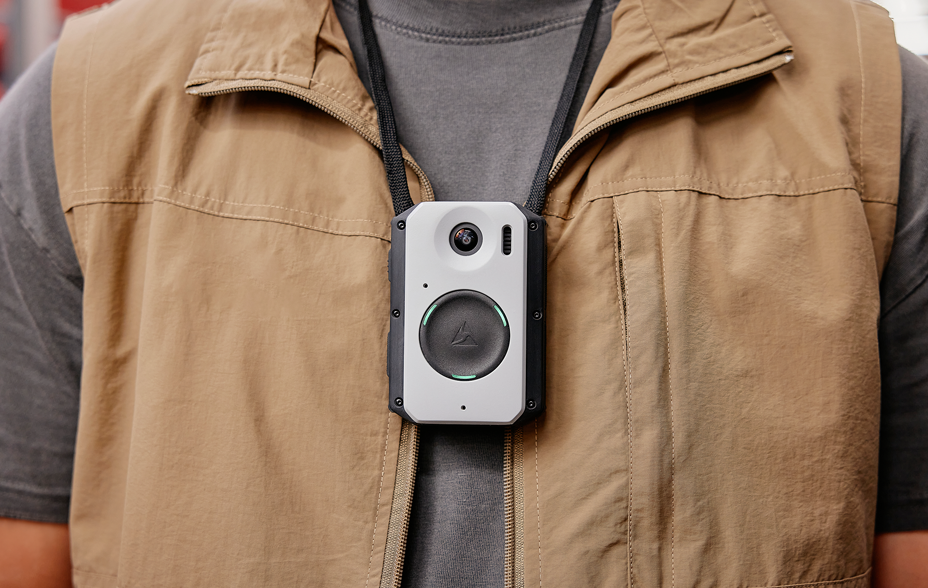
Image courtesy of Axon
We’re now witnessing the early stages of several additional adaptations, including real-time operations, AI assistants embedded in devices, VR training, and drones. Each new act increases the surface area over which Axon can create value. It also deepens switching costs: once your evidence, workflows and training are all running on Axon, moving away is painful.
This continuous adaptability and iteration will be crucial for the company to continue growing its domestic market while pursuing international opportunities. Many international agencies remain underserved. TASER adoption outside the US lags domestic penetration. And new customer groups, such as private businesses, are only just beginning to become customers. Together, these could see Axon compounding revenue at approximately 40 per cent per annum.
Crucially, as software becomes a greater part of the mix, we could see some significant operating leverage, with operating margins increasing from the low-20s today to the mid-30s by 2030. Recent weakness in the shares, driven by near-term concerns, has afforded us a more attractive entry point. However, if our growth and margin expectations materialise, there is ample room for the multiple to contract by as much as 40 per cent and still allow for a quintupling.
Closing the loop
Axon is an unusually mission-driven growth company operating at meaningful scale. Its “protect life” focus has guided three decades of product development, from TASER devices through to cameras, cloud evidence management and now AI-enabled software. That mission is tightly aligned with customer needs. Agencies want fewer tragic incidents, more efficient operations and better outcomes, and Axon’s integrated platform helps them move in that direction.
Importantly, the same feedback loop operates within Axon itself. With millions of real-world deployments, vast datasets and increasingly software-led workflows, the company is continuously refining its products, training and operating model.
Each iteration improves outcomes for customers, strengthens trust and deepens reliance on the platform. If Axon continues to execute on its mission, the result should be a safer, more accountable future for law enforcement and, in our view, a compelling long-term opportunity for outlier returns.
Annual past performance to 31 December each year (%)
| 2021 | 2022 | 2023 | 2024 | 2025 | |
| Long Term Global Growth Composite (gross) | 3.2 | -46.0 | 38.2 | 26.6 | 17.8 |
| Long Term Global Growth Composite (net) | 2.4 | -46.4 | 37.3 | 25.7 | 16.9 |
| MSCI ACWI Index | 19.0 | -18.0 | 22.8 | 18.0 | 22.9 |
Annualised returns to 31 December 2025 (%)
| 1 year | 5 years | 10 years | |
| Long Term Global Growth Composite (gross) | 17.8 | 2.8 | 16.7 |
| Long Term Global Growth Composite (net) | 16.9 | 2.1 | 15.9 |
| MSCI ACWI Index | 22.9 | 11.7 | 12.3 |
Source: Revolution, MSCI. USD. Returns have been calculated by reducing the gross return by the highest annual management fee for the composite. LTGG composite is more concentrated than MSCI ACWI Index.
Past performance is not a guide to future returns.
Legal notice: MSCI makes no express or implied warranties or representations and shall have no liability whatsoever with respect to any MSCI data contained herein. The MSCI data may not be further redistributed or used as a basis for other indexes or any securities or financial products. This report is not approved, endorsed, reviewed or produced by MSCI. None of the MSCI data is intended to constitute investment advice or a recommendation to make (or refrain from making) any kind of investment decision and may not be relied on as such.
Risk factors and important information
The views expressed should not be considered as advice or a recommendation to buy, sell or hold a particular investment. They reflect opinion and should not be taken as statements of fact nor should any reliance be placed on them when making investment decisions.
This communication was produced and approved in January 2026 and has not been updated subsequently. It represents views held at the time of writing and may not reflect current thinking.
Potential for Profit and Loss
All investment strategies have the potential for profit and loss, your or your clients’ capital may be at risk. Past performance is not a guide to future returns.
This communication contains information on investments which does not constitute independent research. Accordingly, it is not subject to the protections afforded to independent research, but is classified as advertising under Art 68 of the Financial Services Act (‘FinSA’) and Baillie Gifford and its staff may have dealt in the investments concerned.
All information is sourced from Baillie Gifford & Co and is current unless otherwise stated.
The images used in this communication are for illustrative purposes only.
Important Information
Baillie Gifford & Co and Baillie Gifford & Co Limited are authorised and regulated by the Financial Conduct Authority (FCA). Baillie Gifford & Co Limited is an Authorised Corporate Director of OEICs.
Baillie Gifford Overseas Limited provides investment management and advisory services to non-UK Professional/Institutional clients only. Baillie Gifford Overseas Limited is wholly owned by Baillie Gifford & Co. Baillie Gifford & Co and Baillie Gifford Overseas Limited are authorised and regulated by the FCA in the UK.
Persons resident or domiciled outside the UK should consult with their professional advisers as to whether they require any governmental or other consents in order to enable them to invest, and with their tax advisers for advice relevant to their own particular circumstances.
Financial Intermediaries
This communication is suitable for use of financial intermediaries. Financial intermediaries are solely responsible for any further distribution and Baillie Gifford takes no responsibility for the reliance on this document by any other person who did not receive this document directly from Baillie Gifford.
10059830
Crowding at the waterhole
Index crowding into megacaps can leave investors overexposed; patient teams look beyond the obvious for winners.