

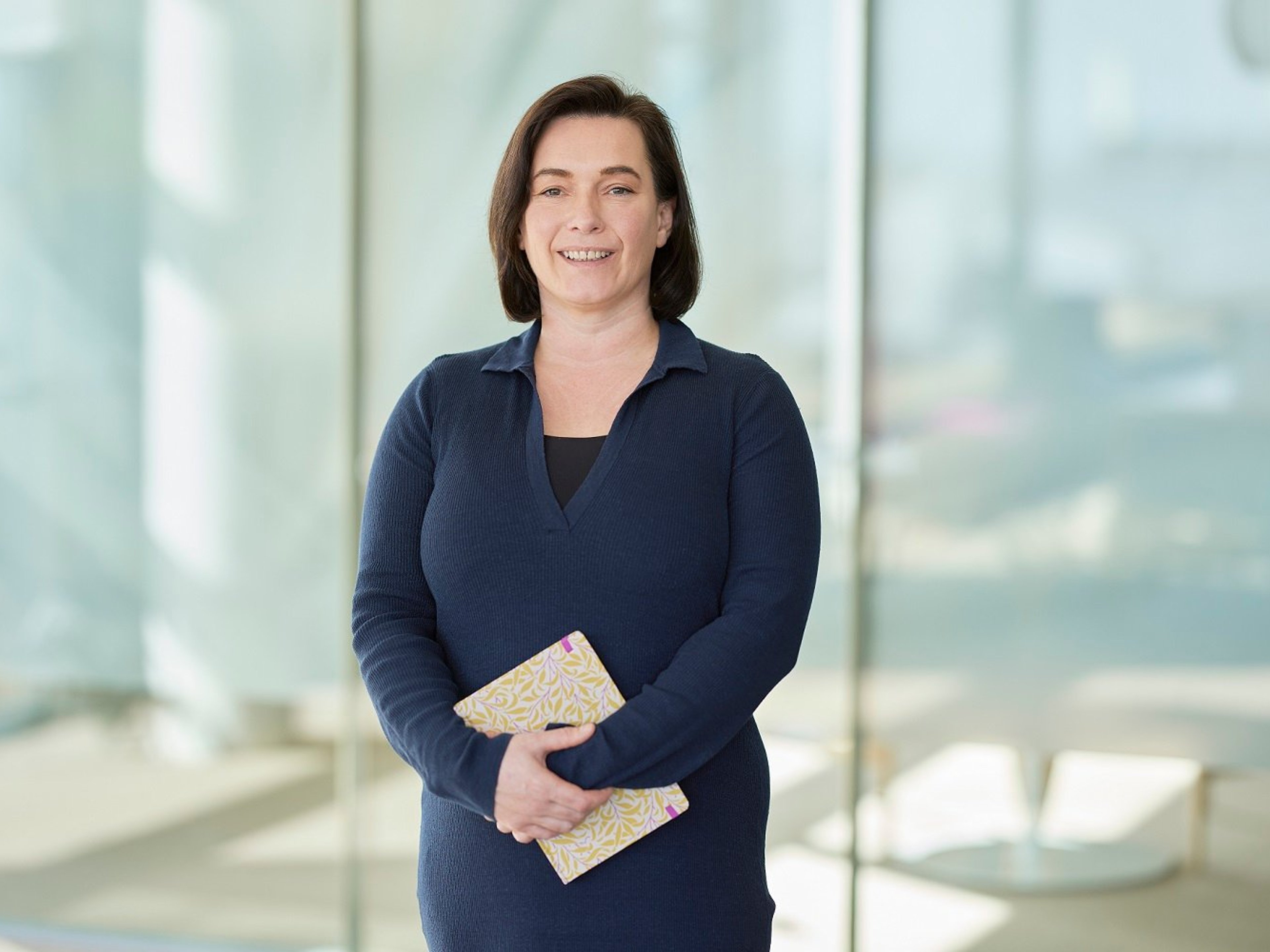
What diversity means to me: Kathrin Hamilton
Client relationship director Kathrin Hamilton talks about diversity and inclusion, and why we should all feel comfortable calling out certain behaviours.
Tell us about your background
My teenage years were spent living in Paris and Vienna, before returning to Scotland for university. I had no intention of settling here in the long term, but life has a funny way of changing your plans.
I studied Business and Economics at Heriot-Watt University before getting a place on a graduate scheme with an accountancy firm in London. I stayed there for almost three years before moving back to Edinburgh.
What progress do you think the firm has made regarding diversity and inclusion?
The fact that we are having this conversation shows that Baillie Gifford has made significant progress. When I joined the firm in 2002, there were relatively few role models for women. Now, there are more females to look up to across the business.
There is also acceptance that fostering diversity and inclusion is something we need to be conscious of, rather than hoping it will take care of itself. This has resulted in us partnering with several external agencies, including Stonewall and the British Disability Forum, whose support will prove valuable.
How do you create an inclusive environment in your team?
I have a diverse team – a number of members work part-time or flexibly – and I was immensely proud to have one of the first individuals in my department to take extended paternity leave in my team.
A number of the practices that assist with diversity and inclusion lie in flexible working, and there are those who have concerns that some people will take advantage.
I believe that if you give people responsibility, they live up to it. If they don’t, it becomes readily apparent. For me, it’s a combination of having faith in people’s professionalism and giving them the responsibility to treat their team and the job which they do with respect.
Have you encountered any challenges in your career in terms of getting to where you are today?
Periodic self-doubt! Women who don’t work in the presence of female role models can experience imposter syndrome. This is a real challenge, as it can impact on confidence levels and make people less inclined to seize opportunities. My advice to anyone who experiences this would be to seek out coaching and mentoring opportunities and work on building confidence and understanding your strengths. Sometimes, you will be flying by the seat of your pants, and that’s OK. Experience is a wonderful thing, but it has to be earned the hard way.
In the Diversity and Inclusion Group, we’ve talked about how we would like the firm to become so diverse and inclusive that it’s no longer a talking point. In other words, we want to ensure nobody is defined in their ability to do their job or progress within the firm by anything other than their talent and experience. Success requires all of us to embrace that attitude.
We want to ensure nobody’s ability to do their job or progress within the firm is defined by anything other than their talent or experience.
What advice would you give anyone who sees behaviour that doesn’t chime with the firm’s diversity and inclusion ethos?
In my graduate role, the company I worked for at the time gave me the opportunity to work away for a month, staying in hotels for the duration. The senior manager who was overseeing the team’s work made advances towards me no fewer than four times, despite me emphatically rebuffing him on each occasion. It was a wholly unpleasant and stressful experience, particularly as I was away from home and my peers. I made my department head aware of the individual’s actions, which ensured appropriate steps were taken. It was an important part of dealing with the experience for me and I would encourage anyone who encounters intolerable behaviour to speak up. It’s far from easy but it is vital.
I hope that people feel confident enough to point out when an individual makes a regrettable joke or passes an off-colour remark. As a partner of the firm, if I said something inappropriate, I would want those around me to feel comfortable enough to talk to me about it. Don’t let the moment go by – social feedback is a powerful tool in adapting behaviours and cultural norms.
Beyond that, where more difficult or sustained negative behaviour occurs, people need to be able to voice concerns without feeling like it reflects on them. I’d advise individuals to have a conversation with their line manager or HR if more appropriate. Good managers recognise that these discussions must be taken seriously, as people can become frustrated if their concerns aren’t being addressed. This can aggregate and become toxic within the culture.
What does diversity and inclusion mean to you?
As a teenager, I attended international schools and although they weren’t the most diverse from a socio-economic perspective, they were melting pots of nationality and ethnicity. As a result, a culturally rich environment became normal to me.
Scotland isn’t obviously the most diverse place (though on my doorstep in Leith I have a Thai massage clinic, a Bulgarian mechanic, an Albanian coffee shop and a Chinese supermarket) but I believe it’s by and large an inclusive place. We need to bear in mind that it’s all very well to draw lots of different people around us, but it’s ineffective if many among them don’t feel valued. Ensuring we demonstrate that we value the people around us, regardless of which category they appear to fall into, is fundamental to diversity and inclusion and I believe we all have a role to play in that.
Make your mark: Angela Geddes
Angela Geddes shares her experience of a coaching programme equipping women with the skills they need to develop their careers.
Important information
Baillie Gifford Overseas Limited provides investment management and advisory services to non-UK clients and is authorised and regulated by the UK Financial Conduct Authority. Baillie Gifford Overseas Limited is not licensed under the Regulation of Investment Advising, Investment Marketing and Portfolio Management Law, 5755-1995 (the “Advice Law”) and does not carry insurance pursuant to the Advice Law.
Baillie Gifford Overseas Limited markets and distributes Baillie Gifford’s range of collective investment schemes to Qualified Clients and Qualified Investors in Israel, as listed in the First Addendum to the Regulation of Investment Advising, Investment Marketing and Portfolio Management Law, 5755-1995 (the “Advice Law”) and in the First Addendum to the Israel Securities Law, 5728-1968 (the “Securities Law”). Detailed disclosure of the collective investment schemes can be found within this website and in the relevant scheme prospectus.
Baillie Gifford Overseas Limited does not provide investment advice. If you are in any doubt about whether an investment is suitable, you should seek independent advice.
No action has been or will be taken in Israel that would permit a public offering or distribution of the Funds mentioned in this website to the public in Israel. This website and the Funds mentioned herein have not been approved by the Israeli Securities Authority (the “ISA”). In addition, the Funds mentioned in this website are not regulated under the provisions of Israel’s Joint Investment Trusts law, 5754-1994 (the “Joint Investment Trusts Law”). This website and the Funds mentioned herein will only be distributed to Israeli residents in reliance on an exemption from any advice or marketing restrictions [in a manner that will not constitute “an offer to the public” under sections 15 and 15a of]/[in reliance on an exemption from the prospectus requirements under] the Israel Securities Law, 5728-1968 (the “Securities Law”) or the Joint Investment Trusts Law, and any guidelines, pronouncements or rulings issued from time to time by the ISA as applicable.
Careers
Explore the possibilities of your career and interests when you join us.