

Key points
-
Elite luxury brands demonstrate remarkable resilience against economic shocks and trade wars through their unique pricing power
-
Ferrari, Hermès and other European leaders can increase demand and desirability by raising prices and profitability
-
Centuries of craftsmanship and financial discipline allow these brands to defy market volatility
Listen to this article
This audio is generated using AI

As with all investments, your capital is at risk
In the great Trump tariff upheaval of Spring 2025, two big European exporters conspicuously kept their cool as their shares temporarily plunged.
“We don’t see any weakening of the order book,” Ferrari’s chief executive Benedetto Vigna told reporters while giving profit guidance a month after President Trump imposed a 25 per cent surcharge on European cars and components (he afterwards threatened to double it).
Analysts noted how continuing demand for ‘personalisation’, with buyers adding expensive features to supercars costing $250,000 and (far) upwards, had helped the carmaker achieve a 23 per cent year-on-year increase in operating profit.
Soon after, French fashion house Hermès International announced that it would bump up the US prices of its famously high-priced handbags by between 6 and 12 per cent to “fully offset” and “neutralise” any effect of the threatened US tariffs on EU imported goods. Nobody was predicting a slump in sales for Hermès as a result.
“We expect the group to benefit from far superior pricing power versus peers,” one luxury sector commentator said. Days after Trump’s Independence Day announcement, Hermès overtook LVMH to become the world’s most valuable luxury company.
Like recessions, trade wars tend not to dent the financial results of Ferrari, Hermès and other unique brands. Their customers are well-insulated against such shocks.
Abnormal economics
These companies, with operating margins (as of July 2025) of 29 per cent (Ferrari) and 43 per cent (Hermès), benefit from the through-the-looking-glass economics first noted by the Norwegian-American sociologist Thorstein Veblen (1857-1929). In this gilded age of “conspicuous consumption,” a phrase he coined in 1899, higher prices actually increase demand for luxury goods as they enhance perceived value and desirability.
Very few companies can crack the alchemy that allows them to benefit from ‘Veblen effects’, as they’re known. In addition to Ferrari and Hermès, the International Growth’s portfolio holds exceptional businesses such as L’Oréal, the world’s largest cosmetics company, whose Luxe division brands include Lancôme, Yves Saint Laurent, Giorgio Armani, Valentino and Prada; and Brunello Cucinelli, which produces understated but high-end menswear and womenswear, especially fine cashmere items.
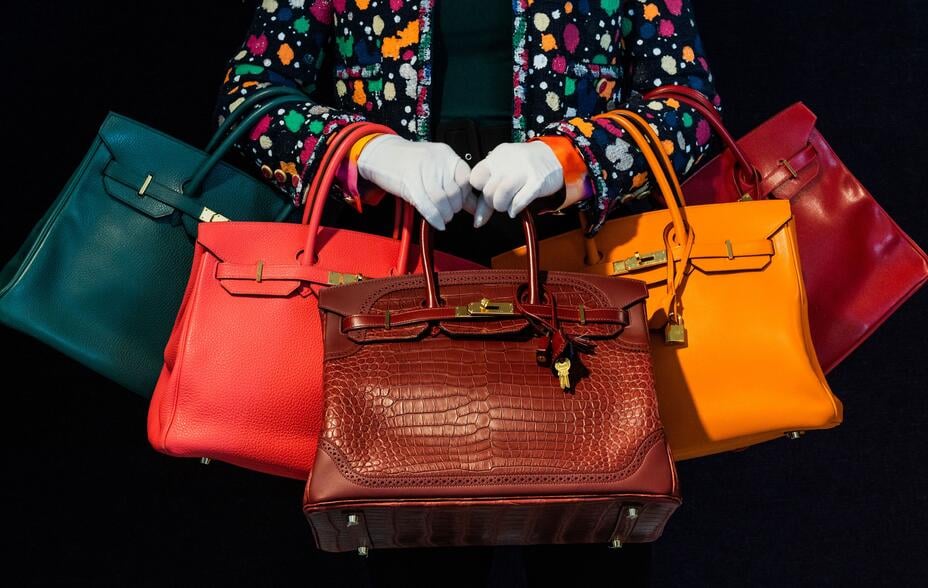
Photo by Guy Bell/Shutterstock (10947489w)
There are good reasons for Europe’s status as the home of luxury. Over centuries, the continent has developed a cross-pollinating tradition of craftsmanship, design expertise and brand cachet that gives this small and highly competitive niche its ability to lock in fantastically high profit margins, engender strong consumer loyalty and spread its appeal to the rich and aspirational across continents.
Much of the growth in the sector has been due to the rising wealth of Asia, particularly China, “the engine of worldwide growth in luxury spending,” according to consultants McKinsey. The luxury market there tripled in size between 2017 and 2021, and despite the protracted Covid-related downturn that has slowed the growth of high-priced brands, expectations are for the luxury market there to be worth $148bn by 2030, surpassing that of the US and making up 24 per cent of the global figure.
The leading brands have many advantages that allow them to weather volatility even at a China-scale. Barriers for new entrants in this sector are high – no amount of marketing spend can retrofit a credible backstory – but maintaining a position in this gilded niche requires constant innovation and enterprise. The leading brands know customer loyalty can’t be taken for granted, as the wealthy have the time and leisure to spot trends and sample other Veblen-benefitting wares.

Leaders in luxury
Ferrari is a good example of how leveraging brand prestige and exclusivity has made it seemingly impervious to the economic cycle and able to achieve steady growth.
The Maranello-based firm effectively controls how fast it grows as demand for its cars outstrips supply, a principle set by founder Enzo Ferrari (1898-1988): “We will always sell one less car than the market demands”. Customers are grateful for being allowed to order a multi-million-dollar car with a vague delivery date years down the line.
For Hermès, surpassing LVMH reflects financial strength and investor confidence in its long-term strategy and resilience. The firm, whose mainstay is leatherwear, especially handbags, outperforms rivals in operational efficiency. It sells its products quickly, has less of its money tied up in stock, and can pay suppliers efficiently. Rigid financial discipline means it has the liquidity to support ongoing growth. The result is that Hermès earns a return of about 33 per cent on the money it invests in its business, three times higher than the norm for companies of its size.
Still controlled mainly by descendants of founder Thierry Hermès (1801-1878), the firm has continued to thrive, even in China. Its products are seen as long-term investments, and it maintains tight control over supply. Like most in this category, it never publicly discounts products, implying that to do so would be an insult to its craftsmanship.
Sustained financial outperformance, operational mastery, brand exclusivity, and a business model prioritising long-term value over short-term gains: these attributes have enabled Hermès to weather headwinds such as a slowdown in a giant market and set new benchmarks for global luxury.
Whether targeting the Gen-Z shoppers of Shanghai and Shenzhen or the ‘old money’ clientele of the boutiques of London, Paris and New York, luxury goods companies tap into traits inseparable from primordial needs and wishes: the desire to possess well-made things, look your best, and signal your high status.
Politicians, pandemics and economic downturns may bend the course of history, but unique brands that have found a way to work so thoroughly within the grain of enduring human behaviour, seem likely to grow, whatever’s in the news.
Risk factors
This communication was produced and approved in July 2025 and has not been updated subsequently. It represents views held at the time and may not reflect current thinking.
The views expressed should not be considered as advice or a recommendation to buy, sell or hold a particular investment. They reflect opinion and should not be taken as statements of fact nor should any reliance be placed on them when making investment decisions.
This communication contains information on investments which does not constitute independent research. Accordingly, it is not subject to the protections afforded to independent research, but is classified as advertising under Art 68 of the Financial Services Act (‘FinSA’) and Baillie Gifford and its staff may have dealt in the investments concerned.
All information is sourced from Baillie Gifford & Co and is current unless otherwise stated.
The images used in this communication are for illustrative purposes only.
Important Information
Baillie Gifford & Co and Baillie Gifford & Co Limited are authorised and regulated by the Financial Conduct Authority (FCA). Baillie Gifford & Co Limited is an Authorised Corporate Director of OEICs.
Baillie Gifford Overseas Limited provides investment management and advisory services to non-UK Professional/Institutional clients only. Baillie Gifford Overseas Limited is wholly owned by Baillie Gifford & Co. Baillie Gifford & Co and Baillie Gifford Overseas Limited are authorised and regulated by the FCA in the UK.
Persons resident or domiciled outside the UK should consult with their professional advisers as to whether they require any governmental or other consents in order to enable them to invest, and with their tax advisers for advice relevant to their own particular circumstances.
Financial Intermediaries
This communication is suitable for use of financial intermediaries. Financial intermediaries are solely responsible for any further distribution and Baillie Gifford takes no responsibility for the reliance on this document by any other person who did not receive this document directly from Baillie Gifford.
Europe
Baillie Gifford Investment Management (Europe) Ltd (BGE) is authorised by the Central Bank of Ireland as an AIFM under the AIFM Regulations and as a UCITS management company under the UCITS Regulation. BGE also has regulatory permissions to perform Individual Portfolio Management activities. BGE provides investment management and advisory services to European (excluding UK) segregated clients. BGE has been appointed as UCITS management company to the following UCITS umbrella company; Baillie Gifford Worldwide Funds plc. BGE is a wholly owned subsidiary of Baillie Gifford Overseas Limited, which is wholly owned by Baillie Gifford & Co. Baillie Gifford Overseas Limited and Baillie Gifford & Co are authorised and regulated in the UK by the Financial Conduct Authority.
South Korea
Baillie Gifford Overseas Limited is licensed with the Financial Services Commission in South Korea as a cross border Discretionary Investment Manager and Non-discretionary Investment Adviser.
Japan
Mitsubishi UFJ Baillie Gifford Asset Management Limited (‘MUBGAM’) is a joint venture company between Mitsubishi UFJ Trust & Banking Corporation and Baillie Gifford Overseas Limited. MUBGAM is authorised and regulated by the Financial Conduct Authority.
Australia
Baillie Gifford Overseas Limited (ARBN 118 567 178) is registered as a foreign company under the Corporations Act 2001 (Cth) and holds Foreign Australian Financial Services Licence No 528911. This material is provided to you on the basis that you are a “wholesale client” within the meaning of section 761G of the Corporations Act 2001 (Cth) (“Corporations Act”). Please advise Baillie Gifford Overseas Limited immediately if you are not a wholesale client. In no circumstances may this material be made available to a “retail client” within the meaning of section 761G of the Corporations Act.
This material contains general information only. It does not take into account any person’s objectives, financial situation or needs.
South Africa
Baillie Gifford Overseas Limited is registered as a Foreign Financial Services Provider with the Financial Sector Conduct Authority in South Africa.
North America
Baillie Gifford International LLC is wholly owned by Baillie Gifford Overseas Limited; it was formed in Delaware in 2005 and is registered with the SEC. It is the legal entity through which Baillie Gifford Overseas Limited provides client service and marketing functions in North America. Baillie Gifford Overseas Limited is registered with the SEC in the United States of America.
The Manager is not resident in Canada, its head office and principal place of business is in Edinburgh, Scotland. Baillie Gifford Overseas Limited is regulated in Canada as a portfolio manager and exempt market dealer with the Ontario Securities Commission ('OSC'). Its portfolio manager licence is currently passported into Alberta, Quebec, Saskatchewan, Manitoba and Newfoundland & Labrador whereas the exempt market dealer licence is passported across all Canadian provinces and territories. Baillie Gifford International LLC is regulated by the OSC as an exempt market and its licence is passported across all Canadian provinces and territories. Baillie Gifford Investment Management (Europe) Limited (‘BGE’) relies on the International Investment Fund Manager Exemption in the provinces of Ontario and Quebec.
Israel
Baillie Gifford Overseas is not licensed under Israel’s Regulation of Investment Advising, Investment Marketing and Portfolio Management Law, 5755-1995 (the Advice Law) and does not carry insurance pursuant to the Advice Law. This material is only intended for those categories of Israeli residents who are qualified clients listed on the First Addendum to the Advice Law.
Singapore
Baillie Gifford Asia (Singapore) Private Limited is wholly owned by Baillie Gifford Overseas Limited and is regulated by the Monetary Authority of Singapore as a holder of a capital markets services licence to conduct fund management activities for institutional investors and accredited investors in Singapore. Baillie Gifford Overseas Limited, as a foreign related corporation of Baillie Gifford Asia (Singapore) Private Limited, has entered into a cross-border business arrangement with Baillie Gifford Asia (Singapore) Private Limited, and shall be relying upon the exemption under regulation 4 of the Securities and Futures (Exemption for Cross-Border Arrangements) (Foreign Related Corporations) Regulations 2021 which enables both Baillie Gifford Overseas Limited and Baillie Gifford Asia (Singapore) Private Limited to market the full range of segregated mandate services to institutional investors and accredited investors in Singapore.
724700 10056514