

Key points
- Reacting to every market story can lead to unnecessary portfolio changes. Baillie Gifford’s Managed Strategy offers a more balanced route to long-term growth
- Headlines change quickly, but long-term portfolio building should not. Baillie Gifford’s Managed Strategy helps build growth portfolios on a shared philosophy
- Built around a mix of equities, bonds and cash, the strategy can help advisers meet different client needs without changing philosophy

As with any investment, your capital is at risk.
In today’s 24/7 news environment, advisers are often under pressure to act. Every day brings a new headline, a new market narrative, a new “must-respond” moment. Whether it’s artificial intelligence, inflation, interest rates, geopolitics, or the latest market darling, there is always one more story competing for attention.
For a time, those stories can feel all-important. They dominate conversations with clients and influence portfolio decisions. But history shows that these narratives rarely persist. Over nearly four decades of managing Managed portfolios, we’ve seen leadership shift between regions, styles and sectors. What matters in one period can quickly fade in the next.
The challenge, then, is not identifying the next story. It is building portfolios that don’t rely on being right about any single one.
That is where a growth-focused approach, grounded in fundamental research and long-term thinking, becomes powerful. The Managed strategy has been investing across equities, bonds and cash since 1987, navigating multiple market cycles. Throughout that time, one principle has remained consistent: the primary driver of long-term equity returns is earnings growth. While headlines can move markets in the short term, it is the ability of businesses to compound earnings over five years and beyond that ultimately determines outcomes.
This overarching investment philosophy is simple in theory, but not easy in practice, especially when advisers and their clients experience market volatility in real time, making it harder to stay focused on what truly drives returns.
A growth portfolio must, therefore, go beyond individual companies, especially when built with resilience in mind. It requires diversification across regions and industries, combining multiple sources of growth rather than relying on any single theme or geography.
Recent purchases in our Managed strategies reflect this, from European banks such as AIB, KBC and CaixaBank to Reece, a distributor of plumbing and bathroom supplies across Australia, New Zealand and the US.
These sit alongside longstanding holdings including Amazon (held since 2014), Dutch semiconductor equipment manufacturer ASML (held since 2018) and South Korean Samsung Electronics (held directly since 2017).1
Active stock selection also plays a critical role here. The asymmetry of equity returns means that a small number of exceptional companies often drive a large proportion of long-term performance. Capturing these winners, while learning from inevitable mistakes, is central to delivering growth. Importantly, this often means looking beyond the headlines, where the market narrative may not fully reflect underlying business fundamentals.
This is why we continue to hold selective software businesses despite the headlines and pronounced market moves in February following the release of Anthropic’s latest AI model. The key question we are asking ourselves isn’t whether software is dead, but where competitive advantages are strongest in this new era.
This is where Samsara and Shopify are great examples. Shopify provides the infrastructure for millions of businesses to sell online globally, driving sustained volume and revenue growth. Meanwhile, Samsara’s sensors and software monitor everything from industrial equipment movements to operational processes – even extending to highly specific uses such as ensuring airline toilets are appropriately emptied before takeoff.
None of this is to say we remain static. We have sold holdings where uncertainty around AI’s impact has increased – UK-listed Trainline and Japanese digital media business CyberAgent are examples.
At the same time, balance matters. Bonds and cash provide diversification and help manage periods when equities struggle, although correlations can vary depending on the macroeconomic environment. For example, bonds have typically offered strong diversification during growth shocks, when weaker economic activity leads to falling yields and rising bond prices. By contrast, during inflation shocks – such as in 2022 and more recently amid the war in Iran – both equities and bonds can come under pressure as yields rise and prices thus fall. The goal is not to eliminate volatility, but to build a bond allocation that is robust and aligned with client outcomes, providing a balance to equities. Doing so requires a global opportunity set spanning developed and emerging government bonds, as well as investment grade and high yield corporate debt. Being selective about what we hold – and in what proportion – helps position portfolios for long-term success while reducing the number of decisions advisers need to make.
Managed Strategy Portfolios
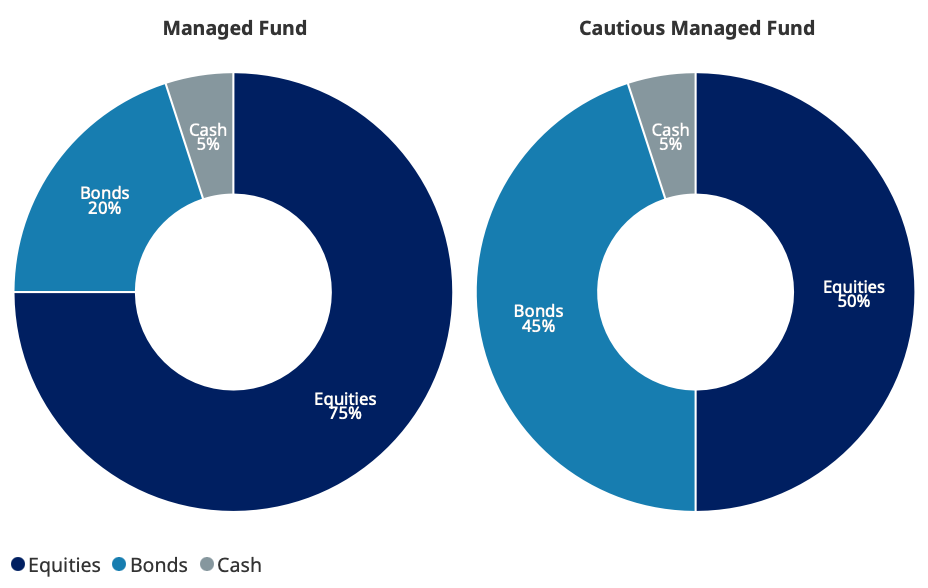
Based on Cautious Managed and Managed Funds’ strategic asset allocation.
| Managed Fund | Cautious Managed Fund | |
| Launch date | 1 April 1987 | 31 July 2025 |
| Ongoing charges figure | 0.43% | 0.31% |
| Dynamic Planner risk rating | 7 | 5 |
This is the thinking behind the Baillie Gifford Managed approach. By combining access to a diverse range of high-quality growth companies with built-in allocations to bonds and cash, it offers a straightforward way to construct growth portfolios without constant reallocation decisions.
The distinction between the Managed Fund and the Cautious Managed Fund is simply the level of balance – that is, the allocation between equities and bonds – which allows advisers to match portfolios to different client needs without changing the underlying philosophy.
Ultimately, the question, therefore, is not “what’s the next story?” There will always be one more. The more important question is whether you want to keep responding to each one - or adopt an approach designed to look beyond them.
Two funds. One approach. Fewer decisions.
1 Purchase dates for holdings apply to the Managed Fund only.
Important information and risk factors
This article was produced in April 2026 and has not been updated subsequently. It represents views held at the time and may not reflect current thinking.
The views expressed should not be considered as advice or a recommendation to buy, sell or hold a particular investment. They reflect opinion and should not be taken as statements of fact nor should any reliance be placed on them when making investment decisions.
This communication contains information on investments which does not constitute independent research. Accordingly, it is not subject to the protections afforded to independent research, and Baillie Gifford and its staff may have dealt in the investments concerned.
Baillie Gifford & Co and Baillie Gifford & Co Limited are authorised and regulated by the Financial Conduct Authority (FCA). Baillie Gifford & Co Limited is an Authorised Corporate Director of OEICs.
Investment markets can go down as well as up and market conditions can change rapidly. The value of an investment in the Fund, and any income from it, can fall as well as rise and investors may not get back the amount invested.
The Fund’s share price can be volatile due to movements in the prices of the underlying holdings and the basis on which the Fund is priced.
Bonds issued by companies and governments may be adversely affected by changes in interest rates, expectations of inflation and a decline in the creditworthiness of the bond issuer. The issuers of bonds in which the Fund invests, particularly in emerging markets, may not be able to pay the bond income as promised or could fail to repay the capital amount.
The Fund invests in emerging markets where difficulties in trading could arise, resulting in a negative impact on the value of your investment.
Further details of the risks associated with investing in the Fund can be found in the Key Investor Information Document or the Prospectus, copies of which are available at bailliegifford.com.
191847 10062055