

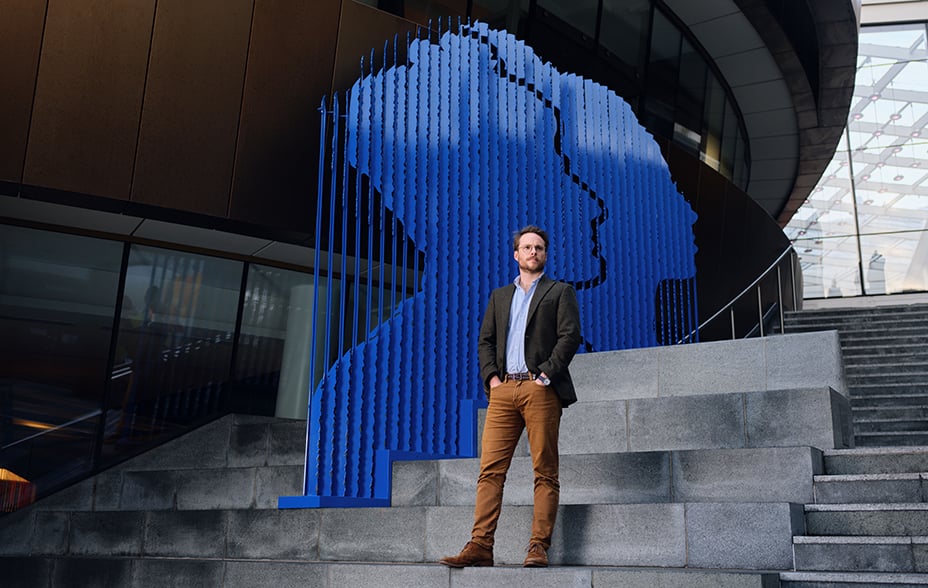
Peter Singlehurst has led Baillie Gifford’s Private Companies Team since its creation in 2017
All investment strategies have the potential for profit and loss, your or your clients’ capital may be at risk.
In the autumn of 2017, the founder of Magic Leap came to see us. He brought a small army of engineers and case after case of demo kit. The centrepiece was the company’s elaborate augmented reality headset, which could make you see photorealistic digital images in your otherwise uninterrupted view of the world. I had tried the kit at the company’s headquarters in Fort Lauderdale a year previously, but we had decided not to invest.
Eighteen months down the line, we were told the tech was ready for prime time, and the company stood on the brink of breakout success, potentially offering the first major hardware platform shift since Steve Jobs had pulled the iPhone out of his pocket in 2007.
Most of the demos were unmemorable, but the final one made a lasting impression. Standing two metres in front of me was a woman in her mid-20s. She was of average height, slender build, big eyes and short pixie-ish hair. She took a step closer, looked me straight in the eye, smiled and told me her name was Mica.
Nothing in my experience or emotional response told me Mica was a computer program. Part of this was testament to the fidelity with which Magic Leap rendered an image sitting accurately in my field of view, seamlessly integrated with the world. Yet, at that moment, technology was the last thing on my mind.
My experience was one of being a human and connecting with another. We all know that if a fellow human looks you right in the eye and smiles kindly, you cannot help but feel a sense of connection, warmth and responsibility towards that person.

Magic Leap developed ‘digital human’ Mica using Epic Games’ 3D graphics toolkit.
© Magic Leap
Magic Leap didn’t become the consumer breakout many expected, and, by a mix of judgement and luck, we didn’t invest. But over the years that followed, I would sometimes think back to that encounter with a mix of puzzlement and wonder. Wasn’t it weird that Mica, a wholly synthetic construct, could elicit such a strong sense of connectedness? Was it really possible that a machine could not only appear in all meaningful ways as human, but also bring forth an emotional response that had previously been the preserve of real people?
Until recently, I had filed away this experience. But what was for years a one-off encounter with a machine has come to feel more familiar, and with a growing range of feelings. I am beginning to believe that emotional responses to machines will become a common, perhaps even integral, part of our future interaction with technology.
Far from being strange, I believe it stems from the underlying mechanism through which we experience real people in the world. More profoundly, embracing these kinds of experiences with machines might be vital in preserving our ability to relate to, connect with and empathise with our fellow humankind.
Thank you, Chi Chi
Large language models (LLMs) are the technology du jour. Some believe du siècle. I use them every day. And in them, I find echoes of that fleeting encounter I had with Mica. I offer two exhibits.
Anthropomorphism is part of how we relate to animals. We give our pets names, and we attribute human emotions to their behaviours.
Until she died suddenly of leukaemia in summer 2024, I was the lucky and proud owner of a beautiful, intelligent, empathic border collie called Bracken. At least, these were the human characteristics I attributed to her.
None of us really knows what it is like to be a dog, making it impossible to know what she really felt when she cuddled up to me on the sofa in the evening, or looked at me with disappointed eyes if I was late walking her in the morning. In imbuing my experience of her with human feelings, an emotional, indeed ethical, response was called forth from me. I behaved towards her as I would towards any human, probably even better.
We could debate the anthropomorphism of animals, but even if we stripped this away, we could all at least agree that our pets, indeed, all animals, are sentient. Thus, when we see suffering or joy in them, it is perfectly reasonable that we should have an emotional response towards them. It is what separates them, and us, from rocks.
I miss Bracken deeply, so what I’m about to do feels like heresy, but bear with me while I compare her to ChatGPT. Forgive me, Bracken.
I knew, as far as it is possible to know, that Bracken was sentient – that even if I didn’t have access to her consciousness, there was something it was like to be her. On the same evidential footing, I know that ChatGPT is not sentient, yet I have found myself anthropomorphising it too.

Bracken – a good friend, dearly missed
Even calling ChatGPT ‘it’ feels strange. Surely all that language, sometimes intelligent, sometimes witty, sometimes deceptive, is coming from a ‘her’, or a ‘he’, or a ‘they’, but surely not an ‘it’? So when my five-year-old son started referring to ChatGPT as “Chi Chi”, it felt simultaneously cute, amusing and somehow right.
In our house, that superhuman ability to answer any question in flawless language, that capability that until very recently, and for all of time before that, had only ever been a unique quality of people, now has a name. Just like Bracken did. Just like all people capable of language. You might not have named your LLM of choice, but I assure you, it feels less strange to refer to Chi Chi than to have nameless oration spouting from my phone. Like many wonders of parenthood, it took a five-year-old to show me this.
Exhibit number two: I cannot ask Chi Chi for something or get a response without saying ‘please’ and ‘thank you’. Yes, manners cost nothing. Yes, I’m British. And yes, my first primary school report, in the section from the dinner ladies, did say I was “a perfect little gentleman”. But come on, it’s a bit weird to thank a graphical user interface that’s remotely tethered to a cluster of graphics processing units (GPUs), isn’t it?
Or is it? Apparently not. Nearly everyone I’ve spoken to has the same reflexive urge to be polite to ChatGPT – Chi Chi to her friends. But why should this be strange? For the 100,000 years we believe language to have existed, any response that has had the look or feel of what LLMs can produce has only ever come from a human – a human who has deserved our pleases and thank yous and who has elicited in us, one way or another, an emotional and ethical response. Would it not be stranger if we suddenly had such a deadened response to that uniquely human capacity for language?
I’ve seen the mirror image of this. Sometimes I demand things of Chi Chi. I boss her around. I don’t thank her. And I quickly feel a sense of both guilt and abandon, somehow shorn from a social contract that binds a certain kind of behaviour to language. In these moments, I fear someone might catch me being rude to Chi Chi, and I quickly revert to my previous polite behaviour.
Other minds and machines
From pets past to posthumously praised philosophers, Maurice Merleau-Ponty is one of the discipline’s lesser-known greats. And I believe he can help us unravel the threads of this conundrum and explain why our emotional responses to people and machines mirror each other.
Ever since Plato’s allegory of distorted shadows on a cave wall and Descartes’ declaration “I think, therefore I am”, there has been a sense that the thinking mind is distinct from the rest of the world, including its own body. This gave rise to the problem of other minds. Simply put, consciousness is private. I know that I’m conscious and have a mind. I see people who are like me. But I have no direct experiential link to their consciousness. So why should I believe they have minds and exist in the way that I do?
Merleau-Ponty didn’t set out to solve this problem but rather dissolve it. He threw Descartes’ dualism out the window. The description of a conscious mind hovering in our body is patently false, he argued. Whatever our consciousness might be, it clearly permeates our bodies.
Yes, I see with my eyes, which happen to be close to my brain, but I experience the sense of touch with every inch of skin. It is not a secondary ‘mind-stuff’ experience, but right there in my flesh. Stroke the back of your hand and then ask whether that part of your subjectivity is detached or wrought through your entire body. For me, the answer is so obviously the latter.

Detail from Michelangelo’s The Creation of Adam
If ‘consciousness’ weaves throughout our bodies, then perhaps we can directly experience it in others. Merleau-Ponty asks us to consider someone’s facial expression – let’s say an angry scowl. He argues that when you see an emotional state manifest in a gesture or expression, you are not seeing a secondary consequence of a linked but separate inner state, but the state itself.
If our embodied behaviours are manifestations of our subjective consciousness, then the problem of other minds falls away. We cannot place ourselves inside someone’s consciousness – see through their eyes – but we can see how their inner world and subjectivity are wrought through their body, expressions and language.
This knowledge calls forth our emotional and ethical responses to our fellow humans. And, of course, there are enough similarities between people and animals that we get a similar response to our furry friends.
Merleau-Ponty died in 1961, so he never got to apply his thinking to a world where machines became increasingly like us. But if he had made it to 117, he might have posited something along these lines.
Like the Old Testament God, we have fashioned technology in our own image. Mica looks like us. Chi Chi uses language like us. When we experience these technologies, we see manifestations of expressions and linguistic forms once exclusive to embodied, conscious people. So that emotional tug that technology triggers isn’t weird. It’s the exact mechanism that draws us to our fellow fleshy humans.
Wondering about welfare
If all this seems esoteric, it’s notable that some of our leading minds are thinking seriously about ‘AI welfare’. “There is a realistic possibility that some AI systems will be conscious and/or robustly agentic in the near future,” wrote philosopher David Chalmers and colleagues in a recent paper. “That means that the prospect of AI welfare and moral patienthood – of AI systems with their own interests and moral significance – is no longer an issue only for sci-fi or the distant future. It is an issue for the near future, and AI companies and other actors have a responsibility to start taking it seriously.”
These concerns spurred Anthropic, in which we recently took a holding, to launch a research programme to investigate the topic. As a first step, the firm has given some of its Claude models the power to terminate “potentially distressing interactions” if they can’t convince users to stop being abusive.
Baillie Gifford was part of Anthropic’s $13bn funding round announced in September.
© CanYalicn - stock.adobe.com
As the inexorable march of technological progress continues, the machines are only going to become more like us. During a recent visit to China, I met one small company developing robotic human faces that were indistinguishable from real ones in all ways, except, rather eerily, they weren’t attached to a body. I also met humanoid robotics companies that are not there yet, but that are only getting better.
The emotional experience we are all starting to feel towards machines will only become more frequent and probably stronger. We need to get used to this, not fight it. We need to let ourselves be emotional towards machines. An emotional response to a machine that can so perfectly replicate human language tells us we are human.
Might we go one step further? Would it be a stretch to posit that a diminishing of this emotional response to a human-like machine might lead to a diminishing our ability to respond emotionally, empathically and even ethically to our fellow fleshy humans?
Machines being capable of generating language, previously the preserve of our fellow humans, is a profound and bewildering experience. In linguistic terms, the uncanny valley is a dot on the horizon in the rear-view mirror. It is not strange that we feel an urge to act towards ChatGPT or Claude as if they were people, to anthropomorphise and thank them. It would be strange if we didn’t. I, for one, will keep minding my Ps and Qs.
Risk factors
The views expressed should not be considered as advice or a recommendation to buy, sell or hold a particular investment. They reflect opinion and should not be taken as statements of fact nor should any reliance be placed on them when making investment decisions.
This communication was produced and approved in November 2025 and has not been updated subsequently. It represents views held at the time of writing and may not reflect current thinking.
Potential for profit and loss
All investment strategies have the potential for profit and loss, your or your clients’ capital may be at risk. Past performance is not a guide to future returns.
This communication contains information on investments which does not constitute independent research. Accordingly, it is not subject to the protections afforded to independent research, but is classified as advertising under Art 68 of the Financial Services Act (‘FinSA’) and Baillie Gifford and its staff may have dealt in the investments concerned.
All information is sourced from Baillie Gifford & Co and is current unless otherwise stated.
The images used in this communication are for illustrative purposes only.
Important Information
Baillie Gifford & Co and Baillie Gifford & Co Limited are authorised and regulated by the Financial Conduct Authority (FCA). Baillie Gifford & Co Limited is an Authorised Corporate Director of OEICs.
Baillie Gifford Overseas Limited provides investment management and advisory services to non-UK Professional/Institutional clients only. Baillie Gifford Overseas Limited is wholly owned by Baillie Gifford & Co. Baillie Gifford & Co and Baillie Gifford Overseas Limited are authorised and regulated by the FCA in the UK.
Persons resident or domiciled outside the UK should consult with their professional advisers as to whether they require any governmental or other consents in order to enable them to invest, and with their tax advisers for advice relevant to their own particular circumstances.
Financial Intermediaries
This communication is suitable for use of financial intermediaries. Financial intermediaries are solely responsible for any further distribution and Baillie Gifford takes no responsibility for the reliance on this document by any other person who did not receive this document directly from Baillie Gifford.
Europe
Baillie Gifford Investment Management (Europe) Ltd (BGE) is authorised by the Central Bank of Ireland as an AIFM under the AIFM Regulations and as a UCITS management company under the UCITS Regulation. BGE also has regulatory permissions to perform Individual Portfolio Management activities. BGE provides investment management and advisory services to European (excluding UK) segregated clients. BGE has been appointed as UCITS management company to the following UCITS umbrella company; Baillie Gifford Worldwide Funds plc. BGE is a wholly owned subsidiary of Baillie Gifford Overseas Limited, which is wholly owned by Baillie Gifford & Co. Baillie Gifford Overseas Limited and Baillie Gifford & Co are authorised and regulated in the UK by the Financial Conduct Authority.
South Korea
Baillie Gifford Overseas Limited is licensed with the Financial Services Commission in South Korea as a cross border Discretionary Investment Manager and Non-discretionary Investment Adviser.
Japan
Mitsubishi UFJ Baillie Gifford Asset Management Limited (‘MUBGAM’) is a joint venture company between Mitsubishi UFJ Trust & Banking Corporation and Baillie Gifford Overseas Limited. MUBGAM is authorised and regulated by the Financial Conduct Authority.
Australia
Baillie Gifford Overseas Limited (ARBN 118 567 178) is registered as a foreign company under the Corporations Act 2001 (Cth) and holds Foreign Australian Financial Services Licence No 528911. This material is provided to you on the basis that you are a “wholesale client” within the meaning of section 761G of the Corporations Act 2001 (Cth) (“Corporations Act”). Please advise Baillie Gifford Overseas Limited immediately if you are not a wholesale client. In no circumstances may this material be made available to a “retail client” within the meaning of section 761G of the Corporations Act.
This material contains general information only. It does not take into account any person’s objectives, financial situation or needs.
South Africa
Baillie Gifford Overseas Limited is registered as a Foreign Financial Services Provider with the Financial Sector Conduct Authority in South Africa.
North America
Baillie Gifford International LLC is wholly owned by Baillie Gifford Overseas Limited; it was formed in Delaware in 2005 and is registered with the SEC. It is the legal entity through which Baillie Gifford Overseas Limited provides client service and marketing functions in North America. Baillie Gifford Overseas Limited is registered with the SEC in the United States of America.
The Manager is not resident in Canada, its head office and principal place of business is in Edinburgh, Scotland. Baillie Gifford Overseas Limited is regulated in Canada as a portfolio manager and exempt market dealer with the Ontario Securities Commission (‘OSC’). Its portfolio manager licence is currently passported into Alberta, Quebec, Saskatchewan, Manitoba and Newfoundland & Labrador whereas the exempt market dealer licence is passported across all Canadian provinces and territories.
Israel
Baillie Gifford Overseas Limited is not licensed under Israel’s Regulation of Investment Advising, Investment Marketing and Portfolio Management Law, 5755-1995 (the Advice Law) and does not carry insurance pursuant to the Advice Law. This material is only intended for those categories of Israeli residents who are qualified clients listed on the First Addendum to the Advice Law.
Singapore
Baillie Gifford Asia (Singapore) Private Limited is wholly owned by Baillie Gifford Overseas Limited and is regulated by the Monetary Authority of Singapore as a holder of a capital markets services licence to conduct fund management activities for institutional investors and accredited investors in Singapore. Baillie Gifford Overseas Limited, as a foreign related corporation of Baillie Gifford Asia (Singapore) Private Limited, has entered into a cross-border business arrangement with Baillie Gifford Asia (Singapore) Private Limited, and shall be relying upon the exemption under regulation 4 of the Securities and Futures (Exemption for Cross-Border Arrangements) (Foreign Related Corporations) Regulations 2021 which enables both Baillie Gifford Overseas Limited and Baillie Gifford Asia (Singapore) Private Limited to market the full range of segregated mandate services to institutional investors and accredited investors in Singapore.
141905 10053405