


As with any investment, your capital is at risk.
AI is an electricity story disguised as a software story. By 2030, the International Energy Agency expects data centres to use around 945 terawatt-hours (TWh) of electricity each year, more than double today’s level and roughly Japan’s annual electricity consumption.
That single figure captures why power has become one of the most compelling ‘picks-and-shovels’ ways to participate in the AI revolution. Models and platforms will compete. Chips and architectures will evolve. Business models will be disrupted. But whatever wins, AI still needs the same thing: reliable power, delivered continuously, at scale.
The system is not ready, and that is where the opportunity begins.
A grid built for a different world
Most electricity networks were designed for a simpler era: large power stations pushing power one-way to passive consumers. Today, that world is disappearing. Demand is rising as electric vehicles, heat pumps and electrified industry shift energy use from fossil fuels onto the grid.

© Prysmian
Supply is becoming more variable as renewables grow. Power flows are increasingly two-way, with generation and storage appearing everywhere from rooftops to industrial parks.
The world is already much further down the renewables road than many people realise. In 2025, renewables supplied roughly 32 per cent of global electricity for the first time. The milestone is meaningful, and it reveals a hard limit. Clean power is being built faster than grids can connect and move it, leaving large volumes of renewables stuck in interconnection queues or curtailed.
In the UK, net-zero pathways imply electricity demand will be around 50 per cent higher by 2035, and roughly double by 2050.
As networks become larger and more complex, the cost of keeping them stable rises, too. These system costs are easy to underestimate, but they matter. In February 2026, Centrica CEO Chris O’Shea warned that UK electricity prices in 2030 could exceed levels seen after Russia’s invasion of Ukraine, driven largely by those system costs.
The next phase of the transition is increasingly about the grid. Decarbonisation will only endure if it delivers reliable power without becoming too expensive for consumers.
How AI adds to the challenge
AI accelerates electrification in three ways that matter for infrastructure:
1. It concentrates demand
Data centres cluster in specific places, creating local pinch points even when national totals look manageable. In the UK, Ofgem has disclosed that around 140 proposed data centre projects are seeking about 50 GW of connection capacity. Not all will be built, but this demand is still enormous when compared with Britain’s current peak demand of around 45 GW.
2. It compresses timelines
A data centre can be built in roughly two years, while major grid upgrades can take ten years to permit and deliver.
3. It changes the shape of demand
AI power demand can be ‘spiky’ compared with many traditional loads. A cluster of 10,000 GPUs moving from idle to training can add tens of megawatts quickly, broadly comparable to switching on tens of thousands of homes at once.
So the challenge is no longer simply to build more clean power; it is a dash to make the electricity system usable at scale.
Two crucial bottlenecks: cables and storage
Many investors have jumped on the most obvious first-order beneficiaries of increased electrification: utility providers, whose shares have risen in value over the past three years. But will these companies really be able to generate exceptional long-term returns at the expense of the broader economy?
We prefer to look for companies with a genuine, defensible edge that can also benefit from demand increases. Spending will concentrate where the grid is physically constrained, making the most acute pressure points transmission build-out and flexibility.
Two of our portfolio holdings helping to alleviate these pressures are cable maker Prysmian and battery maker CATL. Below, we unpack how their contributions towards improved connectivity and storage can mean less wasted clean power, fewer grid bottlenecks, and reduced reliance on fossil fuels.
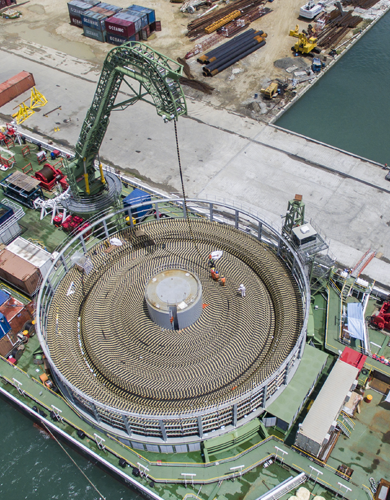
A cable-laying vessel loads high-voltage subsea cable needed to connect offshore wind to the grid.
© Prysmian
Prysmian: cables that carry the energy transition
Clean energy generation is expanding, but grids cannot keep pace. By mid-2024, around 1,650 GW of wind, solar, and hydropower in advanced development were still awaiting grid connection. When networks cannot absorb and transport clean output, projects sit idle, curtailment rises and fossil generation stays online longer than it should.
Sometimes the constraint shows up in stark local terms. In Scotland, wind farms were paid not to generate 37 per cent of their potential output in the first half of 2025 because the cables to move the power south did not exist.
We added Prysmian, maker of the high-voltage and subsea cables that address this pressure point, to the portfolio in 2025. Prysmian’s cables connect offshore wind to the shore, reinforce overloaded transmission corridors, and link electricity markets so clean power can flow to where it is needed.
AI adds urgency because data centres create dense new pockets of electricity demand that need to be connected quickly. Prysmian’s data centre order book already stands at over €700m, evidence that this is becoming a meaningful end-market. More broadly, the annual high-voltage cable awards market, worth roughly €3bn in 2019, is expected to reach six times that figure by the end of the decade.
CATL: storage that makes renewables dependable
Clean electricity is being wasted because power systems cannot absorb it when it arrives in a rush. In California’s main grid in 2024, 3.4 TWh of wind and solar output were curtailed – a 29 per cent jump on the year before, and enough power to support a large city for a year.
Without flexibility, renewables raise system costs and keep high-emissions peakers in place to fill the gaps. Storage is the missing piece. It absorbs surplus electricity when renewables are abundant and releases it when demand spikes. As renewable penetration rises, storage shifts from useful to essential.
We added CATL to the Positive Change portfolio in 2025, a company best known for its electric vehicle batteries. But the scale and systems capability that made it the world’s leading EV battery manufacturer translate directly into grid storage.
In 2024, CATL reported 475 GWh of total battery system sales and 676 GWh of manufacturing capacity – industrial throughput that can serve a fast-growing storage market on a meaningful scale.
By 2030, that market is expected to be far larger. Industry projections suggest annual energy storage shipments could approach 1,400 GWh, equivalent to roughly 23 million EV-sized (60 KWh) battery packs repurposed for the grid.
Data centres prize uninterrupted power and face tighter grid connections, making on-site buffering and backup increasingly practical. Some projections suggest data centre storage demand alone could exceed 300 GWh by 2030, equivalent to around 5 million EV-sized packs in a single year, creating a fast-emerging demand pool that plays directly to CATL’s ability to deliver at scale.
What the AI race needs, whoever wins it
Many of the companies building AI models and platforms are extraordinary businesses, but it is not clear-cut which will capture enduring value over the long term. It is entirely possible to be right about AI’s importance and wrong about who wins.
As investors, we are drawn to businesses that sit at identifiable bottlenecks where spending becomes essential.
The electricity system stands apart. It must be upgraded regardless: for electrification, for renewables integration, and now for AI.
Cables and storage, alongside other parts of the enabling layer, can offer a more winner-agnostic way to participate in the AI build-out while also contributing to a central impact challenge: a cleaner, more resilient and affordable energy system that supports societies.
To explore more of the areas we are investing in to deliver positive change, visit our Insights pages.
Risk factors
The views expressed should not be considered as advice or a recommendation to buy, sell or hold a particular investment. They reflect opinion and should not be taken as statements of fact nor should any reliance be placed on them when making investment decisions.
This communication was produced and approved in March 2026 and has not been updated subsequently. It represents views held at the time of writing and may not reflect current thinking.
This communication contains information on investments which does not constitute independent research. Accordingly, it is not subject to the protections afforded to independent research, but is classified as advertising under Art 68 of the Financial Services Act (‘FinSA’) and Baillie Gifford and its staff may have dealt in the investments concerned.
All information is sourced from Baillie Gifford & Co and is current unless otherwise stated.
The images used in this communication are for illustrative purposes only.
Important information
Baillie Gifford & Co and Baillie Gifford & Co Limited are authorised and regulated by the Financial Conduct Authority (FCA). Baillie Gifford & Co Limited is an Authorised Corporate Director of OEICs.
Baillie Gifford Overseas Limited provides investment management and advisory services to non-UK Professional/Institutional clients only. Baillie Gifford Overseas Limited is wholly owned by Baillie Gifford & Co. Baillie Gifford & Co and Baillie Gifford Overseas Limited are authorised and regulated by the FCA in the UK.
Persons resident or domiciled outside the UK should consult with their professional advisers as to whether they require any governmental or other consents in order to enable them to invest, and with their tax advisers for advice relevant to their own particular circumstances.
Financial Intermediaries
This communication is suitable for use of financial intermediaries. Financial intermediaries are solely responsible for any further distribution and Baillie Gifford takes no responsibility for the reliance on this document by any other person who did not receive this document directly from Baillie Gifford.
189803 10061435