

Key points
- The Baillie Gifford Emerging Markets ETF (BGEG) provides access to the companies building the next phase of global growth across AI infrastructure, electrification, digital finance and rising emerging market consumption
- It offers a genuinely active, research driven approach, built on more than 30 years of emerging markets investing experience
- Clients gain exposure to a diversified portfolio of 60–100 high conviction emerging market companies through the accessibility and flexibility of the ETF structure
Please carefully consider a Fund’s objectives, risks (including risk of loss), charges and expenses before investing. For these, see the prospectus and summary prospectus at bailliegifford.com/etfs. Please read these carefully before investing. Securities are offered through Baillie Gifford Funds Services LLC, an affiliate of Baillie Gifford Overseas Limited and a member of FINRA.
Why emerging markets?
Emerging markets are increasingly where the next phase of global growth is being built – The world’s AI infrastructure, electrification supply chains and critical materials production are disproportionately concentrated across emerging economies. Taiwan and South Korea produce the majority of the world’s advanced semiconductor and memory chips, while countries such as Chile, Indonesia and China sit at the center of the commodities required to power the modern economy.
The asset class has evolved meaningfully over the last two decades – Emerging markets today are more domestically driven, more regionally integrated and, in many cases, more economically resilient than investors often assume. Around half of emerging market trade now occurs between emerging economies themselves, reducing dependence on developed market demand and creating more diversified growth pathways.
Beneath the macro headlines sits a remarkably broad and underappreciated opportunity set – Emerging markets are home to many of the world’s fastest-growing and most innovative businesses across digital finance, ecommerce, logistics, robotics and consumer platforms. Companies such as Nubank, Meituan, Mobile World and Hyundai are building leadership positions in industries that continue to enjoy long growth runways and deep domestic demand.
Despite these improvements, emerging markets remain under-owned and undervalued relative to developed markets – Investor positioning remains cautious after a prolonged period of US exceptionalism, while valuation discounts versus developed markets remain close to historic extremes. Yet earnings growth expectations are improving and the breadth of high growth companies across emerging markets continues to expand. We believe that combination creates an attractive long-term starting point for investors.
Why the Baillie Gifford Emerging Markets ETF (BGEG)?
Baillie Gifford has been investing in emerging markets since 1994 – Over more than three decades, we have invested through financial crises, commodity cycles, geopolitical shocks and periods when investors repeatedly questioned the asset class. Our philosophy has remained consistent throughout: long-term emerging market equity returns are ultimately driven by hard currency earnings growth. The opportunity lies in identifying those businesses before the market fully appreciates them.
We believe emerging markets reward patience far more than prediction – While many investors focus on short-term macro narratives, our approach is grounded in a five-year investment horizon and a willingness to back exceptional businesses through periods of volatility. We focus on three areas where markets often misprice growth: duration, where competitive advantages endure longer than expected; pace, where adoption and scaling happen faster than anticipated; and surprise, where earnings potential improves materially versus consensus expectations.
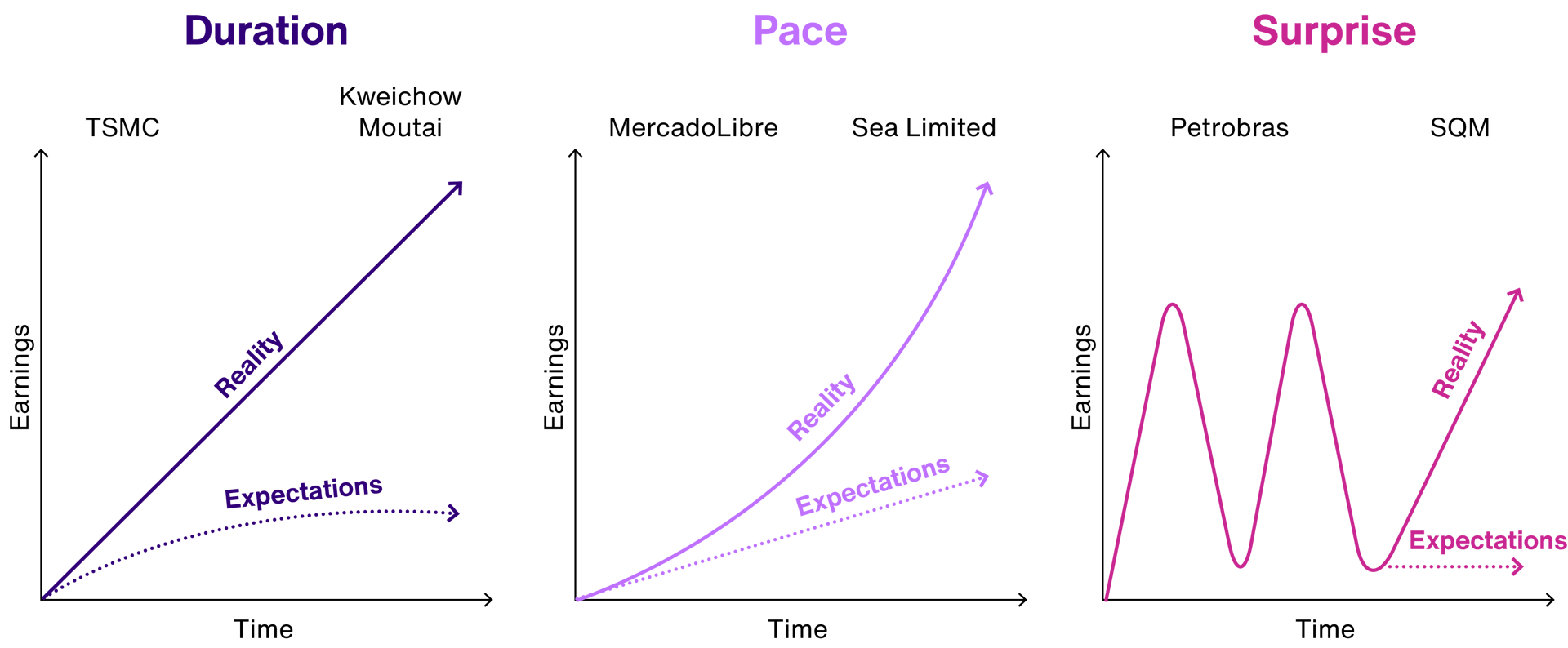
Research sits at the center of our process – Emerging markets remain under-covered and inefficient, with many companies followed by very few analysts and large parts of the universe lacking meaningful long-term research coverage. We therefore build conviction through extensive fundamental work: meeting companies repeatedly, traveling extensively and speaking with suppliers, customers, competitors, academics and industry experts to develop differentiated insight.
EM is under-covered and under-resourced
We are willing to look different – Some of our biggest successes have come from holding exceptional companies in meaningful size and for very long periods of time, whether TSMC, MercadoLibre or other businesses that initially appeared too controversial, too misunderstood or simply too early for wider market acceptance. Equally, we are willing to avoid fashionable areas where valuations or fundamentals do not justify enthusiasm. In an asset class defined by wide dispersion and inefficiency, we believe differentiated portfolios matter.
ETF accessibility and flexibility combined with an active research-driven approach – BGEG will typically hold 60–100 companies, reflecting our highest conviction ideas across a broad opportunity set, while we intend low turnover to reflect our willingness to hold exceptional businesses patiently over long periods of time.
Why Baillie Gifford?
Meet the Emerging Markets Team
Risk factors
The Funds are distributed by Baillie Gifford Funds Services LLC. Baillie Gifford Funds Services LLC is registered as a broker-dealer with the SEC, a member of FINRA and is an affiliate of Baillie Gifford Overseas Limited. All information is sourced from Baillie Gifford & Co unless otherwise stated.
As with all ETFs, the value of an investment in the Fund could decline, so you could lose money.
The most significant risks of an investment in the Baillie Gifford Emerging Markets ETF are: Investment Style Risk, Growth Stock Risk, Emerging Markets Risk, Market Disruption and Geopolitical Risk, Government and Regulatory Risk and Depositary Receipts Risk. The Fund is managed on a bottom-up basis and stock selection is likely to be the main driver of investment returns. Returns are unlikely to track the movements of the benchmark. The prices of growth stocks can be based largely on expectations of future earnings and can decline significantly in reaction to negative news. The Fund focuses on investments in emerging markets, meaning it may offer less diversification and be more volatile than other funds. Investing in emerging markets can involve additional market, credit, currency, liquidity, legal or political risks than investing in more developed markets. The value of investments could be adversely affected by events such as war, public health crises and changes in economic and political conditions in the US and elsewhere. This could prevent the Fund from implementing its investment strategies and increase exposure to other risks. Governmental and regulatory authorities in the US and elsewhere have intervened in markets and may do so again in the future. The effects of these actions can be uncertain and could restrict the Fund in implementing its investment strategies. Some non-US markets have had little regulation which could increase risk of loss due to fraud or market failures. Governmental and regulatory authorities may adopt or change laws that could adversely impact the Fund. The Fund may invest in depositary receipts, including ADRs, EDRs and GDRs. Investments in non-U.S. issuers have the same investment risks as other non-U.S. investments. If a depositary receipt is in a different currency than the underlying security then currency risks will apply to the depositary receipt and the underlying security. Holders of depositary receipts may also have limited or no rights to take action on the underlying security. Other Fund risks include: Asia Risk, China Risk, Conflicts of Interest Risk, Currency Risk, Equity Securities Risk, ESG Risk, ETF Structure Risk, Focused Investment Risk, Frontier Markets Risk, Geographic Focus Risk, Information Technology Risk, IPO Risk, Large-Capitalization Securities Risk, Liquidity Risk, Long-Term Investment Strategy Risk, Market Risk, New and Smaller-Sized ETF Risk, Non-U.S. Investment Risk, Periodic Rebalancing Risk, Risk Model Risk, Service Provider Risk, Settlement Risk, Small-and Medium-Capitalization Securities Risk, Underlying Funds Risk and Valuation Risk.
Investing in Exchange Traded Funds (ETFs) pose additional risks including that shares trade on an exchange and may trade at a price greater than the NAV (a premium) or less than the NAV (a discount).
Shares bought at a premium may have a greater risk of loss than those bought at a discount. Shares are bought and sold at market price (not NAV) and are not individually redeemable. Shares may only be redeemed directly from the Fund in Creation Units by Authorized Participants (APs). Where an ETF relies on a small number of APs, there is a risk if these APs exit the business or are unable to create or redeem shares. In this situation, Fund shares are more likely to trade at a premium or discount to NAV and could face trading halts.
Although shares are listed for trading on an exchange, there can be no assurance that an active trading market for the shares will develop or be maintained. Investors buying or selling shares in the secondary market may also incur bid-ask spreads, which represent the difference between the highest price a buyer is willing to pay and the lowest price a seller is willing to accept for shares and may widen during periods of market volatility or reduced liquidity.
Brokerage commissions may apply and will reduce returns. The market price of shares may fluctuate in response to changes in the value of the Fund’s holdings, supply and demand for shares and other market factors.
For more information about these and other risks of an investment in the Fund see “Additional information about principal strategies and risks” in the prospectus.
There can be no assurance that a Fund will achieve its objective.
This communication was produced and approved in May 2026 and has not been updated subsequently. It represents views held at the time of writing and may not reflect current thinking.
This communication contains information on investments which does not constitute independent research. Accordingly, it is not subject to the protections afforded to independent research and Baillie Gifford and its staff may have dealt in the investments concerned.
The images used in this communication are for illustrative purposes only.
Baillie Gifford holds the following stocks: TSMC, Kweichow Moutai, MercadoLibre, Sea Limited, Petrobras, SQM.
Baillie Gifford Emerging Markets ETF - Top 10 holdings
As of June 30, 2026
| Company | Portfolio weighting (%) |
| TSMC | 13.22 |
| Samsung Electronics | 10.63 |
| SK Hynix | 4.50 |
| Mediatek | 4.45 |
| Tencent | 4.22 |
| Accton Technology | 2.82 |
| Montage Technology Co | 2.64 |
| MercadoLibre | 2.53 |
| Alibaba Group | 2.19 |
| CATL | 2.04 |
197006 10063163