
Photography by Sebastian Nevols
Five out of 10 of Baillie Gifford’s biggest holdings were founded by an immigrant. These companies include AI accelerator chip designer NVIDIA (Jensen Huang), internet conglomerate Sea (Forrest Li) and online shopping platform Shopify (Tobi Lütke).
That connection deepens if you consider that Amazon founder Jeff Bezos’s stepfather, who raised him, was a Cuban refugee.
Just chance? Or is there something about the immigrant experience and mindset that contributes to exceptionalism?
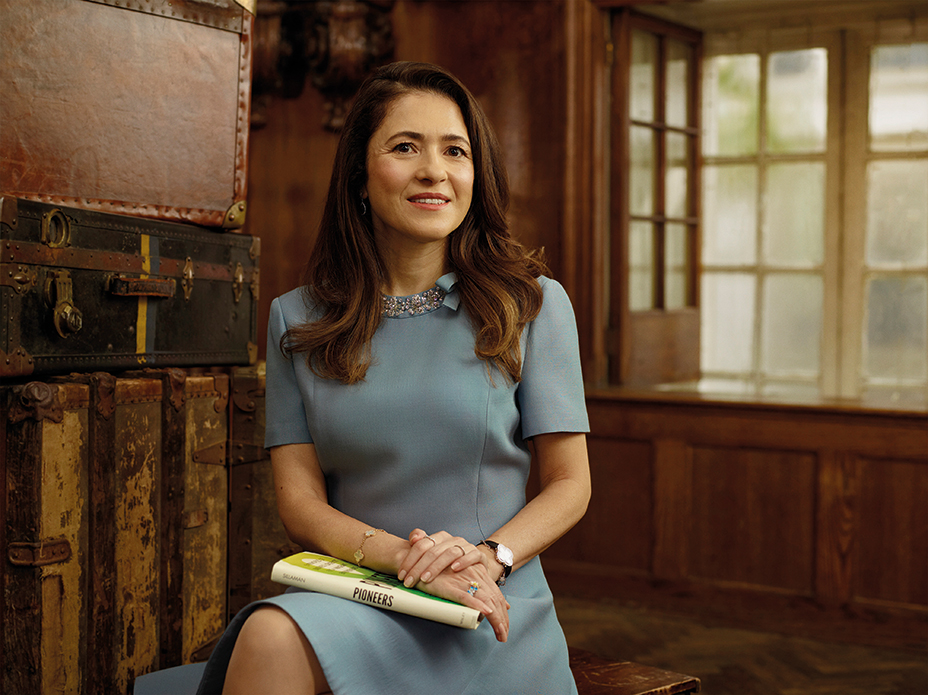
In her new book, Pioneers: 8 Principles of Business Longevity from Immigrant Entrepreneurs, Prof Neri Karra Sillaman makes the case that the disruption, adjustment and reframing involved in swapping countries often spur world-changing business ambition. She cites the statistic that, while immigrants and their children make up just over a quarter of the US population, they start nearly half of all Fortune 500 companies.
Prof Sillaman writes from experience. In 1989, when she was 11, Bulgaria’s then-communist government brutally expelled 360,000 ethnic Turks, her family included.
Forced into a refugee camp in Turkey, she felt “suddenly life as I knew it ended. We only had two suitcases to our names, no money, nothing.” She determined there and then to fight for a good education.
That “inner fire” inspired her to lead a successful upmarket leather goods business, Neri Karra, that now supplies Prada and Miu Miu. It later resulted in a Cambridge PhD and an academic career. Now she teaches entrepreneurship at Oxford and is an influential business coach and public speaker.
Inspired by that statistic, and her own background, Pioneers seeks to pin down the cross-cultural qualities that often lead non-native-founded firms to succeed for longer.
Jenny Davis: Tell me more about your journey towards writing Pioneers.
Neri Karra Sillaman: My own story is intertwined with the book. I wanted to explore themes around ethnic kinship and altruism that were at the heart of my business, and research “born global” companies that became international without first getting big in their home country. We never sold our products in Turkey.
From my early days in my father’s leather goods business in Istanbul, I’ve been aware of “homophilic” ties – the predisposition to trade with people of similar background and experience. This is very much part of international entrepreneurship. Immigrant entrepreneurs tend to thrive between multiple countries and cultures.
JD: Immigration is much in the news, and not always for good reasons. You’ve outlined positive lessons.
NKS: There is research on why immigrants are more likely to become entrepreneurs, but no one has connected it to durability. By reaching out to people who created businesses that changed the world, I came up with these eight principles that help explain this connection (see above).
Mainly, it’s about how immigrants have different ways of looking at problems. They are often able to make connections, noticing something that existed in their original country that doesn’t exist in the new one.
I’d also cite the way they can circumvent risk. In our case, just after communism ended, my father started doing business with Russia and the former Soviet republics. These were risky places to do business, and while we’d never been to Russia, Ukraine or Azerbaijan, because we’d grown up under communism, we knew how to manage the risk as entrepreneurs in the middle. We were buying products from suppliers in Italy, manufacturing in Turkey and selling to former Soviet republics.
JD: You spotted demand for high-craftsmanship brands that hadn’t been available under communism.
NKS: Exactly. When my father first went to Russia, he saw that many carried their belongings in plastic bags. His idea was that leather goods would sell if available. We had no distributors but opened a small shop in the Eminonu-Laleli district, near Istanbul’s Grand Bazaar, with a sign in Russian that said: “Come in for a homeland cup of coffee.”
In the beginning, we didn’t even ask distributors for money. We said: sell the products and bring the money when you can. There was nothing in writing. It was soon after the Berlin Wall came down. Even if there was a contract in place, you couldn’t enforce it.
Many people from Russia and other former communist countries traveled to Turkey to look for opportunities to make money because all the institutions had fallen down. [It illustrates] another important point that the immigrant entrepreneur is, in a strategic way, storytelling about the past, about shared values and connections. You don’t have to come from the same country or culture to find mutual ground.
JD: Even when there’s historical conflict between cultures?
NKS: Yes, including countries with Turkish and Greek communities: we are both immigrants, we understand each other. We did a lot of business with Greeks, with people from Yugoslavia. We’re all from the Balkans at the end of the day. We shared a wish to create a better life for our families.
JD: When you lost markets in Russia and Ukraine when the war started, were you able to use homophilic ties to pivot?
NKS: Absolutely. I see the act of migration as inseparable from innovation and resilience. Innovation is partly about reframing problems. Immigrants don’t view failure the same way as others do. We aren’t surprised by it. In some ways, we expect it.
Take the Nigerian-American founder Tope Awatoma, who started the hit diary app Calendly. He had several failed businesses before setting it up. He says they didn’t fail, they were just all leading up to Calendly. The immigrant entrepreneur treats failure as just a signal of what they need to change and how they need to adapt. They take it as a data point.
JD: Another example of the usefulness of understanding other cultures is WhatsApp.
NKS: Yes, co-founder Jan Koum is one of my favorite examples. How does one come up with a business idea? His case shows how people don’t leave their past behind. Koum was born in communist Ukraine and remembers this fear of being monitored, which is something we all remember. To this day, if I say anything close to political to my mom on WhatsApp, she will say, “Let’s not talk about this now.” When Koum immigrated to the US, he faced the high cost of calling home, which we also had to pay when we became immigrants. WhatsApp was invented because of his past and values.
JD: Culture and values are important, but what about the profit motive?
NKS: Absolutely. You can’t have business longevity without profit. But the drive has to be bigger than profit. It has to be about solving a problem and delivering something of value. The two are connected. The interviewees for this book were aware that their business exists because of the ecosystems they belong to. The healthier that is, the healthier their businesses.
It’s not “how can I make a profit?” but rather “how can we all do this together in a healthy way?”. If you don’t value your employees and have that sense of shared value – of giving back and nurturing that ecosystem – your business won’t last long.
JD: From my psychotherapy studies, I know the distinction between a “doer” mindset and a “done-to” mindset. You’re saying the former is characteristic of immigrants.
NKS: Exactly. And they spot opportunities. Entrepreneurship is challenge after challenge and lots of failures and rejections. But look at how well they adapt. In the book, I talk about “frying in your own oil,” how immigrants learn to work with what they’ve got. I’m a big believer in proving your concept first. Receiving investment early on can be detrimental to a business.
Constraints allow you to become more creative, see what your competitive advantage is and adapt to it. In my work with startups, I see that it’s founders who receive investment early on and keep relying on external investment that tend to fail.
Risk factors
The views expressed should not be considered as advice or a recommendation to buy, sell or hold a particular investment. They reflect opinion and should not be taken as statements of fact nor should any reliance be placed on them when making investment decisions.
This communication was produced and approved in April 2026 and has not been updated subsequently. It represents views held at the time of writing and may not reflect current thinking.
Potential for profit and loss
All investment strategies have the potential for profit and loss, your or your clients’ capital may be at risk. Past performance is not a guide to future returns.
This communication contains information on investments which does not constitute independent research. Accordingly, it is not subject to the protections afforded to independent research and Baillie Gifford and its staff may have dealt in the investments concerned.
All information is sourced from Baillie Gifford & Co and is current unless otherwise stated.
The images used in this communication are for illustrative purposes only.
Important Information
Baillie Gifford Overseas Limited provides investment management and advisory services to non-UK Professional/Institutional clients only. Baillie Gifford Overseas Limited is wholly owned by Baillie Gifford & Co. Baillie Gifford & Co and Baillie Gifford Overseas Limited are authorised and regulated by the FCA in the UK.
Persons resident or domiciled outside the UK should consult with their professional advisers as to whether they require any governmental or other consents in order to enable them to invest, and with their tax advisers for advice relevant to their own particular circumstances. Baillie Gifford Overseas Limited is registered with the SEC in the United States of America.
Baillie Gifford International LLC is wholly owned by Baillie Gifford Overseas Limited; it was formed in Delaware in 2005 and is registered with the SEC. It is the legal entity through which Baillie Gifford Overseas Limited provides client service and marketing functions in North America. Baillie Gifford Overseas Limited is registered with the SEC in the United States of America.
191312 10061839