

Overview
Lessons in disruption, adaptability and the conviction required to invest in outliers.
©Arpan - stock.adobe.com
Investors should carefully consider the objectives, risks, charges and expenses of the Fund before investing. This information and other information about the Fund can be found in the prospectus and summary prospectus. For a prospectus and summary prospectus, please visit our website at bailliegifford.com/usmutualfunds. Please carefully read the Fund's prospectus and related documents before investing. Securities are offered through Baillie Gifford Funds Services LLC, an affiliate of Baillie Gifford Overseas Ltd and a member of FINRA.
“Looking out to 2025, I find it very plausible that Netflix has a multiple of its current subscriber base paying considerably more for its device and platform agnostic content…
I think we should embrace the current flux in the industry and short-term anxiety in the share price and own a company which has a good chance of being one of the long-term winners in the emerging media world.”
So concluded our 2015 10 Question Research Framework on Netflix: four years after first researching the company and roughly 400 per cent appreciation of the shares. We were humbled by our initial miss, but embraced the uncertainty and potential for considerable future returns.
At the time of writing, after 10 years of ownership, Netflix has delivered a holding period return of 20x for our clients and, more importantly, has taught us enduring lessons in disruption, adaptability and the conviction required to invest in outliers.
Lesson 1: ask ‘what if?’
Today, it is hard to imagine a world without Netflix. The distinctive red ‘N’ and the unmistakable “ta-DUM” are a cultural shorthand for streaming. With over 300 million subscribers and presence in over 190 countries, the once mail-order DVD service has grown into one of the world’s most powerful entertainment brands.
Its disruptive potential was not always this obvious. In the late 90s, when Reed Hastings and Marc Randolph launched Netflix, the large cable networks determined what you watched and when. To indulge in a favourite or new movie, most households undertook the Friday-night pilgrimage to their local Blockbuster to rent a DVD or VHS.
The concept of providing a web-based rental service that would deliver DVDs by mail seemed utterly implausible, and how on earth was a flat fee subscription for unlimited consumption going to be lucrative?
It couldn’t have been further from the pay-per-rental and late fee model that the incumbents’ success had relied upon. So far-fetched was the proposition that, ironically, Blockbuster rejected an approach to acquire Netflix in 2000 when the company was valued at a mere $50m.
We, too, had our doubts. By the time we first met Hastings in 2011, the all-you-can-eat DVD plan had turned the physical industry on its head and led to the demise of the two largest players: Blockbuster and Movie Gallery.
Netflix had amassed 25 million subscribers and launched its streaming services. But as the minutes from our stock discussion reveal, we found ourselves disappointingly close to consensus thinking:
“The most tangible concerns centred on the lack of perceived competitive advantage in a streaming world, potential for content cost inflation and the challenges of expanding internationally.
All agreed that future consumption of television and movies would likely look very different and that, intuitively, such a change should throw up some investment opportunities. We should retain an open mind as to whether these changes provided a partial renaissance for the content providers.”
As we often warn, negativity comes easily and can cloud our thinking.
By 2015, subscribers had doubled, including that meaningful international base we once worried about. Netflix had also made bold leaps into the production of original content with shows like House of Cards and Orange Is the New Black.
Again, we paused for thought. Would original content make the company more hit-driven like the cable networks? Would the cost of production ruin margins? Fortunately, this time, these questions did not stop us from taking a holding on behalf of our clients.
We may have missed out on some of the growth between 2011 and 2015, but we had gained further evidence of Netflix’s willingness and ability to challenge orthodoxy. Their odds of success appeared stronger, and the scale of change we faced became clearer.
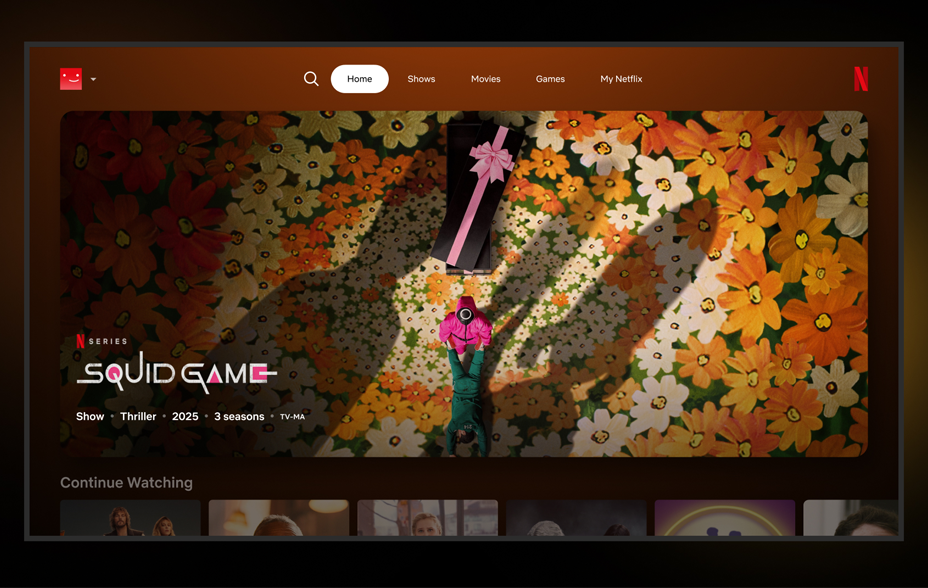
Image courtesy of Netflix
Netflix’s global flywheel now feels almost unparalleled. It can take a Spanish series like Money Heist and make it a global phenomenon. It can launch Squid Game at a modest cost and find it watched by more people than the Super Bowl. Few companies have ever managed to industrialise creativity at this scale.
Still, what makes Netflix extraordinary is not just what it is today, but what it could become. Members collectively watch billions of hours of Netflix content, averaging two hours a day per subscriber — more than double that of Disney or Hulu. Netflix did, after all, popularise ‘binge-watching.’
Yet the amount Netflix earns per hour of viewing is materially lower than nearly all its peers. The company no longer reports its subscriber growth, and perhaps they are right in thinking this is an unhelpful distraction.
The untapped monetisation potential suggests that even if subscriber growth were to eventually saturate, Netflix could comfortably increase its US advertising revenues five- to ten-fold and potentially double company revenues in five years.
As advertising becomes a larger portion of the overall business, we expect margins to widen. Even if Netflix’s shares trade on a lower valuation multiple — for example, a reduced price/earnings ratio — we still see scope for the company to be worth two to three times its current value.
Lesson 2: cultures determine success
While our imagination has sometimes struggled with questions concerning Netflix’s competitive advantage and global expansion, one constant in our analysis has been a deep and growing admiration for the company’s culture.
Netflix was built for flexibility. The founders cultivated a culture of freedom and responsibility, and their culture memo became legendary in Silicon Valley. There were no expense policies or formal holiday allowances, and employees were encouraged to treat company resources as they would their own.
The much-discussed ‘keeper test’ — managers ask themselves whether they would fight to keep each employee — underlined the focus on talent and accountability. Generous severance packages reduced the stigma of departures, reinforcing a culture where performance mattered, but so did trust.
Importantly, this culture paved the way to experimentation. Hundreds of tests are run each year, from subtle tweaks to user interfaces to radical changes in recommendation algorithms. In 2016, Netflix carried out its ‘global switch-on’, launching the service in over 130 new countries simultaneously (!), a feat made possible by a culture of decentralised experimentation and a refusal to be bound by incumbents' legacy constraints.
As with most of the portfolio's best-performing holdings, Netflix’s success is underpinned by constant reinvention. They have moved from DVDs to streaming, from licensing to original production, from pure subscription to advertising and games. Each transition was risky, each met with scepticism, and yet each has proved transformational. Culture did not guarantee success, but it created the conditions for adaptability.
Lesson 3: patience unlocks outliers
Unsurprisingly, Netflix has not been immune to the volatility that accompanies outliers. There have been many instances where doubts have dominated, and the share price has suffered. 2022 was a standout, with shares plummeting 75 per cent on just two quarters of weak subscriber growth and a more challenging macroeconomic backdrop.
Our process forced us to step back and assess whether our long-term contentions were weakening. The excerpt below is from our 2022 10 Question Framework:
“With many markets relatively underpenetrated and pay-TV still comprising a large portion of consumer spend and viewership time, we may still be early in the thesis of streaming completely supplanting linear television…
Many sell-side reports note the uncertainty that the expansion into new verticals adds to the investment case. With these experimental arms gathering pace, it is harder to predict what Netflix will look like in 10 years than at any point in its recent history – our ability to entertain this uncertainty over the long-term and see how these businesses evolve will likely differentiate us from the market if we remain holders.”
We did well to hold on. As of August 2025, shares are up nearly 700 per cent from their trough. A successful crackdown on password sharing, while introducing price hikes and an advertising tier, proved Netflix’s pricing power.
The value of Netflix’s platform is also increasingly undeniable. Its latest hit, KPop Demon Hunters is breaking records as the most watched animated film ever, with 236 million views, chart-topping music, TikTok challenges, fan costumes and even Oscars buzz. Netflix is no longer a subscriber numbers story; it's about activating intellectual property, tapping into fandom and driving commerce.
Over time, Netflix has begun to reap the rewards of scale. Remember when it struggled to pay its bills? These days, the company generates enough money to continue investing in content, reduce debt, and still have ample cash to return to shareholders. In 2024 alone, it spent over $6bn buying back its own shares. This represents momentous progress in our investment case and is an essential competitive advantage over most other streamers today.
The outlier mindset
Earlier this year, we revisited our investment thesis, and the stock discussion opened with the following remarks:
“Netflix is a reminder of our need to exercise humility in our ability to estimate outlier potential for our holdings.”
Even for a team trained for optimism, sometimes our blue-sky upside scenarios pale in comparison to the sheer magnitude of returns created by some outlier companies. To capture and hold such outliers for the benefit of our clients, we must therefore continue to open our minds, stretch our imaginations and think big.
The Baillie Gifford Long Term Global Growth Fund
(Share Class K) as of June 30, 2025
| Gross Expense Ratio | 0.70% |
| Net Expense Ratio | 0.70% |
Annualised total return as of June 30, 2025 (%)
| 1 year | 3 years | 5 years | 10 years | |
|
The Baillie Gifford Long Term Global Growth Fund |
26.08 | 23.50 | 9.27 | 15.94 |
|
MSCI ACWI Index |
16.69 | 17.89 | 14.17 | 10.54 |
Source: Bank of New York Mellon and relevant underlying index provider(s). Net of fees, US dollars.
The performance data quoted represents past performance and is no guarantee of future results. Investment return and principal value of an investment will fluctuate so that an investor’s shares, when redeemed, may be worth more or less than their original cost. Current performance may be lower or higher than the performance data quoted. For the most recent month-end performance please visit our website at www.bailliegifford.com/funds/baillie-gifford-long-term-global-growth-fund/.
Returns are based on the K share class from 28 April 2017. Prior to that date returns are calculated based on the oldest share class of the Fund adjusted to reflect the K share class fees where these fees are higher.
The Baillie Gifford fund’s performance shown assumes the reinvestment of dividend and capital gain distributions and is net of management fees and expenses. Returns for periods less than one year are not annualised. From time to time, certain fees and/or expenses have been voluntarily or contractually waived or reimbursed, which has resulted in higher returns. Without these waivers or reimbursements, the returns would have been lower. Voluntary waivers or reimbursements may be applied or discontinued at any time without notice. Only the Board of Trustees may modify or terminate contractual fee waivers or expense reimbursements. Fees and expenses apply to a continued investment in the funds. All fees are described in each fund’s current prospectus.
Expense Ratios: All mutual funds have expense ratios which represent what shareholders pay for operating expenses and management fees. Expense ratios are expressed as an annualized percentage of a fund’s average net assets paid out in expenses. Expense ratio information is as of the fund’s current prospectus, as revised and supplemented from time to time.
The MSCI All Country World Index is a free float-adjusted market capitalization weighted index that is designed to measure equity market performance in the global developed and emerging markets, excluding the United States. This unmanaged index does not reflect fees and expenses and is not available for direct investment.
Legal Notices
Source: MSCI. MSCI makes no express or implied warranties or representations and shall have no liability whatsoever with respect to any MSCI data contained herein. The MSCI data may not be further redistributed or used as a basis for other indexes or any securities or financial products. This report is not approved, endorsed, reviewed or produced by MSCI. None of the MSCI data is intended to constitute investment advice or a recommendation to make (or refrain from making) any kind of investment decision and may not be relied on as such.
Risk Factors
This content contains information on investments which does not constitute independent research. Accordingly, it is not subject to the protections afforded to independent research and Baillie Gifford and its staff may have dealt in the investments concerned.
As with all mutual funds, the value of an investment in the fund could decline, so you could lose money.
The most significant risks of an investment in the Baillie Gifford Long Term Global Growth Fund are: Investment Style Risk, Growth Stock Risk, Long-Term Investment Strategy Risk, Non-Diversification Risk and Non-U.S. Investment Risk. The Fund is managed on a bottom up basis and stock selection is likely to be the main driver of investment returns. Returns are unlikely to track the movements of the benchmark. The prices of growth stocks can be based largely on expectations of future earnings and can decline significantly in reaction to negative news. The Fund is managed on a long-term outlook, meaning that the Fund managers look for investments that they think will make returns over a number of years, rather than over shorter time periods. The Fund may have a smaller number of holdings with larger positions in each relative to other mutual funds. Non-U.S. securities are subject to additional risks, including less liquidity, increased volatility, less transparency, withholding or other taxes and increased vulnerability to adverse changes in local and global economic conditions. There can be less regulation and possible fluctuation in value due to adverse political conditions. Other Fund risks include: Asia Risk, China Risk, Conflicts of Interest Risk, Currency Risk, Developed Markets Risk, Emerging Markets Risk, Equity Securities Risk, Environmental, Social and Governance Risk, Focused Investment Risk, Government and Regulatory Risk, Information Technology Risk, Initial Public Offering Risk, Large-Capitalization Securities Risk, Liquidity Risk, Market Disruption and Geopolitical Risk, Market Risk, Service Provider Risk, Settlement Risk, Small-and Medium-Capitalization Securities Risk, and Valuation Risk.
For more information about these and other risks of an investment in the fund, see “Principal Investment Risks” and “Additional Investment Strategies” in the prospectus. The Baillie Gifford Long Term Global Growth Fund seeks to provide long-term capital appreciation. There can be no assurance, however, that the fund will achieve its investment objective.
The fund is distributed by Baillie Gifford Funds Services LLC. Baillie Gifford Funds Services LLC is registered as a broker-dealer with the SEC, a member of FINRA and is an affiliate of Baillie Gifford Overseas Limited.
All information is sourced from Baillie Gifford & Co and is current unless otherwise stated.
The images used in this article are for illustrative purposes only.
Top Ten Holdings
|
Holdings |
Fund % |
|
1. Amazon |
6.10 |
|
2. Netflix |
5.32 |
|
3. NVIDIA |
5.25 |
|
4. Cloudflare |
4.84 |
|
5. Spotify |
4.67 |
|
6. Sea Limited |
3.88 |
|
7. Coupang |
3.61 |
|
8. MercadoLibre |
3.45 |
|
9. Tencent |
3.29 |
|
10. Adyen |
3.22 |
As at June 30, 2025
It should not be assumed that recommendations/transactions made in the future will be profitable or will equal performance of the securities mentioned. A full list of holdings is available on request. The composition of the fund's holdings is subject to change. Percentages are based on securities at market value.
172604 10057616