
Listen to this article
This audio is generated using AI
Investors should consider the investment objectives, risks, charges and expenses carefully before investing. This information and other information about the Funds can be found in the prospectus and summary prospectus. For a prospectus and summary prospectus, please visit our website at bailliegifford.com/usmutualfunds Please carefully read the Fund's prospectus and related documents before investing. Securities are offered through Baillie Gifford Funds Services LLC, an affiliate of Baillie Gifford Overseas Ltd and a member of FINRA.
The phrase stablecoin summer has gone from a group chat meme to market reality almost overnight. Digital assets are in vogue again, but this time, the buzz isn’t about casino-like experimentation. It’s about a simple, boring promise: instant, borderless cash that settles like email.
The recent passage of the GENIUS Act (Guiding and Establishing National Innovation for US Stablecoins) by the US Senate brings stablecoins into the mainstream and marks the start of digital asset regulation. This opens new opportunities in the growth investing landscape.
Over the last few years, our conversations with thought leaders and companies in this space have helped us understand the potential future implications of stablecoins, introduced in this note.
But first, what exactly are stablecoins, and why should investors pay attention?
Stablecoins 101
Stablecoins are simply 1-for-1 pegged digital versions of a reference asset, typically the US dollar, on blockchain infrastructure. They leverage this technology to improve the movement of money without the wild price swings of the broader asset class. As Circle CEO Jeremy Allaire puts it, the vision is "to express money in a digital currency form... store it and move it instantly at no cost."

The US Senate has passed the GENIUS Act, a bill aimed at regulating certain cryptocurrencies.
The GENIUS Act: a game-changer?
The GENIUS Act, along with its companion FIT21 Act (Financial Innovation and Technology for the 21st Century Act), are bipartisan bills that aim to provide regulatory clarity and professionalise the space, enabling it to scale. As Allaire said in our recent meeting, it has the potential to "enshrine our operating model and unlock our tech in the traditional financial system.”
The Act brings simplicity and guardrails, lowering the adoption hurdle for banks, corporations and users worldwide. Hence, we see potential for stablecoins to become an inevitable part of the global payments system. This could be a watershed moment for exciting companies aiming to achieve the scale that the technology promises.
Short-term implications: payment rails, upgraded
In the immediate future, we are likely to see increased institutional interest in stablecoins across both back-office and consumer-facing processes, leveraging the improved speed, cost, and disintermediation of payments.
Digitising the same reference asset lowers the hurdles to transformational change. Companies can then integrate it and transform their existing finance systems without having to completely overhaul their existing business models. A consumer-facing example already announced is Shopify’s use of Circle’s USDC as a native payment method inside Shopify Payments, built with Coinbase’s “Base” network and Stripe as the settlement partner.

Medium-term: reshaping cross-border payments
Looking ahead, stablecoins could revolutionise cross-border payments. Coinbase's CEO Brian Armstrong told us that "if Scale AI is paying out contractors all over the world, they don't have a way to get money to all of them with traditional rails. So, they are using stablecoins to automate the payouts to long-tail contractors all over the world". This single use case could represent a multi-trillion-dollar opportunity and helps to continue the US dollar’s dominance in global payments. As US Secretary Scott Bessent has said, “Stablecoin legislation backed by US Treasuries or T-bills will create a market that will expand US dollar usage via these stablecoins all around the world.”
Long-term vision: programmable money
Stablecoins point to the next leap: programmable money – cash that carries its own code. Jeremy Allaire argues this could unlock “a completely new phase of money’s utility.” Picture dollars that auto-route: rent on the 1st, payroll every Friday, micro-fees by the second, all without banking rails. The efficiency gains could be massive, and the associated increase in the velocity of money could bring significant benefits to the economy through increased inclusion and innovation.

Key players in the stablecoin race
Several US companies are centrally positioned within the ecosystem:
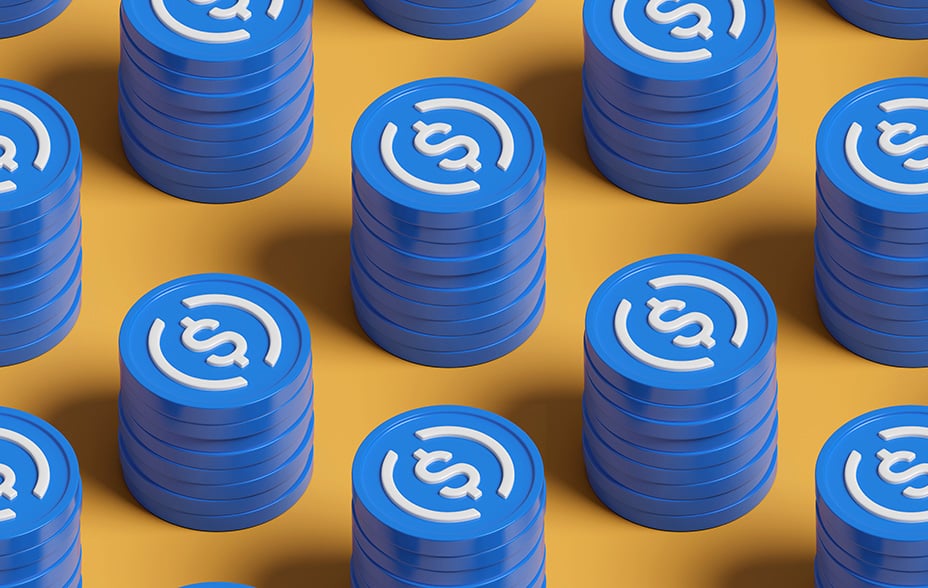
- Circle: The issuer of USDC, the second-largest US dollar stablecoin by market cap, is at the forefront of the stablecoin revolution. With partnerships including Visa, Stripe, and Coinbase, Circle is building a robust ecosystem around its stablecoin. Some of our portfolios recently participated in the Circle IPO.
- Coinbase: As a key partner and distributor of USDC, Coinbase is well-positioned to benefit from stablecoin adoption through trading and infrastructure. The company sees USDC as "special" and believes "there will be a winner-takes-most" in the stablecoin market.
- Stripe: The private fintech giant has integrated USDC for global payouts, starting with Twitter creator earnings and expanding to broader disbursements. This forward-looking management team has already made strategic acquisitions to position itself for this long-term trend.
Furthermore, we’re noticing a trend of top talent from market-leading companies in this space moving into large incumbent financial institutions. This signals a growing change in appetite for these firms to adopt this technology. We are asking how this could rejuvenate margins and embed these legacy businesses’ moats in the future?
Potential risks and challenges
The road is not risk-free. Rulebooks outside the US remain fluid; a patchwork of regimes could splinter liquidity. Incumbent banks and card networks are engineering their own deposit tokens and rails to defend interchange, FX and custody fees. Trust, transparency and operational resilience will be battle-tested, and some legacy payment rails might need costly upgrades before they can talk to token standards. Yet, those challenges resemble the frictions the internet faced in the 1990s – a time when lack of standards and patchy connectivity did little to halt its eventual ubiquity.
A new frontier for money (and growth investors)
The summer of 2025 may be remembered for geopolitical events, but if history rhymes, the “boring” promise of email-speed cash may prove anything but dull for growth investors: a starting point for a secular rewiring of the global financial stack, one line of programmable code at a time.
For a firm that thrives on inflection points and is willing to be early, there’s an exciting opportunity set. It’s driven by companies that share the same characteristics – scalability, network dominance, mission-driven founders – that have powered some of Baillie Gifford’s outsized winners in the past.
We are asking the question: Is stablecoin summer less a passing season – and more the beginning of a decades-long growth wave?
Risk factors
The Funds are distributed by Baillie Gifford Funds Services LLC. Baillie Gifford Funds Services LLC is registered as a broker-dealer with the SEC, a member of FINRA and is an affiliate of Baillie Gifford Overseas Limited. All information is sourced from Baillie Gifford & Co unless otherwise stated.
As with all mutual funds, the value of an investment in the Fund could decline, so you could lose money. International investing involves special risks, which include changes in currency rates, foreign taxation and differences in auditing standards and securities regulations, political uncertainty and greater volatility. These risks are even greater when investing in emerging markets. Security prices in emerging markets can be significantly more volatile than in the more developed nations of the world, reflecting the greater uncertainties of investing in less established markets and economies. Currency risk includes the risk that the foreign currencies in which a Fund’s investments are traded, in which a Fund receives income, or in which a Fund has taken a position, will decline in value relative to the U.S. dollar. Hedging against a decline in the value of currency does not eliminate fluctuations in the prices of portfolio securities or prevent losses if the prices of such securities decline. In addition, hedging a foreign currency can have a negative effect on performance if the U.S. dollar declines in value relative to that currency, or if the currency hedging is otherwise ineffective.
For more information about these and other risks of an investment in the Funds, see "Principal Investment Risks" and "Additional Investment Strategies" in the prospectus. There can be no assurance that the Funds will achieve their investment objectives.
This communication was produced and approved in July 2025 and has not been updated subsequently. It represents views held at the time of writing and may not reflect current thinking.
This communication contains information on investments which does not constitute independent research. Accordingly, it is not subject to the protections afforded to independent research and Baillie Gifford and its staff may have dealt in the investments concerned.
As at July 2025, Baillie Gifford held Circle, Shopify and Stripe. A full list of holdings is available on request and is subject to change.
162715 10056497