


Investors should consider the investment objectives, risks, charges and expenses carefully before investing. This information and other information about the Funds can be found in the prospectus and summary prospectus. For a prospectus and summary prospectus, please visit our website at bailliegifford.com/usmutualfunds Please carefully read the Fund's prospectus and related documents before investing. Securities are offered through Baillie Gifford Funds Services LLC, an affiliate of Baillie Gifford Overseas Ltd and a member of FINRA.
Healthcare is an industry of radical uncertainty: a place where the most important outcomes cannot be neatly forecast. Most experiments fail. Timelines stretch. Promising ideas disappear. Then, occasionally, a breakthrough changes what seemed impossible.
The pursuit of upside means dealing with uncertainty. In healthcare, this is especially true. When the range of outcomes is wide, markets struggle to price what success could look like. Our edge is not in predicting every result, but in backing the few platforms where learning compounds and the upside could be dramatic.
Three of our healthcare holdings bring that idea into focus. In each case, the investment case rests less on a single product than on whether the platform becomes more useful with every experiment.
Guardant Health: detecting disease earlier
Healthcare, historically, has been reactive. Symptoms appear, a diagnosis follows, then treatment. But better diagnostics are changing that model. Earlier detection paired with greater precision is improving treatment, and the gap between diagnosis and prevention is shrinking.
Guardant Health sits at the centre of this change. It started with a simple proposition: reading a tumour's genetic signals from a blood sample and offering an alternative to a tissue biopsy.
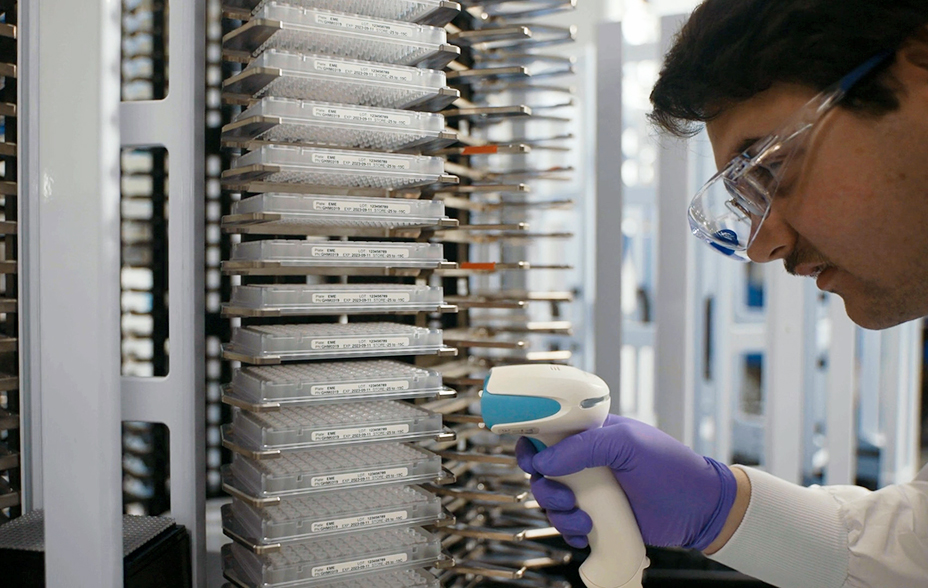
© Guardant Health
Since then, the company has broadened its footprint across therapy selection, recurrence monitoring and cancer screening, expanding the opportunity set with each step.
Its Shield cancer screening product has seen volumes rise from roughly 9,000 tests to 44,000 last year, and management’s ambition now extends beyond colorectal cancer towards multi-cancer screening. The platform could detect signals linked to diseases beyond cancer, expanding its uses.
That said, screening is a different commercial challenge from therapy selection. It requires integration into primary care workflows, payer support at scale and real-world evidence that earlier detection changes outcomes rather than simply triggering more follow-up tests.
Nevertheless, what makes Guardant interesting is that the opportunity continues to evolve. The key question is no longer simply whether a blood test can help guide cancer care. It is how many diseases this kind of information platform could eventually help detect.
Alnylam: making drug discovery more repeatable
Platforms often matter more than products. The biggest outcomes tend to come from capabilities that can be applied repeatedly, raising the likelihood of success. We think Alnylam is building that kind of biological capability.
We have owned the company for more than a decade because of its work in RNA interference (RNAi). The concept is elegant. Rather than treating the downstream symptoms of disease, RNAi aims to silence the genetic instructions that produce harmful proteins in the first place.
When we first invested, the promise was unproven. Today it is more tangible: multiple approved medicines, quarterly revenues exceeding $1bn and a growing presence in cardiovascular disease.
For example, AMVUTTRA began as a treatment for a rare condition in which a harmful protein builds up in the body, damaging nerves and the heart. It is now expanding into a broader cardiovascular market, demonstrating how Alnylam’s platform could move from specialist uses into larger areas of medicine.
However, we believe the platform’s real superpower lies in its modular, repeatable approach, which has proven successful at a rate well above industry benchmarks.
The company is not eliminating uncertainty from drug development, but it may be improving the odds. That is what makes Alnylam interesting: each success may make the next programme a little less uncertain.
Moderna: proving mRNA beyond Covid
Moderna’s pandemic success validated messenger RNA (mRNA) as a medical technology. But it also created a problem: investors came to see the company mainly as a Covid vaccine business.
For us, the more important question concerns the capabilities being built beneath the surface.
Despite recent challenges, Moderna has assembled one of the broadest pipelines in biotechnology, spanning infectious disease, oncology and rare disease. While the respiratory franchise has dominated attention, the company’s ambition has steadily broadened.
One of its most attractive prospects is the personalised cancer programme, Intismeran. Unlike traditional medicines, each patient receives a therapy designed specifically for their tumour. The value lies not in a molecule, but in a process: sequencing a patient’s cancer, selecting the most relevant neoantigens and manufacturing a bespoke treatment.
Each treated patient generates more data, helping Moderna improve selection and execution for the next. It becomes a learning process that can get better over time. Moderna is trying to scale this competitive advantage, its proprietary data and learning loop, into a durable platform. The market may still be underestimating what that platform could become.
Investing in possibility
Most biological experiments fail. But a small number of platforms learn as they go. Each test, patient and programme builds on the last, making the next step more informed and the opportunity larger over time. Those are the businesses that can reshape healthcare.
The challenge is identifying them while the evidence is still incomplete. Biology does not lend itself to precise prediction, so we look for companies where progress compounds: where each experiment improves the odds of the next, and where the eventual payoff could be far greater than the market expects.
Risk factors
This content contains information on investments which does not constitute independent research. Accordingly, it is not subject to the protections afforded to independent research and Baillie Gifford and its staff may have dealt in the investments concerned.
As with all mutual funds, the value of an investment in the fund could decline, so you could lose money.
The most significant risks of an investment in the Baillie Gifford US Equity Growth Fund are Investment Style Risk, Growth Stock Risk, Long-Term Investment Strategy Risk, Geographic Focus Risk and Non-Diversification Risk. The Fund is managed on a bottom up basis and stock selection is likely to be the main driver of investment returns. Returns are unlikely to track the movements of the benchmark. The prices of growth stocks can be based largely on expectations of future earnings and can decline significantly in reaction to negative news. The Fund is managed on a long-term outlook, meaning that the Fund managers look for investments that they think will make returns over a number of years, rather than over shorter time periods. The Fund focuses on investments in the US, meaning it may offer less diversification and be more volatile than other funds. The Fund may have a smaller number of holdings with larger positions in each relative to other mutual funds. Other Fund risks include: Conflicts of Interest Risk, Developed Markets Risk, Equity Securities Risk, Environmental, Social and Governance Risk, Focused Investment Risk, Government and Regulatory Risk, Information Technology Risk, Initial Public Offering Risk, Large-Capitalization Securities Risk, Liquidity Risk, Market Disruption and Geopolitical Risk, Market Risk, New and Smaller-Sized Funds Risk, Service Provider Risk, Small-and Medium-Capitalization Securities Risk and Valuation Risk.
For more information about these and other risks of an investment in the fund, see “Additional Information about Principal Strategies and Risks” in the prospectus. The Baillie Gifford U.S. Equity Growth Fund seeks capital appreciation. There can be no assurance, however, that the fund will achieve its investment objective.
The fund is distributed by Baillie Gifford Funds Services LLC. Baillie Gifford Funds Services LLC is registered as a broker-dealer with the SEC, a member of FINRA and is an affiliate of Baillie Gifford Overseas Limited.
All information is sourced from Baillie Gifford & Co and is current unless otherwise stated.
The images used in this article are for illustrative purposes only.
Baillie Gifford U.S. Equity Growth Fund's top ten holdings as of March 31, 2026
| Holdings | Fund % |
| Amazon.com | 8.21 |
| NVIDIA | 7.56 |
| Meta Platforms | 6.83 |
| Netflix | 5.84 |
| Cloudflare | 5.80 |
| Shopify | 4.77 |
| DoorDash | 4.15 |
| Guardant Health | 3.03 |
| Tesla Inc | 2.95 |
| The Ensign Group, Inc. | 2.81 |
It should not be assumed that recommendations/transactions made in the future will be profitable or will equal performance of the securities mentioned. A full list of holdings is available on request. The composition of the fund's holdings is subject to change. Percentages are based on securities at market value.
201718 10064314