
Key points
- SpaceX turned rocket reuse from impossible to routine, lowering launch costs and opening new markets
- Starlink shows how cheaper space access can create entirely new global business models
- Conventional valuation models struggle with SpaceX because its largest opportunities may not yet exist
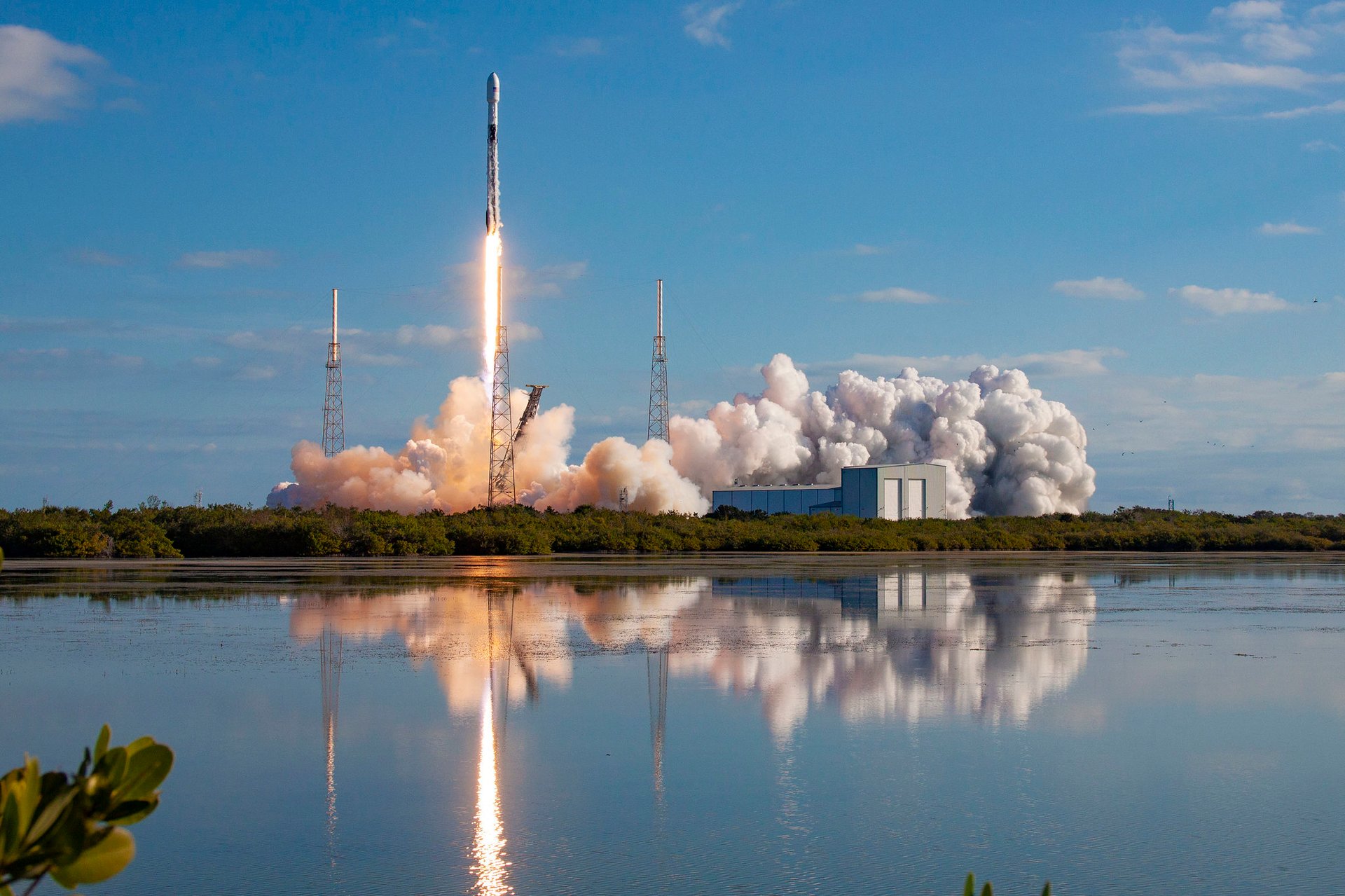
Image courtesy of SpaceX.
Please carefully consider a Fund’s objectives, risks (including risk of loss), charges and expenses before investing. For these, see the prospectus and summary prospectus at bailliegifford.com/etfs. Please read these carefully before investing. Securities are offered through Baillie Gifford Funds Services LLC, an affiliate of Baillie Gifford Overseas Limited and a member of FINRA.
Imagine standing on a sidewalk in Manhattan, in the shadow of the Empire State Building. You reach into your pocket, pull out a pencil, and throw it cleanly over the top of the tower – landing it perfectly in a shoebox on the other side.
That, according to SpaceX, is roughly the level of difficulty involved in launching a rocket into orbit and bringing it safely back to Earth, ready for reuse.
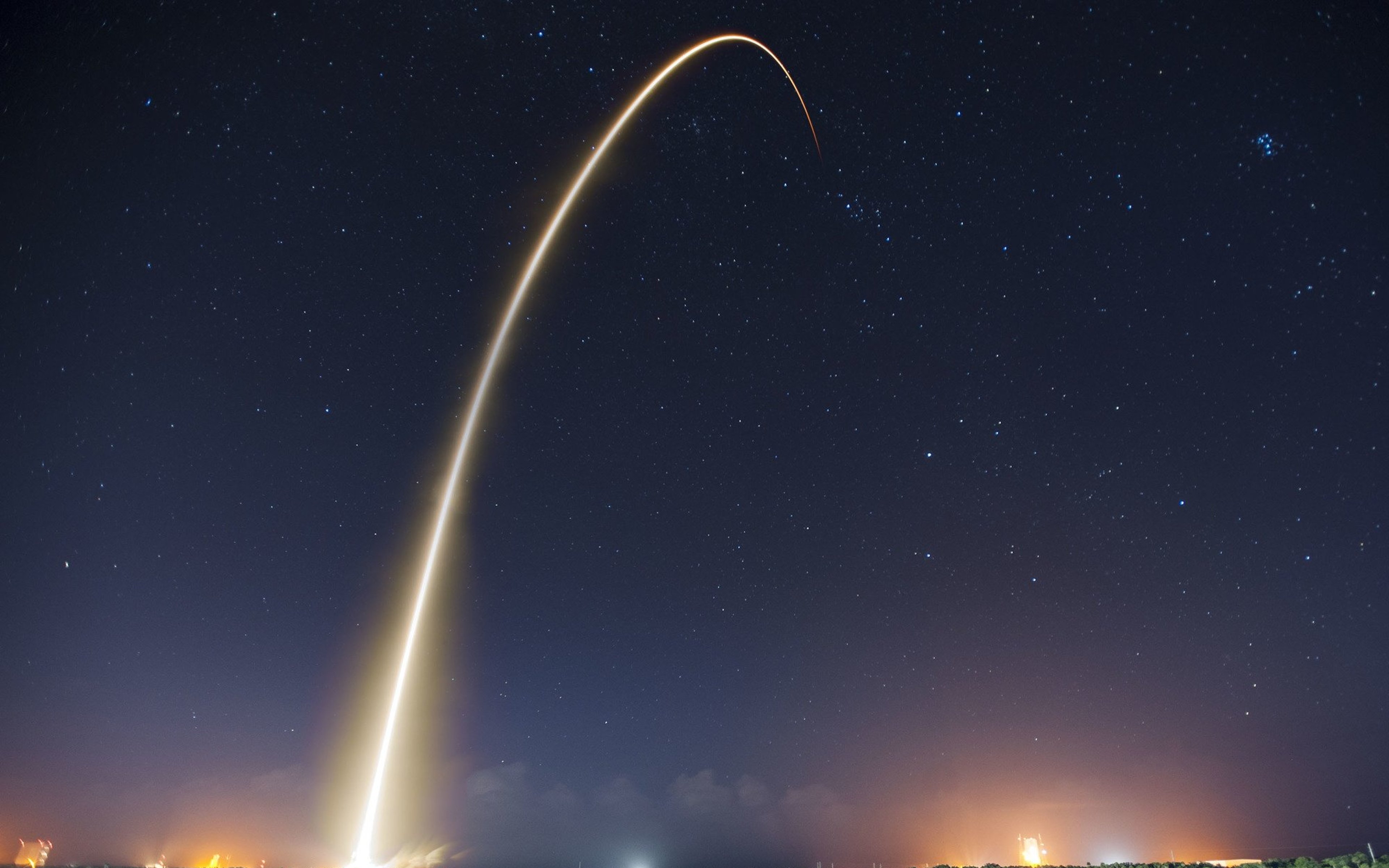
It was a feat that sounded like science fiction, until the company’s Falcon 9 rocket proved it to be science fact, on 21 December 2015. A day that changed what the industry thought was possible.
Making space affordable
Before this, spaceflight wasn’t expensive simply because it was difficult. It was expensive because it was organised around disposability.
Boosters are the most expensive part of rockets. Solving reusability for this component alone meant SpaceX achieved an 85 percent reduction in the average launch cost. And they aren’t finished yet. Starship, Falcon’s successor, promises to be fully reusable, with four times the capacity – reducing costs by a further 90 percent or more. Ultimately, Starship offers the prospect of getting cargo into space for roughly what it costs to send a parcel by post.
The question, then, is what becomes possible once the cost of reaching space falls by another order of magnitude? Things that today seem like the impossible preserve of science fiction may suddenly become economically rational. Manufacturing in orbit, space-based datacentres, or entirely new industries that we have yet to imagine all become more plausible as launch costs continue to fall.
This is why SpaceX is best understood as more than just a rocket company. It is reducing the cost of accessing an entirely new economic frontier. And it also stands to benefit directly from that expanding opportunity. SpaceX is not merely enabling the space economy – through businesses such as Starlink, it is becoming one of its largest participants. In other words, it is its own best customer.
Learning faster by failing cheaper
Lower launch costs create another advantage, too.
When launch is rare, expensive and disposable, experimentation is rationed. Rockets have to be designed through long development cycles, exhaustive modelling and extreme caution, because each flight is too costly to treat as part of the learning process. The industry becomes optimised for avoiding failure rather than experimentation and discovery.
By radically lowering the cost of each launch, SpaceX has lowered the cost of learning itself. More launches generate more data. More data enables faster iteration. Faster iteration produces better rockets, which lower launch costs still further. A powerful flywheel that drives SpaceX’s competitive advantage and perfectly encapsulates the kind of unbounded upside that Long Term Global Growth (LTGG) seeks.
There will undoubtedly be failures along the way. Indeed, they are almost inevitable. But those setbacks should not automatically be interpreted as signs that SpaceX is moving further from its long-term ambitions. In many cases they may simply represent another turn of the flywheel.
As a firm, Baillie Gifford first researched SpaceX back in 2016, shortly after that first successful launch and return of Falcon 9. We then invested in 2018 while it was still a private company. Over those eight years of ownership, we have built a deep proprietary understanding of the business through repeated engagement with the company and close observation of its execution. That perspective has been invaluable in informing LTGG's decision to invest today.
Valuing tomorrow's markets
We should also be frank. At first glance, it isn't just SpaceX's rockets that appear to defy the laws of gravity. A business valued at approximately 100 times its current revenues is, to say the least, difficult to reconcile with conventional valuation metrics.
But perhaps that is precisely the point. Traditional discounted cash flow models are built to value existing businesses. They are much less comfortable with companies whose greatest opportunities may lie in entirely new markets that have yet to emerge. We have little interest in trying to calculate a discounted cash flow for a colony on Mars. Instead, our task is to judge how far SpaceX's opportunity might plausibly expand.
One of the 10 questions we ask of every holding is: What societal considerations are most likely to prove material to the company's long-term growth? For SpaceX, that list is unusually long, spanning issues from AI safety, to corporate governance, to climate change.
Such considerations, as ever, are reflected in our process, and factored into the position size. Some we accept are part of the nature of this investment. Others we are monitoring, and will attempt to engage on. Either way, we do not dismiss them, and enter this investment with our eyes wide open. Our willingness to invest doesn’t mean we’re comfortable with all aspects of the case.
SpaceX is anything but an ordinary company. Time and again, it has proven the impossible possible. Should it succeed in delivering further outlier returns from here, the prize is not simply a share of today’s space industry; it is a share of the economic activity that emerges when space becomes cheap enough to use.
If that future unfolds, it may ultimately prove that the market was not impossibly optimistic about SpaceX, but insufficiently imaginative.
Risk factors
The Funds are distributed by Baillie Gifford Funds Services LLC. Baillie Gifford Funds Services LLC is registered as a broker-dealer with the SEC, a member of FINRA and is an affiliate of Baillie Gifford Overseas Limited. All information is sourced from Baillie Gifford & Co unless otherwise stated.
As with all ETFs, the value of an investment in the Fund could decline, so you could lose money.
The most significant risks of an investment in the Baillie Gifford Long Term Global Growth ETF are: Investment Style Risk, Growth Stock Risk, Long-Term Investment Strategy Risk, Non-Diversification Risk and Non-U.S. Investment Risk. The Fund is managed on a bottom-up basis and stock selection is likely to be the main driver of investment returns. Returns may differ significantly from those of the benchmark due to the Fund’s active, bottom-up investment approach. The prices of growth stocks can be based largely on expectations of future earnings and can decline significantly in reaction to negative news. The Fund is managed on a long-term outlook, meaning that the Fund managers look for investments that they think will make returns over a number of years, rather than over shorter time periods. The Fund may have a smaller number of holdings with larger positions in each relative to other funds. Non-U.S. securities are subject to additional risks, including less liquidity, increased volatility, less transparency, withholding or other taxes and increased vulnerability to adverse changes in local and global economic conditions. There can be less regulation and possible fluctuation in value due to adverse political conditions. Changes in currency exchange rates and broader market conditions may also affect the value of investments. Other Fund risks include: Asia Risk, China Risk, Conflicts of Interest Risk, Currency Risk, Developed Markets Risk, Emerging Markets Risk, Equity Securities Risk, ESG Risk, ETF Structure Risk, Focused Investment Risk, Government and Regulatory Risk, Information Technology Risk, IPO Risk, Large-Capitalization Securities Risk, Liquidity Risk, Market Disruption and Geopolitical Risk, Market Risk, New and Smaller-Sized ETF Risk, Periodic Rebalancing Risk, Risk Model Risk, Service Provider Risk, Settlement Risk, Small-and Medium-Capitalization Securities Risk, and Valuation Risk.
Investing in Exchange Traded Funds (ETFs) pose additional risks including that shares trade on an exchange and may trade at a price greater than the NAV (a premium) or less than the NAV (a discount). Shares bought at a premium may have a greater risk of loss than those bought at a discount. Shares are bought and sold at market price (not NAV) and are not individually redeemable.
Shares may only be redeemed directly from the Fund in Creation Units by Authorized Participants (APs). Where an ETF relies on a small number of APs, there is a risk if these APs exit the business or are unable to create or redeem shares. In this situation, Fund shares are more likely to trade at a premium or discount to NAV and could face trading halts.
Although shares are listed for trading on an exchange, there can be no assurance that an active trading market for the shares will develop or be maintained.
Investors buying or selling shares in the secondary market may also incur bid-ask spreads, which represent the difference between the highest price a buyer is willing to pay and the lowest price a seller is willing to accept for shares and may widen during periods of market volatility or reduced liquidity.
Brokerage commissions may apply and will reduce returns. The market price of shares may fluctuate in response to changes in the value of the Fund’s holdings, supply and demand for shares and other market factors.
For more information about these and other risks of an investment in the Fund see “Additional information about principal strategies and risks” in the prospectus.
There can be no assurance that a Fund will achieve its objective.
This communication was produced and approved in July 2026 and has not been updated subsequently. It represents views held at the time of writing and may not reflect current thinking.
This communication contains information on investments which does not constitute independent research. Accordingly, it is not subject to the protections afforded to independent research and Baillie Gifford and its staff may have dealt in the investments concerned.
The images used in this communication are for illustrative purposes only.
Top Ten Holdings
| Holdings | Fund % |
| ASML | 8.14 |
| NVIDIA | 6.98 |
| Amazon.com | 6.98 |
| TSMC | 5.80 |
| Cloudflare | 5.16 |
| APPLOVIN | 5.08 |
| Tencent | 3.01 |
| Nu Holdings | 2.91 |
| Spotify | 2.79 |
| CATL | 2.78 |
As at June 30, 2026
It should not be assumed that recommendations/transactions made in the future will be profitable or will equal performance of the securities mentioned. A full list of holdings is available on request. The composition of the fund's holdings is subject to change. Percentages are based on securities at market value.
10064741