Key points
- Vietnam continues its structural growth story with significant reforms now backing private sector expansion and infrastructure development, underpinning its long-term investment appeal.
- While potential US tariffs create uncertainty, the country's export engine remains competitive in global supply chains.
- Vietnam's young, urbanising population and growing middle class are driving a shift from informal to formal consumption.

As with any investment, your capital is at risk.
Some investors approach Vietnam the way many first-timers approach crossing the street in Saigon (Ho Chi Minh City) – hesitant, wide-eyed, and waiting for the perfect break in traffic that never quite arrives. But as any local will tell you, the way across is to step forward with calm confidence and steady intent. This, to some extent, mirrors how we think about investing in Vietnam: trust your process and be aware of, but consciously block out the noise around you to focus on your destination.
While the headlines give you corruption scandals, new tariffs, or short-term volatility, there is clear evidence to show that the long-term, structural story unfolding on the ground is very much intact and perhaps one of the most exciting in the world. As I’m sure you know by now, we look for growing businesses riding structural trends, run by capable people, in markets that are transforming. In Vietnam, that’s exactly what we’re finding.
Vietnam’s export-led engine
Vietnam has spent the past two decades quietly becoming one of the world’s most competitive export hubs. It focuses on exactly what global supply chains need: high-volume, cost-efficient manufacturing across electronics, apparel and increasingly, value-added tech components. It has built deep infrastructure and expertise in this space, and as a result, multinationals have been entrenching Vietnam in their supply chains. For instance, it is now responsible for about half of Samsung’s global smartphone production. This has meant that the country’s export engine has delivered around 10 per cent per annum growth for much of the last decade, before stalling in 2023. Encouragingly, with significant reforms now underway, we’re already seeing forecasts return to long-term averages.
Tariffs: noise, not narrative
Of course, the biggest overhang for exporters is the announcement (courtesy of Truth Social) of new US tariffs. However, there’s an argument to be made that there’s more stability now that Vietnam has managed to avoid the previously threatened 46 per cent worst-case scenario and faces a more manageable adjustment.
What we know is that a 20 per cent tariff is being proposed on most exports to the US, and a higher 40 per cent rate is targeted at goods deemed ‘trans-shipped’, i.e. those thought to originate in China but rerouted via Vietnam. This is higher than the current 10 per cent, but far less severe than the 46 per cent initially suggested.
We can’t draw any conclusions yet, but the key questions remain, particularly around how Washington intends to define and enforce ‘trans-shipment’. Until there’s clarity, it’s important not to overreact, especially now that we all know how quickly things can change.
In short, while tariffs may pose a headwind, they are unlikely to derail the longer-term export narrative, especially when viewed through the lens of Vietnam’s broader structural transformation.
Significant reforms backing private sector growth
Before we get into the companies themselves, it’s worth mentioning that the country has been through significant reforms of late. While these have been difficult for investors to work through, we think the resultant outlook is now very positive. The new General Secretary, To Lam, marks a significant change from his predecessor and has cemented his power base through the new infrastructure project approvals, unclogging the property market, restructuring the government to remove bureaucracy and raising credit growth targets.
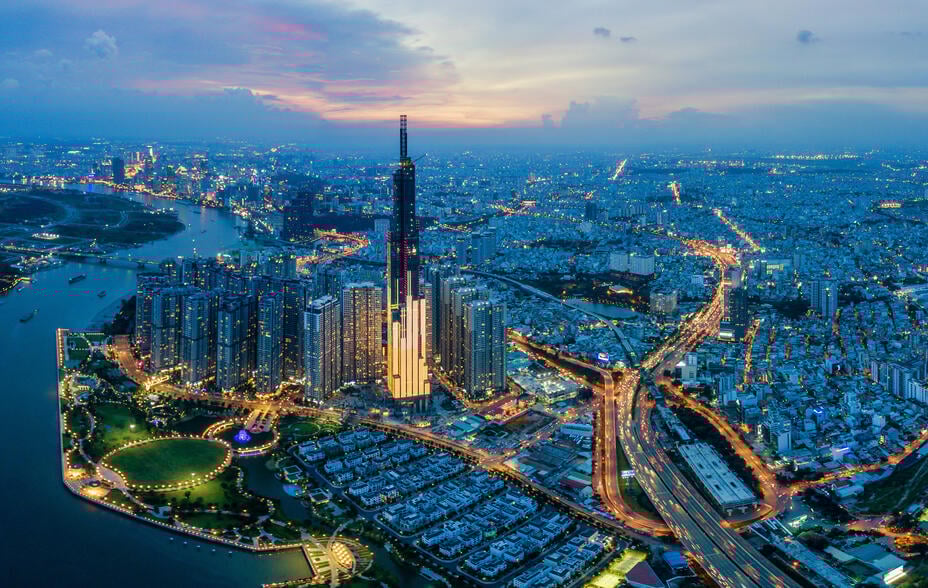
Simplifying the government structures is not a cosmetic move; it’s about a rapid and effective removal of red tape. Over 100,000 state roles have been eliminated as the government shifts its focus toward backing private sector growth and new infrastructure projects at scale. A case in point: the long-delayed Ho Chi Minh City metro line was previously stalled for many years and has since been fast-tracked under the new leadership and finally opened at the end of 2024. So, the government is investing heavily: from railways to airports, they are focusing on enabling commerce, connectivity and consumption. Here, the private sector will be key to delivering on these initiatives, and local champions in various sectors will emerge.
Asia’s domestic star
Two members of the investment team recently returned from a research trip to Vietnam and were notably upbeat about the strong execution across the companies they met. Some of the changes made already have positive impacts on businesses against this backdrop. Hearing from firms on the ground only reaffirms our positive outlook on Vietnam’s domestic trajectory.
Vietnam is home to a young, urbanising, growing middle-class population that will be digitally fluent and consumption hungry. Vietnam has around 100 million people with a median age of 32, which is young relative to Asian peers. Almost 40 per cent of the population now lives in urban areas, which has doubled since the 1990s. Some estimates suggest that half of the population will be middle class by 2035. For context, this figure was around 13 per cent in 2015.
In Vietnam, we are witnessing a generational shift in spending. Younger Vietnamese are willing to pay a premium for quality, convenience and lifestyle, from food to fashion to tech. With over 70 million internet users and smartphone penetration at over 80 per cent, Vietnam is primed for modern retail.

CravenA - stock.adobe.com
As this transition unfolds, one of the clearest themes is the shift from informal to formal consumption (shifting spending from street stalls and open markets to organised chain stores), a trend that directly supports the growth of companies like Mobile World.
Mobile World – leading the formalisation of retail
Mobile World Investment Corporation (MWG) is one of the companies leading this consumption transformation on the ground. We have followed the company for many years, given that our EM team has been investing in Vietnam since 2016 in our Asia ex Japan portfolios. This company is a newer buy for our more concentrated EM portfolios, and it has been held in our EM All Cap portfolios since 2023. While Vietnam sits off-benchmark and remains subject to foreign ownership limits and liquidity constraints, which naturally narrow our investable universe, we continue to find selective opportunities, and our position in MWG is a prime example.
Often described as the “Best Buy plus Walmart” of Vietnam, MWG started out as a mobile phone retailer and has grown into the country’s largest multi-category retail platform spanning smartphones, electronics, groceries, pharmaceuticals and fashion.
Today, MWG operates over 4,000 stores nationwide, and it is the clear leader in mobile phones and home appliances. Its grocery chain, Bach Hoa Xanh, is quickly establishing itself as the most scaled and organised player in a sector still largely dominated by traditional informal markets. What sets MWG apart is not just its reach, but its ability to adapt, leveraging an omnichannel strategy that integrates its physical stores with an increasingly strong digital presence.
The past year has been challenging, with industry-wide oversupply in electronics and softer grocery demand due to the broader economic slowdown. But we see this as a classic capital cycle moment: the fundamentals are intact, competition has weakened, and MWG is positioning itself for a stronger rebound. Its management team has consistently demonstrated the ability to restructure, refocus, and execute with discipline in tough environments.
Looking ahead, the opportunity is clear. As Vietnam’s middle class expands and spending habits evolve, MWG is well placed to deepen its presence and continue leading the retail formalisation trend. In our view, it represents one of the most compelling ways to gain exposure to Vietnam’s domestic transformation – combining scale, innovation, and operational strength in one of Asia’s most exciting economies.
From the sidelines, Vietnam may appear hectic, but the direction of travel is clear. From policy reforms to population dynamics, from capital cycles to consumer shifts, the long-term story remains firmly intact and just like crossing the street in Saigon, we’re choosing to walk into it with conviction.
Risk factors
The views expressed should not be considered as advice or a recommendation to buy, sell or hold a particular investment. They reflect opinion and should not be taken as statements of fact nor should any reliance be placed on them when making investment decisions.
This communication was produced and approved in July 2025 and has not been updated subsequently. It represents views held at the time of writing and may not reflect current thinking.
This communication contains information on investments which does not constitute independent research. Accordingly, it is not subject to the protections afforded to independent research, but is classified as advertising under Art 68 of the Financial Services Act (‘FinSA’) and Baillie Gifford and its staff may have dealt in the investments concerned.
All information is sourced from Baillie Gifford & Co and is current unless otherwise stated.
The images used in this communication are for illustrative purposes only.
Important information
Baillie Gifford & Co and Baillie Gifford & Co Limited are authorised and regulated by the Financial Conduct Authority (FCA). Baillie Gifford & Co Limited is an Authorised Corporate Director of OEICs.
Baillie Gifford Overseas Limited provides investment management and advisory services to non-UK Professional/Institutional clients only. Baillie Gifford Overseas Limited is wholly owned by Baillie Gifford & Co. Baillie Gifford & Co and Baillie Gifford Overseas Limited are authorised and regulated by the FCA in the UK.
Persons resident or domiciled outside the UK should consult with their professional advisers as to whether they require any governmental or other consents in order to enable them to invest, and with their tax advisers for advice relevant to their own particular circumstances.
Financial intermediaries
This communication is suitable for use of financial intermediaries. Financial intermediaries are solely responsible for any further distribution and Baillie Gifford takes no responsibility for the reliance on this document by any other person who did not receive this document directly from Baillie Gifford.
Europe
Baillie Gifford Investment Management (Europe) Ltd (BGE) is authorised by the Central Bank of Ireland as an AIFM under the AIFM Regulations and as a UCITS management company under the UCITS Regulation. BGE also has regulatory permissions to perform Individual Portfolio Management activities. BGE provides investment management and advisory services to European (excluding UK) segregated clients. BGE has been appointed as UCITS management company to the following UCITS umbrella company; Baillie Gifford Worldwide Funds plc. BGE is a wholly owned subsidiary of Baillie Gifford Overseas Limited, which is wholly owned by Baillie Gifford & Co. Baillie Gifford Overseas Limited and Baillie Gifford & Co are authorised and regulated in the UK by the Financial Conduct Authority.
Hong Kong
Baillie Gifford Asia (Hong Kong) Limited 柏基亞洲(香港)有限公司 is wholly owned by Baillie Gifford Overseas Limited and holds a Type 1 license from the Securities & Futures Commission of Hong Kong to market and distribute Baillie Gifford’s range of collective investment schemes to professional investors in Hong Kong. Baillie Gifford Asia (Hong Kong) Limited 柏基亞洲(香港)有限公司 can be contacted at Suites 2713–2715, Two International Finance Centre, 8 Finance Street, Central, Hong Kong. Telephone +852 3756 5700.
South Korea
Baillie Gifford Overseas Limited is licensed with the Financial Services Commission in South Korea as a cross border Discretionary Investment Manager and Non-discretionary Investment Adviser.
Japan
Mitsubishi UFJ Baillie Gifford Asset Management Limited (‘MUBGAM’) is a joint venture company between Mitsubishi UFJ Trust & Banking Corporation and Baillie Gifford Overseas Limited. MUBGAM is authorised and regulated by the Financial Conduct Authority.
Australia
Baillie Gifford Overseas Limited (ARBN 118 567 178) is registered as a foreign company under the Corporations Act 2001 (Cth) and holds Foreign Australian Financial Services Licence No 528911. This material is provided to you on the basis that you are a “wholesale client” within the meaning of section 761G of the Corporations Act 2001 (Cth) (“Corporations Act”). Please advise Baillie Gifford Overseas Limited immediately if you are not a wholesale client. In no circumstances may this material be made available to a “retail client” within the meaning of section 761G of the Corporations Act.
This material contains general information only. It does not take into account any person’s objectives, financial situation or needs.
South Africa
Baillie Gifford Overseas Limited is registered as a Foreign Financial Services Provider with the Financial Sector Conduct Authority in South Africa.
North America
Baillie Gifford International LLC is wholly owned by Baillie Gifford Overseas Limited; it was formed in Delaware in 2005 and is registered with the SEC. It is the legal entity through which Baillie Gifford Overseas Limited provides client service and marketing functions in North America. Baillie Gifford Overseas Limited is registered with the SEC in the United States of America.
The Manager is not resident in Canada, its head office and principal place of business is in Edinburgh, Scotland. Baillie Gifford Overseas Limited is regulated in Canada as a portfolio manager and exempt market dealer with the Ontario Securities Commission (‘OSC’). Its portfolio manager licence is currently passported into Alberta, Quebec, Saskatchewan, Manitoba and Newfoundland & Labrador whereas the exempt market dealer licence is passported across all Canadian provinces and territories. Baillie Gifford International LLC is regulated by the OSC as an exempt market and its licence is passported across all Canadian provinces and territories. Baillie Gifford Investment Management (Europe) Limited (‘BGE’) relies on the International Investment Fund Manager Exemption in the provinces of Ontario and Quebec.
Israel
Baillie Gifford Overseas Limited is not licensed under Israel’s Regulation of Investment Advising, Investment Marketing and Portfolio Management Law, 5755–1995 (the Advice Law) and does not carry insurance pursuant to the Advice Law. This material is only intended for those categories of Israeli residents who are qualified clients listed on the First Addendum to the Advice Law.
Singapore
Baillie Gifford Asia (Singapore) Private Limited is wholly owned by Baillie Gifford Overseas Limited and is regulated by the Monetary Authority of Singapore as a holder of a capital markets services licence to conduct fund management activities for institutional investors and accredited investors in Singapore. Baillie Gifford Overseas Limited, as a foreign related corporation of Baillie Gifford Asia(Singapore) Private Limited, has entered into a cross-border business arrangement with Baillie Gifford Asia (Singapore) Private Limited, and shall be relying upon the exemption under regulation 4 of the Securities and Futures (Exemption for Cross-Border Arrangements) (Foreign Related Corporations) Regulations 2021 which enables both Baillie Gifford Overseas Limited and Baillie Gifford Asia (Singapore) Private Limited to market the full range of segregated mandate services to institutional investors and accredited investors in Singapore.
165121 10056726