


Photography: © COVER
As with any investment, your capital is at risk.
The darkened arena in LA is a sea of multicoloured light wands, waving to a crescendo of frenzied cheers. On stage, a five-strong girl group breaks into a song-and-dance routine as a high-energy J-pop (Japanese pop) number blares out.
Except it’s not a real stage, but an ingenious illusion, involving mirrors, projections and AI-enhanced motion-capture technology, and these aren’t flesh-and-blood performers.
They’re animated life-size cartoons, drawn in the anime style globally recognised as contemporary Japan’s visual signature: huge eyes, button noses, ‘cute’ animal ears, festoons of luridly coloured hair and eccentrically detailed, elaborately layered or skimpy costumes.
Welcome to the Hololive on-stage experience, a state-of-the-art showcase of the virtual intellectual property (IP) of Cover Corporation. It sounds strange but then so do most global pop culture phenomena when they first appear.
What’s VTubing and what’s Hololive? Short for ‘virtual YouTubing’, VTubing is the live streaming by ‘influencers’ (online celebrities) via video channels such as YouTube.
Cartoon avatars of real people, they use motion-capture technology to translate their creators’ expressions and movements into those of fantasy alter-egos.
These virtual idols have carefully constructed looks, personalities and fictional backstories. Cover’s Hololive brand is a talent agency that, for a share of the action, helps launch and promote these semi-imaginary stars.
Big-name VTubers such as Houshou Marine, Usada Pekora and Mori Calliope have millions of subscribers who tune in to interact, watch them sing or play video games, draw pictures, or listen to them chat about this and that.
Recent live performances – such as Cover Corp’s technically complex Hololive STAGE tour of the US and south-east Asia in 2024 – are helping to blast VTubing from a Japanese niche into the universal mainstream.
Now valued at more than $2.5bn globally, the VTubing market is projected to be worth $20bn in 10 years, with revenue derived from subscriptions, sponsorship, merchandising and licensing. Cover Corp, founded in 2016 by Motoaki Tanigo, is best placed to benefit.
This is thanks to a hand-picked talent roster and investment in technology that allows Cover Corp to innovate in the increasingly lucrative space between the virtual and real worlds.
The value of the company’s IP gives it the potential to ride the expected wave of global popularity in VTubing. And its business model doesn’t require big injections of capital to grow – always music to investors’ ears.
Nicknamed Yagoo, Tanigo San’s genial entrepreneurial persona and close involvement in the careers of his Hololive ‘family’ have made him key to the brand’s identity. On a video call to Tokyo, I spoke to him about the commercial opportunities of this fantastical new realm.

Cover Corp founder Motoaki ‘Yagoo’ Tanigo, star of many VTubing storylines
Meet the man behind the anime interface
Brian Lum: How did you come to found Cover Corp?
Motoaki Tanigo: I majored in mechanical engineering, but my passion was for computer games, not cars. My first job was with Sanrio, best known for the cartoon character Hello Kitty. I was creating games and forming joint ventures based on its IP. Later, I oversaw ecommerce at istyle.inc, an online beauty portal, which featured a lot of user-generated product reviews and other content.
In those days, I had an almost religious belief in the potential of the internet: I felt it could bring peace to the world. I also had a passion for the content, unlike many other entrepreneurs who were making smartphone games businesses. We founded Cover Corp with the idea of creating content for virtual reality, though without much idea of how to monetise it.
BL: How does Cover Corp support its stable of VTubers?
MT: We help create the characters and manage the careers of around 90 VTubers, mostly in Japan but also now in the US and south-east Asia. We provide the studio and the tools they need to create their content and support them by streaming events, developing games and helping with merchandising. We also bring artists together for live group performances.
BL: What’s changed since you launched nearly 10 years ago?
MT: When we started, YouTube was our only platform, and the main source of income was audience tips. Now, it’s more about the merchandising business, licensing and creating games based on our characters. We want to be a technology-entertainment company like Disney or Pixar.
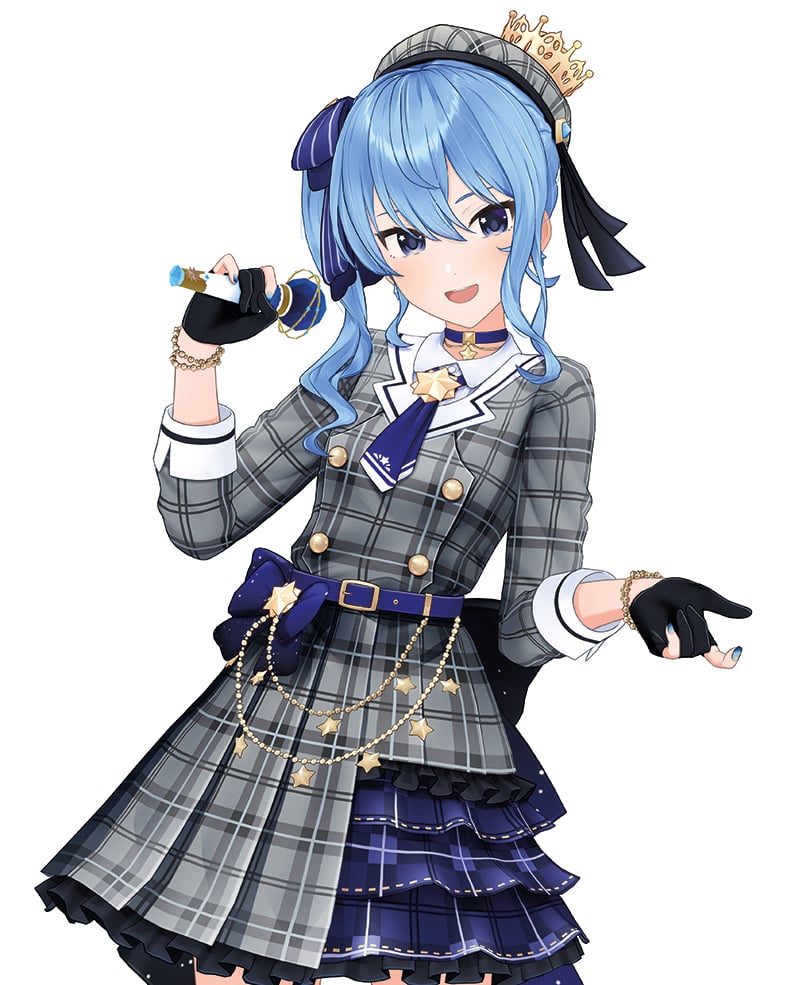
Hoshimachi Suisei describes herself as “a shooting star from diamonds in the rough”. She “works tirelessly towards her dream of performing in Tokyo Dome one day”
BL: How do you see the future of VTubing?
MT: We’ve seen a massive expansion of the wider global market for Japanese anime [in TV and film]. It’s now worth about ¥3tn (£15bn), almost double 10 years ago. It’s hard to get most anime characters into a live environment because of licensing, but owning the rights allows us to give VTuber fans the live interactive engagement that’s key to its popularity.
There’s a whole universe of anime, games and music that VTubers can step into. The scene is getting bigger and more mainstream. It’s now a new medium itself, full of opportunities, such as card-trading games based on our characters, which VTubers can promote in their livestreams. We’re creating a distinct, self-contained ‘ecosystem’ that’s hard for competitors to enter.
We’re now using AI to improve motion tracking, which gives more realistic synchronisation. We’ve also launched a service that enables all users to make their own avatars via their smartphone or PC cameras so our users worldwide can communicate with each other in this way.
BL: How are you reaching markets outside Japan?
MT: We have a presence at world anime conventions or exhibitions and will adjust our marketing so that VTubers stream popular games in that area. Cover USA, based in LA, does sales promotion for game companies and licensing deals with apparel companies.
BL: What makes a great VTuber?
MT: They must be highly skilled in music, singing or game streaming. But they also need ambition: ‘I want to conduct a live performance in this place by this time’, ‘I want to collaborate with [video game giant] Sega’. It’s that ambition and motivation that get the fans excited enough to buy into their VTuber journey and want to support them to achieve their goals.
Important information
This article does not constitute, and is not subject to the protections afforded to, independent research. Baillie Gifford and its staff may have dealt in the investments concerned. The views expressed are not statements of fact and should not be considered as advice or a recommendation to buy, sell or hold a particular investment.
Some of the views expressed are not necessarily those of Baillie Gifford. Investment markets and conditions can change rapidly, therefore the views expressed should not be taken as statements of fact nor should reliance be placed on them when making investment decisions.
Baillie Gifford & Co and Baillie Gifford & Co Limited are authorised and regulated by the Financial Conduct Authority (FCA). The investment trusts managed by Baillie Gifford & Co Limited are listed on the London Stock Exchange and are not authorised or regulated by the FCA.
A Key Information Document is available by visiting bailliegifford.com
10057514