


As with any investment, your capital is at risk and any income is not guaranteed.
Retirement income needs to do more than cover spending today. It also needs to hold up as living costs rise.
That is where inflation becomes a real challenge. It rarely arrives as a single shock. More often, it appears gradually in the weekly shop, insurance renewals, energy bills, holidays, or the prospect of care later in life. Each increase may feel manageable on its own. Over time, though, they can materially change what retirement costs.
Cash has an important role in this picture. It helps cover bills, supports emergency spending and can provide reassurance when markets are unsettled. The difficulty comes when money intended for later life stays in cash for long periods. The balance may look steady, or even higher, while its spending power slips.
A simple example shows the effect. Take £100,000 held in cash for five years. At an annual interest rate of 2.3 percent, the balance would rise to around £112,000. If inflation averaged 3 percent over the same period, that sum would be worth roughly £97,000 in today’s terms.
The account balance has risen, but the money buys less.
The balance rises, spending power falls
An illustration of £100,000 held in cash for five years.
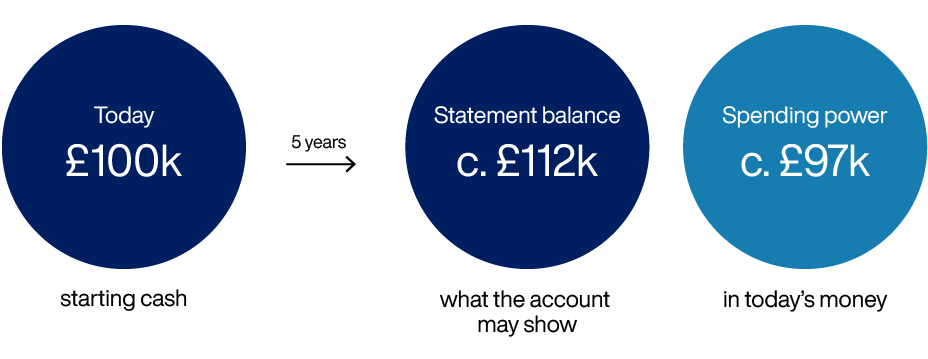
Illustrative only. Assumes 2.3 percent annual cash interest and 3 percent annual inflation. Broadly consistent with current RPI-based forecasts.
At this point, a fair question is: why not avoid the uncertainty and simply buy a 15-year gilt?
For some investors, a gilt can be useful. It offers a known stream of income and, if held to maturity, a clearer return of capital in nominal terms. That can be valuable when the need is specific and dated.
Retirement, however, is rarely a single fixed payment on a single fixed date. It is a long sequence of spending needs, many of which are likely to rise over time. A conventional gilt may help with certainty, but it does not, by itself solve the problem of growing income. Its coupons are fixed, its maturity is fixed, and its spending power still depends on what inflation does over the years ahead.
That is the distinction. The challenge is not simply to avoid market movement. It is to preserve purchasing power across a retirement that may last 20 or 30 years.
The capital is returned, spending power falls
An illustration of £100,000 invested in a 15-year conventional gilt
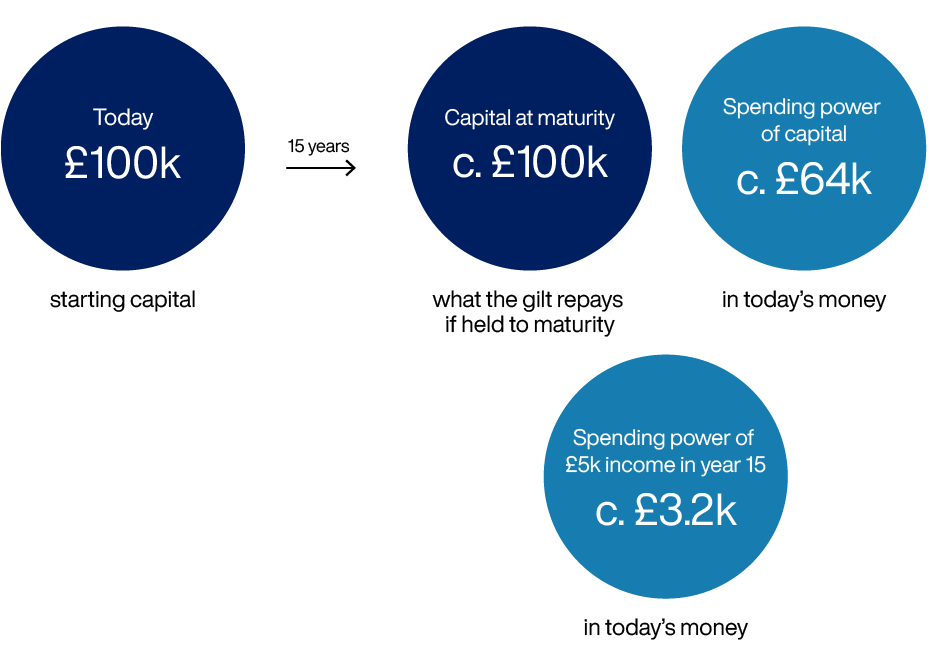
Illustrative only. Assumes £100,000 invested at par in a 15-year conventional gilt, held to maturity, paying a fixed 5 percent annual coupon. Spending power is adjusted using a 3 percent annual inflation assumption, broadly in line with near-term RPI-based forecasts.
It is easy to see why this risk is often overlooked. Market falls are visible in statements and headlines. Inflation is quieter, which can make it easier to underestimate. The cost of being too cautious may only become clear later, when the same level of income stretches less far.
Why savers leave money on the sidelines
This is especially relevant for retirees who hold several years of planned spending in cash. A reserve can make sense, particularly if it helps avoid selling investments during weaker markets. But a large reserve can also leave a meaningful share of the portfolio with little chance of keeping up with inflation. A four-year cash buffer, for example, might leave 15-to-20 percent of a pension pot outside assets that likely have a stronger chance of protecting real value.
Retirement income often needs some growth as well as accessibility. Over long periods, cash has struggled to preserve value after inflation. Growth assets have been more volatile, but they have historically offered better protection against rising prices.
Cash has struggled to keep pace with inflation
That does not mean simply taking more risk. It means choosing a mix of assets that reflects the long-term purpose of the portfolio.
A retirement portfolio has to meet several demands at once. It needs to provide income now, give that income some scope to grow, and remain durable for as long as it is needed. Cash, guaranteed income and investments can all contribute, depending on the investor’s needs and time horizon.
Inflation-linked annuities, for example, can provide more certainty, although they usually start from a lower income level. For some investors, that trade-off will be sensible. Others may prefer to keep more of their money invested, especially in the earlier years of retirement when the portfolio may still need to support decades of withdrawals.
The Baillie Gifford Monthly Income Fund is designed for this part of the retirement income challenge. It aims to provide monthly income while seeking to maintain the value of that income and of capital in line with the UK consumer price index (CPI) over five-year periods.
We believe this objective aligns well with better client outcomes, because inflation affects income as well as capital. An income that feels comfortable at the start of retirement may feel much tighter ten years later.
The fund invests in a range of assets, including equities, real assets and fixed income. Equities can offer exposure to companies with the potential to grow profits and dividends over time. Real assets, such as property and infrastructure, may provide income streams with some link to inflation. Bonds can provide regular interest and broaden the sources of income within the portfolio.
This mix is intended to reduce reliance on any one source of return. For investors drawing an income, that can matter both now and later, when preserving spending power becomes more important.
Cash should remain part of retirement planning where it serves a clear purpose and is available for near-term needs. For money intended to support later years, a more useful test is whether it has a reasonable chance of protecting future spending power.
We are all familiar with the “capital at risk, income not guaranteed” caveat on investments. Cash, however, rarely carries a label.
Maybe it is time to do so: “Cash returns may lag inflation. Over time, this can reduce your spending power and put your goals at risk.”
The Baillie Gifford Monthly Income Fund does not remove investment risk. Its aim is to help investors draw a regular income while giving both income and capital a better chance of keeping pace with rising costs.
For investors holding more cash than they are likely to need in the near term, it may be worth considering whether some of that money could be working harder within a wider, advice-led retirement income plan.
Past performance
Baillie Gifford Monthly Income Fund
Annual past performance to 31 March each year (net%)
| 2022 | 2023 | 2024 | 2025 | 2026 | |
| Baillie Gifford Monthly Income Fund B Inc | 7.4 | -3.9 | 6.4 | 2.3 | 5.2 |
| Sector Average* | 5.2 | -4.5 | 10.2 | 3.3 | 11.1 |
Source: FE, Revolution. Net of fees, total return in sterling. *Investment Association Mixed Investment 40-85% Shares Sector
Past performance is not a guide to future returns.
The Fund has no target. However you may wish to assess the performance of both income and capital against inflation (UK CPI) over a five-year period. In addition, the manager believes an appropriate performance comparison for this Fund is the Investment Association Mixed Investment 40-85% Shares Sector.
Important information and risk factors
This article was produced and approved in June 2026 and has not been updated subsequently. It represents views held at the time and may not reflect current thinking.
The views expressed should not be considered as advice or a recommendation to buy, sell or hold a particular investment. They reflect opinion and should not be taken as statements of fact nor should any reliance be placed on them when making investment decisions.
This communication contains information on investments which does not constitute independent research. Accordingly, it is not subject to the protections afforded to independent research, and Baillie Gifford and its staff may have dealt in the investments concerned.
Baillie Gifford & Co and Baillie Gifford & Co Limited are authorised and regulated by the Financial Conduct Authority (FCA). Baillie Gifford & Co Limited is an Authorised Corporate Director of OEICs.
Investment markets can go down as well as up and market conditions can change rapidly. The value of an investment in the Fund, and any income from it, can fall as well as rise and investors may not get back the amount invested.
Market values for illiquid securities which are difficult to trade, or value less frequently than the Fund, such as holdings in weekly or monthly dealt funds, may not be readily available. There can be no assurance that any value assigned to them will reflect the price the Fund might receive upon their sale. In certain circumstances it can be difficult to buy or sell the Fund’s holdings and even small purchases or sales can cause their prices to move significantly, affecting the value of the Fund and the price of shares in the Fund.
Bonds issued by companies and governments may be adversely affected by changes in interest rates, expectations of inflation and a decline in the creditworthiness of the bond issuer. The issuers of bonds in which the Fund invests, particularly in emerging markets, may not be able to pay the bond income as promised or could fail to repay the capital amount.
Derivatives may be used to obtain, increase or reduce exposure to assets and may result in the Fund being leveraged. This may result in greater movements (down or up) in the price of shares in the Fund. It is not our intention that the use of derivatives will significantly alter the overall risk profile of the Fund.
The Fund’s share price can be volatile due to movements in the prices of the underlying holdings and the basis on which the Fund is priced.
Further details of the risks associated with investing in the Fund can be found in the Key Investor Information Document or the Prospectus, copies of which are available at bailliegifford.com.
187600 10060498