

Key points
- AI has split global markets, creating leaders, laggards and overlooked companies in the pack
- Monks is adding to AI hardware, resilient software and industrial businesses with long-term growth opportunities
- The managers believe balanced growth exposure leaves the portfolio well placed for endurance

As with any investment, your capital is at risk.
While a certain football tournament across the Atlantic may have hogged the sporting limelight this summer, an older event closer to home has cycled around for the 113th time. Over three weeks, riders will race the equivalent distance from Edinburgh to Tbilisi and climb six Mount Everests, in temperatures expected to top 40°C.
If you spend time admiring the pain, suffering and tactical battles in the Tour de France, you are likely to see a pattern play out. The race splits into three: the breakaway group pulling away at the front, the bulk of the field conserving energy in the peloton and the unfortunate few trying to regain contact after a puncture or crash.
Unprecedented investment in AI infrastructure and the threat this technology poses to digital businesses have similarly split global markets into three over the past 12 months. AI hardware companies have streaked ahead, software and digital services companies have fallen behind and the rest of the index is tightly packed in the middle.
Against this backdrop, Monks delivered very strong absolute share price (+25.7 percent) and net asset value (NAV) returns (+19.4 percent) over the last 12 months, but it has lagged behind its FTSE World Benchmark (+30.2 percent).
However, in the Tour de France, daily stage wins matter less than winning the entire, longer event. The same is true in investing. That means endurance over outright speed. To deliver that, we’re building a select team of complementary companies from each of those three groups that can still be contenders at the finish line.
The breakaway: AI hardware
First, the leading pack: the beneficiaries of the gargantuan investment in chips, cables, cooling and power-generation equipment required to run AI systems. Spending by Amazon, Alphabet, Microsoft, Meta and others has become the hardware providers’ profits, driving incredible performance.
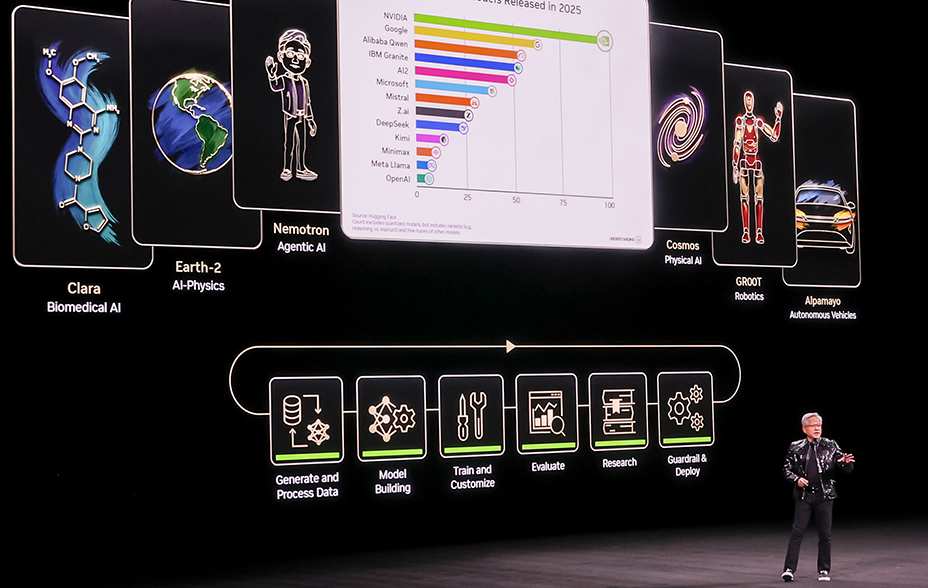
NVIDIA CEO Jensen Huang presents Open Model Ecosystem.
© NVIDIA
We prefer to own the highest-quality companies here, such as NVIDIA and Taiwan Semiconductor Manufacturing Company (TSMC), that do things that cannot easily be replicated. However, the deluge of cash trying to secure supply has lifted some marginal suppliers even faster, but we believe these gains will prove shorter lasting.
We remain optimistic about AI. Demand for AI services is strong and the tech giants are showing early signs of profitable businesses, so we’ve added more of the highest-quality, but misunderstood, companies to your portfolio.
We added SK Hynix, the memory supplier, complementing our existing holding, Samsung. They trade at less than six times forward earnings, yet the market underappreciates how long the supply shortage may last and how much less cyclical the businesses have become.
We also added chip equipment makers Lasertec and BE Semiconductor Industries (BESI). Demand for chipmaking equipment should rise as semiconductor production expands, but both have growth cases built on stronger foundations than near-term AI spending.
We’re also wary that supply bottlenecks across chips, memory and power might constrain the buildout. New holding Wärtsilä should see profits rise if the datacentre power logjam continues. MediaTek could also benefit if AI computation is forced to shift instead to local devices, or ‘edge’ computing.
This trading shows a view that marginal players may capture stage wins, but we prefer the battle-hardened riders with stamina to endure and the up-and-coming riders with fuel in the tank.
The laggards: digital services
Software and digital services are at the back of the pack, having suffered a severe sell-off after the release of Anthropic’s new AI tools in January. But rather than punctures for an unlucky few, the crash has hit valuations across the group, putting their potential success at much longer odds.
We wrote last quarter about adding to those impacted, but with enduring and AI-protected growth prospects, such as Samsara, Shopify and Adyen. We’ve now gone further, adding Axon, the leading provider of Tasers and body cameras to law enforcement agencies. We believe the market underappreciates the growth potential of its expanding AI-powered software and services business.
Some software companies will be casualties, as AI companies such as Anthropic lower the cost of building digital services, creating a supply shock that permanently hurts growth prospects.
That is why we took part in Anthropic’s $65bn private funding round in May on behalf of Monks shareholders. Its growth has been exponential, model training has become more efficient and it is only starting to expand into large markets beyond software development. The risks are many and material, but few companies have quite such unbounded upside potential.
The Peloton: the rest
The winning riders of the Tour spend most of their time in the peloton, where sitting in the bunch can reduce aerodynamic drag by up to 40 percent. We’re continuing to broaden our exposure into the best but overlooked contenders in the mass of the pack, with growth reserves in the bank. As AI encroaches on more of the index, unrelated exposure becomes increasingly valuable.
We have numerous AI-insensitive enthusiasms, including healthcare innovation, emerging market champions and consumer brands. Recently, we’ve been looking at resilient industrials, an area poised for a growth renaissance.
Linde is an exceptionally well-run industrial gas producer, less prone to cycles due to its acquisition excellence and close customer relationships. RBC Bearings, a specialist maker of bearings for the aerospace, defence and manufacturing industries, is also well positioned as spending increases across its customer base. Together, they enhance our diverse exposures to resilient industrials, including roofing suppliers, electrical cables and battery makers.
Built to outlast
Any market backdrop can present opportunities for those with a broad and balanced growth approach, but this splintered market feels more opportunity-laden than most.
Finding underappreciated but enduring profit growth will drive Monks’ returns. With this lens, a select group of riders in the breakaway, the peloton and the trailing group have great potential to deliver faster or more enduring profit growth than the market expects.
Bringing them together delivers a portfolio with superior growth prospects and higher profitability than the index. Remarkably, it now trades at the same valuation, a parity that has not happened since our team started managing Monks in April 2015. While AI spending has propelled parts of the market to streak ahead, most of those early leaders will be gobbled up by the pack before the finish.
Monks is built on balanced growth exposures, designed to outlast the index. From today’s staggered starting point, we’ve rarely been more confident in the portfolio we’ve assembled.
Net asset value (NAV): the difference between a company’s assets and its liabilities calculated at the end of each business day.
Forward earnings: estimates of a company's future earnings that are used by investors to assess potential stock performance.
Supply shock: sudden, unexpected events that significantly change the availability of goods or services in an economy, causing rapid price shifts.
Edge computing: a distributed computing model that brings computation and data storage closer to the sources of data.
The Monks Investment Trust plc
Annual discrete performance to 30 June (%)
| 2022 | 2023 | 2024 | 2025 | 2026 | |
| Share Price | -32.1 | 6.8 | 19.6 | 9.7 | 25.7 |
| NAV | -26.8 | 9.1 | 17.9 | 9.2 | 19.4 |
| FTSE World Index | -2.8 | 13.5 | 21.1 | 7.8 | 30.2 |
Source: Morningstar, FTSE, total return in sterling
Past performance is not a guide to future returns.
Important information
This communication was produced and approved in July 2026 and has not been updated subsequently. It represents views held at the time of writing and may not reflect current thinking.
The Trust invests in overseas securities. Changes in the rates of exchange may also cause the value of your investment (and any income it may pay) to go down or up.
The Trust invests in private companies. The risk of investing in private companies could be greater as these assets may be more difficult to sell, so changes in their prices may be greater.
This article does not constitute, and is not subject to the protections afforded to, independent research. Baillie Gifford and its staff may have dealt in the investments concerned. The views expressed are not statements of fact and should not be considered as advice or a recommendation to buy, sell or hold a particular investment.
Baillie Gifford & Co and Baillie Gifford & Co Limited are authorised and regulated by the Financial Conduct Authority (FCA). The investment trusts managed by Baillie Gifford & Co Limited are listed on the London Stock Exchange and are not authorised or regulated by the FCA.
A Key Information Document is available at bailliegifford.com.
FTSE index data
Source: London Stock Exchange Group plc and its group undertakings (collectively, the “LSE Group”). © LSE Group 2026. FTSE Russell is a trading name of certain of the LSE Group companies. “FTSE®” “Russell®”, “FTSE Russell ®, is/are a trade mark(s) of the relevant LSE Group companies and is/are used by any other LSE Group company under license. All rights in the FTSE Russell indexes or data vest in the relevant LSE Group company which owns the index or the data. Neither LSE Group nor its licensors accept any liability for any errors or omissions in the indexes or data and no party may rely on any indexes or data contained in this communication. No further distribution of data from the LSE Group is permitted without the relevant LSE Group company’s express written consent. The LSE Group does not promote, sponsor or endorse the content of this communication.
202613 10064512