
Key points
- Coinbase has become the trusted bridge between traditional finance and the digital asset economy
- With stablecoin growth, subscription revenue and a regulatory-first approach, Coinbase is driving the next wave of digital finance

As with any investment, your capital is at risk.
Picture the early days of the internet: clunky dial-up modems, clumsy websites, and only a vague sense of – beneath the hype – what it was all actually for. Yet it was during this period of frenzied experimentation that the foundations of the modern digital economy were laid.
The crypto industry – a catch-all term referring to the ecosystem of cryptographically secured digital assets - has felt similarly messy and oft discredited. Yet beneath the hyperbole and headlines, Coinbase has been quietly building the infrastructure that is transforming the financial system.
When Coinbase was founded in 2012, it was little more than an exchange for trading Bitcoin (the original digital, or cryptocurrency). This was always just a stepping stone in a much bolder vision. In 2016, Coinbase’s founder, Brian Armstrong, shared what he called his 'Secret Master Plan’. A roadmap to achieving the company's mission of increasing economic freedom by helping to establish a new open financial system. One where assets can be transferred globally, instantly, and essentially for free. Armstrong’s master plan was simple, comprising just four steps: establish the protocols, build the infrastructure, develop a consumer interface, and unlock mass adoption.
Since then, Coinbase has progressed admirably through the first three phases of the master plan, evolving to become the trusted gateway between the existing financial infrastructure and the fast-growing digital asset economy.
At its simplest, a software protocol is a rulebook that computers follow to exchange information. Cryptocurrencies such as Bitcoin and Ethereum are examples of such protocols – agreed-upon systems that allow people to send value securely, just as email protocols enable the sending of messages. Completing step one enabled Coinbase to build its business on top of these rulebooks, offering a safe way to buy and hold these assets.
During step two, the company rode the wave of broader crypto popularity and adoption. However, Coinbase actively positioned itself as a leader in regulatory advocacy. Amongst its crypto peers, Coinbase could be described as a teacher’s pet in an unruly classroom. This decision to embrace regulation and security set it apart. With over 100 million users worldwide and over US$400 billion worth of assets under custody, Coinbase has become the custodian of choice for everyday investors and institutions. With competitors undone by regulatory failure, Coinbase’s embrace of safety and legitimacy has become a competitive moat, not a burden.
Armstrong’s plan anticipated that exchanges and custody would be the “pipes and plumbing” of the new financial system. Coinbase has built both at scale. Its exchange – the core marketplace for buying and selling cryptocurrencies – has laid the groundwork by helping to broaden crypto's adoption and established Coinbase as the trusted partner for both retail and institutional investors, offering an intuitive and compliance-friendly interface. The company is now turning its attention to the final stages of Armstrong’s plan: expanding crypto’s everyday utility.
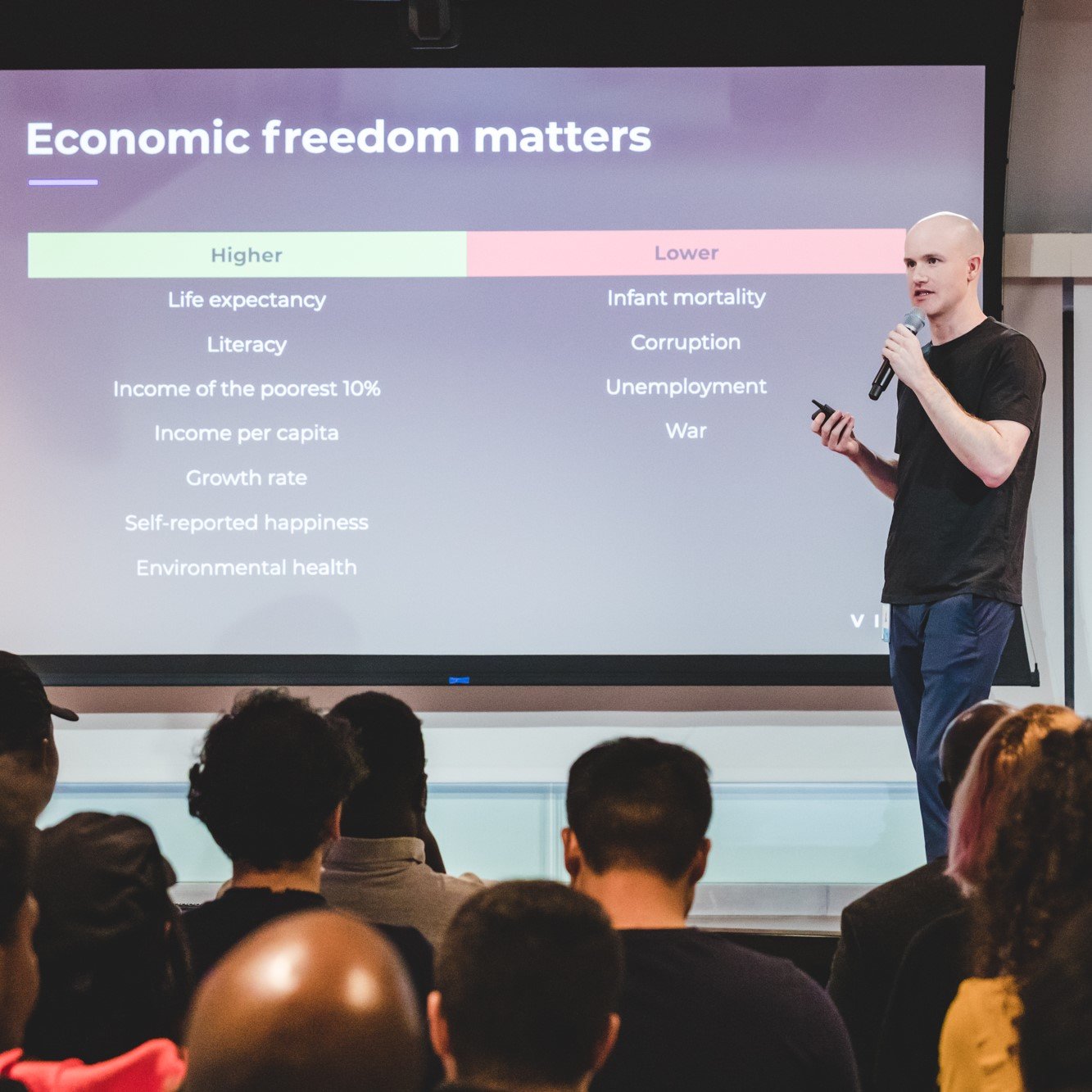
Brian Armstrong, chief executive of Coinbase. © Coinbase
If the mission is clear, the exact path forward from here is less so. Armstrong readily admits he cannot predict which innovations will gain traction, so Coinbase embraces uncertainty with a culture of internal entrepreneurship. Around 10 per cent of resources are set aside for ‘venture bets’, reflecting a strategic desire to have many irons in the fire.
This entrepreneurial culture is bearing fruit. In 2019, over 80 per cent of Coinbase’s revenues came from notoriously volatile retail trading fees. Since then, the company has intentionally pivoted towards recurring revenue streams. The clearest example is Coinbase One, a monthly subscription service that provides members with perks such as 0 per cent trading fees. Coinbase One cannibalises transaction fees but converts them into stickier, high-quality, recurring revenue streams.
Stablecoins, digital currencies backed by traditional currencies like the US dollar and designed to maintain a stable value while offering the benefits of digital transactions, are another area of opportunity which is already maturing into real-world use cases. Together with Circle, Coinbase launched USDC, a digital dollar that has become one of the world’s most widely used payment tokens.
The economic model is simple but powerful, with Coinbase earning a share of the interest income on the reserves backing USDC. During 2024, stablecoin transaction volume overtook the amounts enabled by both Visa and Mastercard. No longer just a niche experiment, but a financial system operating at a globally significant scale. As circulation has grown, so too has Coinbase’s revenue from stablecoins – about 15 per cent of total sales today, up from zero in 2019.
The market views Coinbase primarily as a volatile trading exchange tied to crypto price cycles, but its earnings profile is evolving into something far more resilient than the market appreciates. A company building the plumbing of a new financial system, Coinbase is maturing into a diversified financial infrastructure company, spanning a stablecoin payments network, institutional custody services, and subscription services like Coinbase One.
While success still depends on broader crypto adoption, growth is increasingly driven by the steady migration of assets from traditional finance into digital form. Longer term, only around 0.5 per cent of global GDP currently moves through the crypto ecosystem. A shift to even 2-3 per cent would be transformative – and Coinbase, with its scale, trust and expanding suite of recurring-revenue products, is exceptionally well placed to benefit.
Risk factors
The views expressed should not be considered as advice or a recommendation to buy, sell or hold a particular investment. They reflect opinion and should not be taken as statements of fact nor should any reliance be placed on them when making investment decisions.
This communication was produced and approved in September 2025 and has not been updated subsequently. It represents views held at the time of writing and may not reflect current thinking.
Potential for profit and loss
All investment strategies have the potential for profit and loss, your or your clients’ capital may be at risk. Past performance is not a guide to future returns.
This communication contains information on investments which does not constitute independent research. Accordingly, it is not subject to the protections afforded to independent research, but is classified as advertising under Art 68 of the Financial Services Act (‘FinSA’) and Baillie Gifford and its staff may have dealt in the investments concerned.
All information is sourced from Baillie Gifford & Co and is current unless otherwise stated.
The images used in this communication are for illustrative purposes only.
Important information
Baillie Gifford & Co and Baillie Gifford & Co Limited are authorised and regulated by the Financial Conduct Authority (FCA). Baillie Gifford & Co Limited is an Authorised Corporate Director of OEICs.
Baillie Gifford Overseas Limited provides investment management and advisory services to non-UK Professional/Institutional clients only. Baillie Gifford Overseas Limited is wholly owned by Baillie Gifford & Co. Baillie Gifford & Co and Baillie Gifford Overseas Limited are authorised and regulated by the FCA in the UK.
Persons resident or domiciled outside the UK should consult with their professional advisers as to whether they require any governmental or other consents in order to enable them to invest, and with their tax advisers for advice relevant to their own particular circumstances.
Financial intermediaries
This communication is suitable for use of financial intermediaries. Financial intermediaries are solely responsible for any further distribution and Baillie Gifford takes no responsibility for the reliance on this document by any other person who did not receive this document directly from Baillie Gifford.
Europe
Baillie Gifford Investment Management (Europe) Ltd (BGE) is authorised by the Central Bank of Ireland as an AIFM under the AIFM Regulations and as a UCITS management company under the UCITS Regulation. BGE also has regulatory permissions to perform Individual Portfolio Management activities. BGE provides investment management and advisory services to European (excluding UK) segregated clients. BGE has been appointed as UCITS management company to the following UCITS umbrella company; Baillie Gifford Worldwide Funds plc. BGE is a wholly owned subsidiary of Baillie Gifford Overseas Limited, which is wholly owned by Baillie Gifford & Co. Baillie Gifford Overseas Limited and Baillie Gifford & Co are authorised and regulated in the UK by the Financial Conduct Authority.
Hong Kong
Baillie Gifford Asia (Hong Kong) Limited 柏基亞洲(香港)有限公司 is wholly owned by Baillie Gifford Overseas Limited and holds a Type 1 license from the Securities & Futures Commission of Hong Kong to market and distribute Baillie Gifford’s range of collective investment schemes to professional investors in Hong Kong. Baillie Gifford Asia (Hong Kong) Limited 柏基亞洲(香港)有限公司 can be contacted at Suites 2713-2715, Two International Finance Centre, 8 Finance Street, Central, Hong Kong. Telephone +852 3756 5700.
South Korea
Baillie Gifford Overseas Limited is licensed with the Financial Services Commission in South Korea as a cross border Discretionary Investment Manager and Non-discretionary Investment Adviser.
Japan
Mitsubishi UFJ Baillie Gifford Asset Management Limited (‘MUBGAM’) is a joint venture company between Mitsubishi UFJ Trust & Banking Corporation and Baillie Gifford Overseas Limited. MUBGAM is authorised and regulated by the Financial Conduct Authority.
Australia
Baillie Gifford Overseas Limited (ARBN 118 567 178) is registered as a foreign company under the Corporations Act 2001 (Cth) and holds Foreign Australian Financial Services Licence No 528911. This material is provided to you on the basis that you are a “wholesale client” within the meaning of section 761G of the Corporations Act 2001 (Cth) (“Corporations Act”). Please advise Baillie Gifford Overseas Limited immediately if you are not a wholesale client. In no circumstances may this material be made available to a “retail client” within the meaning of section 761G of the Corporations Act.
This material contains general information only. It does not take into account any person’s objectives, financial situation or needs.
South Africa
Baillie Gifford Overseas Limited is registered as a Foreign Financial Services Provider with the Financial Sector Conduct Authority in South Africa.
North America
Baillie Gifford International LLC is wholly owned by Baillie Gifford Overseas Limited; it was formed in Delaware in 2005 and is registered with the SEC. It is the legal entity through which Baillie Gifford Overseas Limited provides client service and marketing functions in North America. Baillie Gifford Overseas Limited is registered with the SEC in the United States of America.
The Manager is not resident in Canada, its head office and principal place of business is in Edinburgh, Scotland. Baillie Gifford Overseas Limited is regulated in Canada as a portfolio manager and exempt market dealer with the Ontario Securities Commission (‘OSC’). Its portfolio manager licence is currently passported into Alberta, Quebec, Saskatchewan, Manitoba and Newfoundland & Labrador whereas the exempt market dealer licence is passported across all Canadian provinces and territories. Baillie Gifford International LLC is regulated by the OSC as an exempt market and its licence is passported across all Canadian provinces and territories. Baillie Gifford Investment Management (Europe) Limited (‘BGE’) relies on the International Investment Fund Manager Exemption in the provinces of Ontario and Quebec.
Israel
Baillie Gifford Overseas Limited is not licensed under Israel’s Regulation of Investment Advising, Investment Marketing and Portfolio Management Law, 5755–1995 (the Advice Law) and does not carry insurance pursuant to the Advice Law. This material is only intended for those categories of Israeli residents who are qualified clients listed on the First Addendum to the Advice Law.
Singapore
Baillie Gifford Asia (Singapore) Private Limited is wholly owned by Baillie Gifford Overseas Limited and is regulated by the Monetary Authority of Singapore as a holder of a capital markets services licence to conduct fund management activities for institutional investors and accredited investors in Singapore. Baillie Gifford Overseas Limited, as a foreign related corporation of Baillie Gifford Asia (Singapore) Private Limited, has entered into a cross-border business arrangement with Baillie Gifford Asia (Singapore) Private Limited, and shall be relying upon the exemption under regulation 4 of the Securities and Futures (Exemption for Cross-Border Arrangements) (Foreign Related Corporations) Regulations 2021 which enables both Baillie Gifford Overseas Limited and Baillie Gifford Asia (Singapore) Private Limited to market the full range of segregated mandate services to institutional investors and accredited investors in Singapore.
179203 10058678