

All investment strategies have the potential for profit and loss, capital is at risk. Past performance is not a guide to future returns.
© Yoshio Tsunoda/AFLO/Shutterstock
Remember Yahoo!? The web portal was once one of Silicon Valley’s biggest success stories before it was sold to Verizon for mere pennies on its peak valuation. Meanwhile, its corporate cousin Yahoo! Japan has been far more fortunate.
Set up in 1996 as a joint venture between Yahoo! Inc (supposedly an acronym of ‘Yet Another Hierarchical Officious Oracle!’) and Softbank, with the latter taking 60 per cent control, Yahoo! Japan evolved independently to serve the Japanese market, where it quickly became synonymous with the internet itself.
Among the reasons for its success are:
- Adopting ‘time machine’ management:
The company took advantage of the slower progress of the Japanese internet to see what worked in the US and then rapidly replicated the right parts to stay ahead of the competition. - Exploiting strong local knowledge:
Softbank supremo Masayoshi Son helped the company avoid the mistakes of its US forerunner, which fumbled the transition to mobile. Softbank group’s broader portfolio of businesses also helped create an ecosystem tailored to local tastes – there’s anecdotal evidence of Son using his Vision Fund connections (such as Paytm) to develop similar business models in Japan. - Diversifying beyond search:
Unlike Google and Yahoo! Inc, which originally focused their advertising revenue-raising efforts on results pages from searches, Yahoo! Japan developed other revenue streams, becoming a news aggregator and an auction site, as well as operating various online shopping malls. The auction business, in particular, highlights how the US and Japanese firms’ destinies diverged. After failing to convince founder Jerry Yang to merge Yahoo! Inc with eBay in 1999, Son resolved to create online auctions at home in Japan. When eBay tried to enter the Japanese market in partnership with IT giant NEC Corporation in 2000, Son led a diehard resistance, charging no fees until eBay retreated, which it did a few years later. The auction business later became one of Yahoo! Japan’s fattest cash cows.
Two decades on, it is now held across several Baillie Gifford portfolios. Its opportunity has evolved within three distinct areas following its merger with LINE, the country’s dominant online messaging platform. It has gone, so to speak, ‘from Y to Z’ by adopting the name Z Holdings. Binding these businesses will inevitably take time but it allows the potential emergence of a ‘super app’.
Leading in digital advertising
Combining Yahoo! Japan, Japan’s number one website (with an estimated 14 per cent market share of digital advertising), with the number one messaging app, LINE (with an 8 per cent market share), creates a company with significant advertising real estate and unparalleled first-party user data. This will be ever more important after Apple restricted third-party cookies in 2021, degrading the ability of Facebook and other advertisers to target users. In due course, this should result in Z taking more of the digital ad market and, in turn, a share of the total ad market.
Challenging for the ecommerce top spot
Although Yahoo! Japan ranks as third most successful in Japan's ecommerce space behind Rakuten and Amazon, its expanded offering makes it a formidable force. It is now well-positioned across the entire ecommerce landscape, with Yahoo! Shopping offering the broadest range of products of any ecommerce platform. This, complemented by PayPay Mall, offers a more premium offering, with the latter also hosting Zozotown, Japan’s leading online apparel store. It also operates in the consumer-to-consumer space with Yahoo! Auctions and PayPay Flea Market, which are encroaching on Mercari’s dominance of the second-hand ecommerce space.
Disrupting domestic payments
Just over six years ago the current chair of Z, Kentaro Kawabe, and Masayoshi Son met with Jack Ma, founder of Alibaba. Reportedly all Ma would talk about was Alipay. He was asked to educate Yahoo! Japan on digital payments and the best way they could tap the potential of a ¥600tn ($5.5tn) domestic consumer payment market.
The outcome was PayPay, launched in 2018. It has quickly become the de facto digital payment solution in Japan, accounting for well over 50 per cent of the QR code payment market.
© LightRocket/Getty Images
This astonishing growth was supported by Softbank Corp, leveraging its oligopolistic position in telecoms to broaden the app’s appeal across ‘mom-and-pop’ merchants. PayPay QR is now one of the only ways to pay without cash in small and medium-sized stores (SMEs). LINE, Ikkyu (a Z company facilitating high-end restaurant and hotel reservations), Yahoo! Japan, and Askul (another Z company for B2B office supplies) are all linked to PayPay and give a social and service edge that other payment providers cannot match. Z has also been undercutting credit cards by 66 per cent, with commission rates of less than 1 per cent versus 2–3 per cent, and in some cases offering a 0 per cent take rate to entice SMEs. Commission rates can then be raised once incumbency in e-money is achieved.
Starting with 1 per cent penetration, there is huge upside potential in gaining share from both cash (which accounts for 67 per cent of transactions in Japan) and credit card transactions (27 per cent of transactions). The Japanese government is targeting a 40 per cent cashless rate by 2025; Kawabe believes it’s more likely to hit 80 per cent, given the economic benefits to both consumers and companies.
Beyond payments lies the potential to monetise similar areas, by moving into banking, investments, insurance and other financial products. This is what Ant Group has done successfully, providing an obvious playbook to follow that takes the business into profit pools beyond the basic model of taking a cut on flows. Encouraging the use of points and rebates for cross-use of services within the ecosystem will also allow the group to amass valuable credit data for providing small-ticket loans (a particularly profitable part of Alipay, which uses client’s usage data on Taobao/Tmall to reduce bad debt risk).
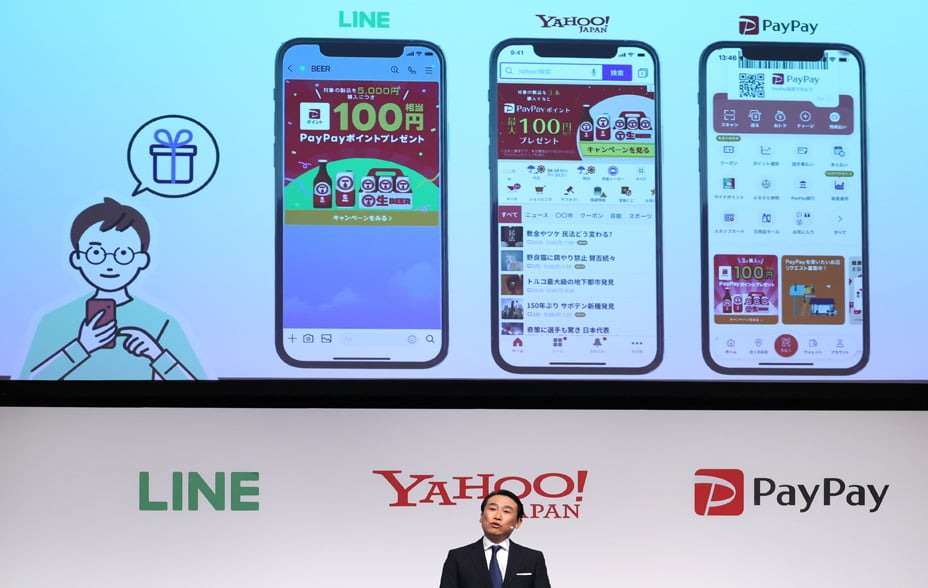
Z clearly enjoys immense advantages. Its customer reach through Yahoo! Japan (86 million monthly active users or MAUs), LINE (92 million MAUs in Japan, with another 81 million abroad), PayPay (47 million MAUs) and parent company, SoftBank Corp (39 million subscribers) will give it unprecedented referral traffic. Also, rather than being potentially one ‘super app’, the company's CFO, Ryosuke Sakaue, claimed that Z was an amalgam of three super apps: Yahoo! Japan; PayPay; and LINE. These three appealing areas provide significant breadth in its product and service offering that should provide new paths for growth well into the future.
Regulatory Information
This content was produced and approved at the time stated and may not have been updated subsequently. It represents views held at the time of production and may not reflect current thinking. Read our Legal and regulatory information for further details.
A Key Information Document is available by visiting our Documents page. Any images used in this communication are for illustrative purposes only.
This communication does not constitute, and is not subject to the protections afforded to, independent research. Baillie Gifford and its staff may have dealt in the investments concerned. The views expressed are not statements of fact and should not be considered as advice or a recommendation to buy, sell or hold a particular investment.
Baillie Gifford & Co and Baillie Gifford & Co Limited are authorised and regulated by the Financial Conduct Authority (FCA). The investment trusts managed by Baillie Gifford & Co Limited are listed on the London Stock Exchange and are not authorised or regulated by the FCA.
Baillie Gifford Overseas Limited (BGO) provides investment management and advisory services to non-UK clients. BGO is wholly owned by Baillie Gifford & Co. Both are authorised and regulated in the UK by the Financial Conduct Authority.
Baillie Gifford Asia (Hong Kong) Limited 柏基亞洲(香港)有限公司 (BGA) holds a Type 1 licence from the Securities and Futures Commission of Hong Kong to market and distribute Baillie Gifford’s range of collective investment schemes and closed-ended funds such as investment trusts to professional investors in Hong Kong.
Baillie Gifford Asia (Singapore) Private Limited (BGAS) is regulated by the Monetary Authority of Singapore as a holder of a capital markets services licence to conduct fund management activities for institutional investors and accredited investors in Singapore. BGA and BGAS are wholly owned subsidiaries of Baillie Gifford Overseas Limited, which is wholly owned by Baillie Gifford & Co.
Scottish Mortgage Investment Trust PLC (the “Company”) is an alternative investment fund for the purpose of Directive 2011/61/EU (the “AIFM Directive”). Baillie Gifford & Co Limited is the alternative investment fund manager (“AIFM”) of the Company and has been authorised for marketing to Professional Investors in this jurisdiction.
This communication is made available by Baillie Gifford Investment Management (Europe) Limited (“BGE”), which has been engaged by the AIFM to carry out promotional activities relating to the Company. BGE is authorised by the Central Bank of Ireland as an AIFM under the AIFM Regulations and as a UCITS management company under the UCITS Regulation. BGE also has regulatory permissions to perform promotional, advisory and Individual Portfolio Management activities. BGE has passported its authorisations under the mechanisms set out in the AIFM Directive.
Australia
This information is provided to you on the basis that you are a “wholesale client” within the meaning of section 761G of the Corporations Act 2001 (Cth) (“Corporations Act”). In no circumstances should this information be made available to a “retail client” within the meaning of section 761G of the Corporations Act. This information contains general information only. It does not take into account any person’s objectives, financial situation or needs.
Belgium
The Company has not been and will not be registered with the Belgian Financial Services and Markets Authority (Autoriteit voor Financiële Diensten en Markten / Autorité des services et marchés financiers) (the FSMA) as a public foreign alternative collective investment scheme under Article 259 of the Belgian Law of 19 April 2014 on alternative collective investment institutions and their managers (the Law of 19 April 2014). The shares in the Company will be marketed in Belgium to professional investors within the meaning the Law of 19 April 2014 only. Any offering material relating to the offering has not been, and will not be, approved by the FSMA pursuant to the Belgian laws and regulations applicable to the public offering of securities. Accordingly, this offering as well as any documents and materials relating to the offering may not be advertised, offered or distributed in any other way, directly or indirectly, to any other person located and/or resident in Belgium other than to professional investors within the meaning the Law of 19 April 2014 and in circumstances which do not constitute an offer to the public pursuant to the Law of 19 April 2014. The shares offered by the Company shall not, whether directly or indirectly, be marketed, offered, sold, transferred or delivered in Belgium to any individual or legal entity other than to professional investors within the meaning the Law of 19 April 2014 or than to investors having a minimum investment of at least EUR 250,000 per investor.
Germany
The Trust has not offered or placed and will not offer or place or sell, directly or indirectly, units/shares to retail investors or semi-professional investors in Germany, i.e. investors which do not qualify as professional investors as defined in sec. 1 (19) no. 32 German Investment Code (Kapitalanlagegesetzbuch – KAGB) and has not distributed and will not distribute or cause to be distributed to such retail or semi-professional investor in Germany, this document or any other offering material relating to the units/shares of the Trust and that such offers, placements, sales and distributions have been and will be made in Germany only to professional investors within the meaning of sec. 1 (19) no. 32 German Investment Code (Kapitalanlagegesetzbuch – KAGB).
Luxembourg
Units/shares/interests of the Trust may only be offered or sold in the Grand Duchy of Luxembourg (Luxembourg) to professional investors within the meaning of Luxembourg act by the act of 12 July 2013 on alternative investment fund managers (the AIFM Act). This communication does not constitute an offer, an invitation or a solicitation for any investment or subscription for the units/shares/interests of the Trust by retail investors in Luxembourg. Any person who is in possession of this document is hereby notified that no action has or will be taken that would allow a direct or indirect offering or placement of the units/shares/interests of the Trust to retail investors in Luxembourg.
Switzerland
The Trust has not been approved by the Swiss Financial Market Supervisory Authority (“FINMA”) for offering to non-qualified investors pursuant to Art. 120 para. 1 of the Swiss Federal Act on Collective Investment Schemes of 23 June 2006, as amended (“CISA”). Accordingly, the interests in the Trust may only be offered or advertised, and this document may only be made available, in Switzerland to qualified investors within the meaning of CISA. Investors in the Trust do not benefit from the specific investor protection provided by CISA and the supervision by the FINMA in connection with the approval for offering.
Singapore
This communication has not been registered as a prospectus with the Monetary Authority of Singapore. Accordingly, this communication and any other content or material in connection with the offer or sale, or invitation for subscription or purchase, of the Trust may not be circulated or distributed, nor may be offered or sold, or be made the subject of an invitation for subscription or purchase, whether directly or indirectly, to persons in Singapore other than (i) to an institutional investor (as defined in Section 4A of the Securities and Futures Act 2001, as modified or amended from time to time (SFA)) pursuant to Section 274 of the SFA, (ii) to a relevant person (as defined in Section 275(2) of the SFA) pursuant to Section 275(1), or any person pursuant to Section 275(1A), and in accordance with the conditions specified in Section 275 of the SFA, or (iii) otherwise pursuant to, and in accordance with the conditions of, any other applicable provision of the SFA.
Where the Trust is subscribed or purchased under Section 275 by a relevant person which is:
(a) a corporation (which is not an accredited investor (as defined in Section 4A of the SFA)) the sole business of which is to hold investments and the entire share capital of which is owned by one or more individuals, each of whom is an accredited investor; or
(b) a trust (where the trustee is not an accredited investor) whose sole purpose is to hold investments and each beneficiary of the trust is an individual who is an accredited investor, securities or securities-based derivatives contracts (each term as defined in Section 2(1) of the SFA) of that corporation or the beneficiaries’ rights and interest (howsoever described) in that trust shall not be transferred within six months after that corporation or that trust has acquired the securities pursuant to an offer made under Section 275 except:
(1) to an institutional investor or to a relevant person or to any person arising from an offer referred to in Section 275(1A) or Section 276(4)(c)(ii) of the SFA,
(2) where no consideration is or will be given for the transfer;
(3) where the transfer is by operation of law; or
(4) pursuant to Section 276(7) of the SFA or Regulation 37A of the Securities and Futures (Offers of Investments) (Securities and Securities-based Derivatives Contracts) Regulations 2018.
Ref: 37476 10019475