
Illustrations by Philippe Nicolas
As with any investment, your capital is at risk.
Early in 2024, as investors in Uber pondered its prospects, Tesla founder Elon Musk outlined his vision of a fully autonomous ‘robo-taxi’ service. One day, he hinted, his company would surpass Uber’s achievements in revolutionising personal transport.
Human drivers, he told investors, will become as rare as human lift-operators: “[This will] be how cars work: you just summon a car using your phone. You get in, it takes you to a destination, you get out. Tesla will be operating the fleet [like a] combination of Airbnb and Uber.”
The prospect of going up against the might of Tesla in a new technology that could slash the cost of ride-hailing weighed for a spell on Uber’s share price. It didn’t help that the latter firm had aborted a previous bid for autonomous vehicle (AV) leadership, following legal wrangles.
But to us, the market was missing something big: Uber already offered the frictionless future Musk had envisaged, by combining robo-taxis with human drivers.
Why we bought when others sold
Uber matches passengers with Alphabet’s Waymo autonomous vehicles (AVs) via its app in Phoenix, Austin and Atlanta. People simply get into these robo-taxis, travel and get out. What’s more, Uber’s partnerships with AV and AI technology leaders Pony.ai, Baidu, Wayve, WeRide, Lucid and Nuro put it in a good position to aggregate future global demand for robo-rides.
When the market proclaims a company a loser, our managers try to stay flexible and consider things from a different angle. Often, the market is spot on. Revolutionary technologies do shift the ground beneath incumbents, even young ones like Uber. We’re not contrarian for the sake of it.
In Uber’s case, however, we came to a different view. Early in 2025, we pounced, taking advantage of the market’s jitters to buy a stake in Uber for our shareholders. We believed the stock was significantly undervalued.
There are three reasons we have the confidence to hold this differentiated view.
1. Growing current markets
Uber has become so ubiquitous that it’s easy to forget that it is itself a transformative technology. Founded as recently as 2009, it’s been mainstream for barely a decade. Over 180 million customers now use the app to take over a billion trips each month.
Given these numbers, you might think Uber has already grown all it can. But we see Uber’s core product as only halfway there. It can still:
- expand into new countries
- reach more people within existing markets
- increase their use of the app
Uber recently said that in India and Spain only about 0.5 per cent of adults use Uber each week. In Australia, the number is 6.5 per cent.
There are of course big differences between these markets. However, the fundamental usefulness of Uber’s offering to consumers means other countries should eventually move closer to the most fully penetrated of Uber’s markets, such as Australia.
Eventually, this would add tens, if not hundreds, of millions of additional users, once city-by-city regulatory and technical hurdles have been overcome. It takes time to revolutionise global transport infrastructure.
Meanwhile, because Uber offers both ride-hailing and food delivery through Uber Eats, it can generate more value per dollar spent acquiring a new customer than single-product rivals. Similarly, when it recruits drivers, it can keep them busier – and earning more – by finding them work through both ferrying passengers and delivering food.
To us, those factors add up to a powerful engine with a long way to run. The more people hail Ubers, the busier its drivers, the cheaper its rides and the more people hail Ubers. And so on.
2. Top of the robo-taxi rank
The future of transport is a world where people’s cars are loaned out, rather than sitting idle for most of the day, as at present.
Anyone considering buying an AV to earn income by putting it on a ride-hailing network will face a simple – but not easy – calculation. What’s the return on investment?
This depends on a few variables, most importantly the cost of the vehicle and the time it spends earning money for its owner – its utilisation rate.
That in turn depends on how many customers the vehicle can reach. As the largest ride-hailing network in the world, Uber offers a structural advantage here. Anyone who puts their vehicle on Uber’s network has instant access to all its customers, driving up utilisation.
Uber’s experience with Waymo supports this. Waymo AVs on Uber in Phoenix were busier than 99 per cent of human equivalents. Uber also has scale advantages in being able to manage the ‘ground ops’ of an autonomous fleet – charging, cleaning and servicing.
Building a rival network to Uber’s poses formidable challenges and would cost extraordinary amounts.
Think of the daily demand spike as people go to and from work at rush hour. Any would-be AV competitor would have to flood an area with vehicles on day one to meet that demand. Why? Because customers would quickly ditch the service in disgust if it didn’t get them to work or home on time.
Then, at night, when demand falls, this upstart network would have vast numbers of passengerless vehicles, earning nothing. Returns-per-vehicle would fall off a cliff.
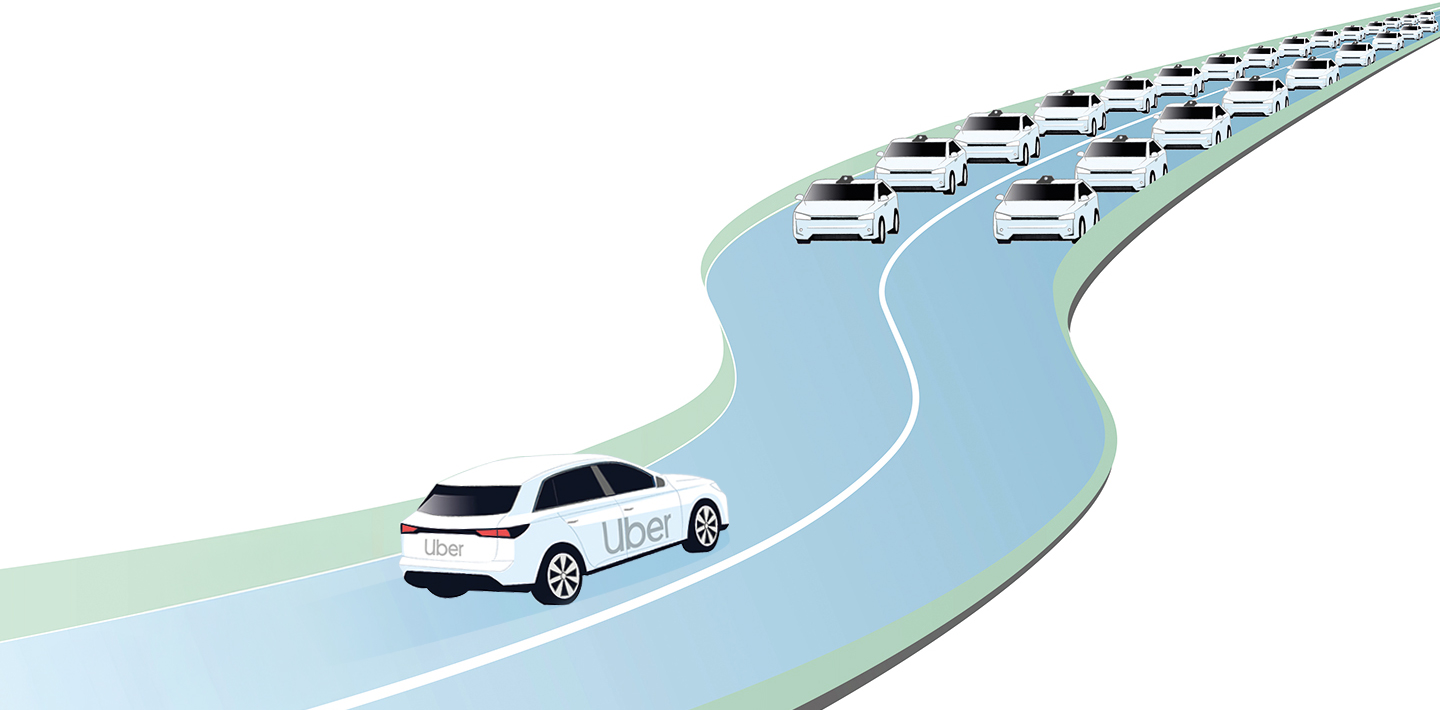
Uber, meanwhile, can blend human and autonomous drivers into a single network, expanding and contracting supply to meet demand. Over time, customers will stick to the network that reliably gets them, or their food, to where they need to be quickest and at the lowest cost.
To be clear, we don’t think autonomous ride-hailing is a winner-takes-all market. Decreasing costs and increasing ride quality should expand the total market, creating more opportunity for everyone. Even in markets such as San Francisco, where Waymo has gained market share through its own app (rather than Uber’s), demand for Uber’s rides has continued to grow.
Transformative new technologies are rarely zero-sum. But it’s when most investors think they are that the more flexibly minded can seize opportunities.
3. A ‘super-app’ and more
Some readers will be among the 36-million-plus members of Uber’s subscription programme Uber One. Others will have booked a flight or a train journey through its travel-booking service. Many will have noticed adverts in the Uber app, another growing profit stream.
These add-ons show Uber expanding its offering and making its app more useful. If successful, Uber could become an Asian-style ‘super app’, helping consumers run their daily lives.
Uber also owns stakes in a range of other companies, from south-east Asia’s super-app Grab to autonomous trucking specialist Aurora in the US. And in August 2025, it announced a buyback of up to $20bn of its own shares, a sign of confidence in the health of its balance sheet.
The company has also announced a partnership with NVIDIA that will enable ‘level-4’ fully autonomous vehicles to run on Uber’s network, meaning they can handle all driving tasks within a pre-defined zone. That would let owners earn money while they work or sleep, echoing Musk’s vision for Tesla.
To Baillie Gifford, these are all signs of a company firing on all cylinders. We’re excited to watch Uber help lead the global transition to autonomous transport.
Waymo: another stake in future mobility
The subsidiary of Baillie Gifford holding Alphabet (formerly Google) is a leader in fully autonomous technology. Its system handles all aspects of driving without human oversight and powers a public ride-hailing service in several US cities. Aiming to replace drivers rather than just assist them, it’s an investment in the long-term vision of autonomous mobility as a service.
 Waymo Ojai autonomous minivan
Risk factors
The views expressed should not be considered as advice or a recommendation to buy, sell or hold a particular investment. They reflect opinion and should not be taken as statements of fact nor should any reliance be placed on them when making investment decisions.
This communication was produced and approved in March 2026 and has not been updated subsequently. It represents views held at the time of writing and may not reflect current thinking.
Potential for profit and loss
All investment strategies have the potential for profit and loss, your or your clients’ capital may be at risk. Past performance is not a guide to future returns.
This communication contains information on investments which does not constitute independent research. Accordingly, it is not subject to the protections afforded to independent research, but is classified as advertising under Art 68 of the Financial Services Act (‘FinSA’) and Baillie Gifford and its staff may have dealt in the investments concerned.
All information is sourced from Baillie Gifford & Co and is current unless otherwise stated.
The images used in this communication are for illustrative purposes only.
191813 10061946