

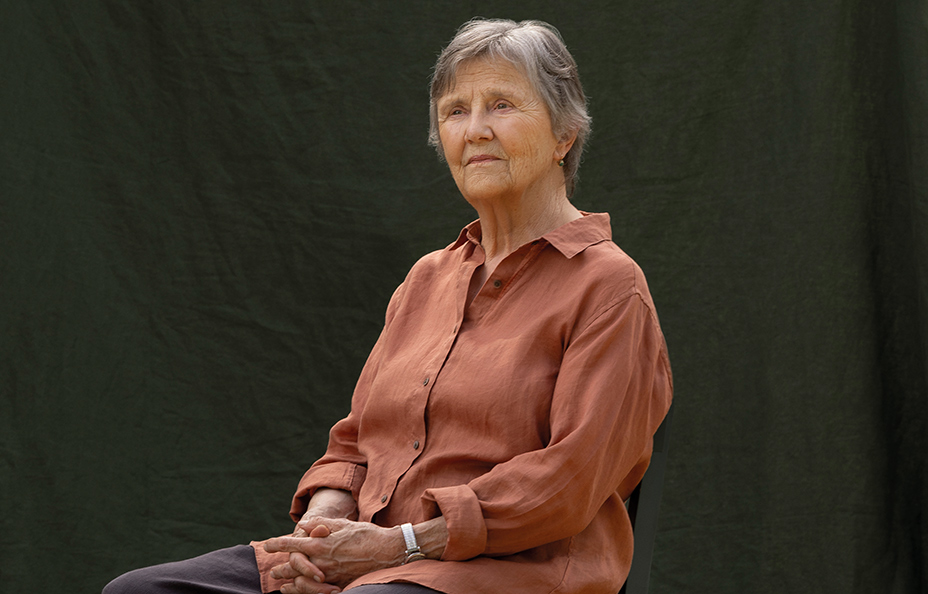
Photography by Charlie Kinross
Helen Garner, author of How to End a Story: Collected Diaries, has long been a recorder of small things, details so slight they can seem almost throwaway. Yet in her hands, even a line about breakfast can break your heart.
The Australian writer most recently co-authored The Mushroom Tapes, following the case of Erin Patterson, the middle-aged woman from small-town Victoria convicted of poisoning three relatives and attempting to kill another. Garner recalled a man telling the court about the morning before his wife’s murder.
It brought home to her the horror and cruelty of the crime: “The little things he said, like ‘we had a nice bowl of porridge’. That kind of ordinariness draws you in.”
Such touches, Garner explains, catch the moment just before life broke open, when the day still felt like any other. These particulars, she tells me from her home in Melbourne, bring us closer to reality and expose us to the terrible truth of how catastrophe lurks amid daily banality. At 83, small and birdlike on screen, she speaks, after pausing for thought, with precision.
Making art out of the everyday
For nearly half a century, critics told her that such concerns were trivial. The “literary world”, as she calls it, dismissed the domestic as unserious, ‘women’s writing’ rather than writing proper.
She published Monkey Grip in 1977, her first novel, a raw portrait of a single mother living in bohemian Melbourne, struggling with a difficult relationship with a heroin addict. One critic scolded her for drawing on her own life, implying she had not done the intellectual labour of a ‘real’ writer.
Garner recalls, too, with wry amusement, the year she spent in France with her young daughter. She returned to Melbourne with a new manuscript centred, not on existential cafes or the Seine, but on her “boring old domestic life”. Her critics were affronted.
“I was supposed to go to Paris and have a revelation, to see there was a world out there,” she says. Instead, she found herself drawn to routine interactions and feelings, and so she dug in. She had another realisation too: that Australia was where she belonged. “That huge blue sky is not found anywhere else.”
For Garner, attention to everyday life is serious work. How to End a Story is a testament to this. The three volumes of diaries, spanning 1978 to 1998, won her 2025’s Baillie Gifford Prize for Non-Fiction.
A diary, not a notebook
The journal forms a long, unfolding self-portrait. Honest without being confessional, exact without being clinical, they record her day-to-day ideas, emotions and happenings with care. They were not, she insists, an attempt “to drop your load”, but a way of examining her thoughts and actions as she lived them.
She wrote morning or night as a calming ritual, in full sentences, never in scraps. “A notebook is for overheard things,” she tells me. “The diary is different. It has to be my best writing. It is where I try out tones and sentences. And no one can tell me it’s ridiculous.”
Running through the second and third volumes is a turbulent love affair with the novelist Murray Bail, her third husband. She spares him, and everyone else, a few blushes by using only initials for names, but the emotional clarity is brutal. At first, the entries vibrate with early attraction: the thrill of discovery, the shared vocation, the wild infatuation. That is, before it slowly goes wrong. They were married for eight years.
“Scorched earth” is how she looks back on the relationship now, but those first pages reveal what she calls a touching “naivety”. “Why didn’t I see it coming?” she shakes her head, laughing. The diaries answer for her: the creeping tensions over work, his always taking precedence. The subtle humiliations. The gradual erosion of her confidence. And, finally, the affair he would not acknowledge even as it unfolded in front of her.
The courage to court controversy
This same habit of meticulous recording would have explosive public consequences. In The First Stone, her 1995 account of a University of Melbourne sexual-harassment case, her refusal to paint in black and white provoked a storm.
Furious letters poured in from women who felt she had taken the wrong side, although she sided with neither. “I am taking your books off my shelves,” one wrote. A lifelong feminist, Garner came to resist the idea that she had to write within acceptable ideological boundaries. “If I did not express the current line, I would be considered a heretic,” she says. “But I wanted to think for myself.”
She nearly had a breakdown, she says. “I learned what I can cop. And then I felt free.” Years later, strangers still write to apologise.
That resistance to conformity runs through How to End a Story, in which she charts the reaction to The First Stone and reflects on generational shifts. Prefiguring #MeToo, the younger generation of women took against her, while hers tended to think a man’s clumsy pass not worth a fuss.
Anyone expecting overt political analysis, however, will find little of it here. As she points out, diaries written during the French Revolution do not address it directly either. It is simply there, in the background.
For decades, the diaries were private, written only for her. During the Covid pandemic, when daily life became all-encompassing, her editor suggested she assess them for publication. Garner read them, thought yes, and rewrote nothing, although she “cut the boring bits”.
Imposter syndrome
She asked most of those involved for permission. Everyone said fine and that they trusted her, refusing her offer to let them read parts in advance, and no one has since complained. She thinks Bail, with whom she has had no contact for decades, has not read them. “He never much liked reading me anyway.”
When the diaries were shortlisted for the Baillie Gifford Prize, she barely registered it. “Prizes bring out infantile stuff. You start thinking, pick me! pick me! like a little girl.” She assumed she wouldn’t win. “I thought, what am I doing on this list? These people have written proper books.”
Winning the £50,000 award “staggered” her. “For two weeks, I could not believe it. People asked what I would do with the money, and I would say: ‘What money?’ I was wandering around in a daze.”
Now, as the shock clears, something else begins to stir.
“The joy of it,” she says, “is that it validated the work I did all those years in those diaries. They are the core of everything I have ever written.”
It turns out that the things she has always written about, breakfast, the unguarded phrase, the lecherous pass, the exact moment when love turns, were never small at all.


