
© SpaceX
As with any investment, your capital is at risk.
The US Growth team first invested in SpaceX in 2018. It was a private company holding in our London-listed investment trust. At the time, the company was valued at approximately $30bn.
Importantly, our decision to buy shares at the IPO seven years later was not a judgment on the success of that earlier investment. Just because we invest in a company when it is private does not guarantee we will buy it if it goes public. We always conduct a fresh assessment of the returns available from the IPO price.
SpaceX came to market at a valuation of about $1.7tn, equivalent to roughly 92 times its 2025 revenues. The valuation leaves little room for an ordinary outcome. We’re comfortable with that, given that we aim to own the future long-run outliers in the stock market, it would need to deliver something extraordinary for us to consider buying the shares, anyway.
But to justify investing, we needed evidence of durable businesses, credible expansion routes and an operating model that could support new revenue streams.
Evidence: launch
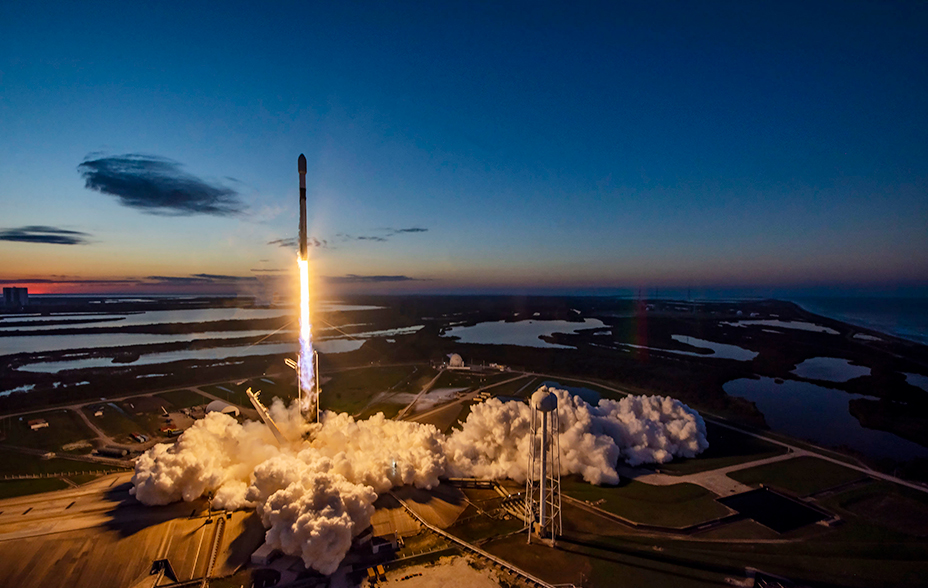
SpaceX accounted for more than 80 percent of the world’s mass delivered to orbit since 2023. In 2025, it completed 165 launches, close to one every other day. That cadence creates manufacturing scale, operational data and repeated opportunities to improve reliability and cost. Competitors who launch only occasionally simply cannot learn as quickly.
SpaceX also controls a large source of demand for those launches. Starlink uses the company’s rockets to deploy and replenish its satellite network. This keeps launch frequency high while improving the economics of both businesses. It is a practical example of vertical integration rather than simply a theoretical one.
Evidence: Starlink
Starlink is now the company’s largest business. It generated about 61 percent of SpaceX’s 2025 revenues and had more than 10 million subscribers by early 2026. Rural broadband remains important, but the addressable market is broader.
Satellite connectivity can be particularly valuable in aircraft, ships, remote industrial sites, emergency response and defence, where terrestrial networks are unavailable, fragile or uneconomic.
Direct-to-device services could extend that reach from dedicated terminals to ordinary mobile phones, which is another huge market.

Starlink provides high-speed, low-latency internet with more than 99.9% average uptime and reliable connectivity worldwide
SpaceX’s launch and satellite markets are observable, and customers are paying for the service today. Its network business is continually improving through frequent satellite launches and higher-volume manufacturing. That makes its launch business and Starlink a useful anchor in our analysis before we attempt to estimate what the space economy might one day become.
Yes, there is undoubtedly huge potential in the commercialisation of space, its AI business and orbital compute. These are harder, perhaps impossible to model. Yet our experience investing in Elon Musk’s companies for more than a decade shapes our analysis here.
Potential: Starship and the commercialisation of space
The next stage of launch growth depends substantially on Starship. If successful, it could carry about four times the payload of Falcon 9 and reduce launch costs by a further order of magnitude (perhaps >90-fold by some estimates). That would further improve Starlink’s economics and make larger satellites and new infrastructure projects more feasible.
We do not treat Starship’s success as guaranteed. Delays, technical setbacks or weaker-than-expected economics would materially reduce the investment case. However, progress is sufficient for us to keep underwriting the opportunity, despite clear execution risk.
Potential: AI and orbital compute
Musk’s track record of successfully integrating seemingly different businesses to propel long-term growth (think Tesla incorporating solar and energy storage, and now automation and robotics) is helpful when assessing SpaceX and its opportunity in AI.
SpaceX now includes xAI, X.com and substantial datacentre capacity. In July 2026, Anthropic is now paying $1.25bn a month for space at its Colossus datacentre in Memphis, and Google has agreed to pay $920mn a month to rent approximately 110,000 Nvidia GPUs. That’s $26bn in annual revenues from these two companies alone over the next few years. While these contracts may be relatively short-term (to mid-2029 at present), demand for compute driven by the growth of agentic AI appears structural, which bodes well for SpaceX.

A rendering of one of SpaceX's planned AI1 satellites in orbit
© SpaceX
There may also be strategic benefits from combining launch, communications, computing infrastructure and AI models. Orbital computing could eventually be strategically important if terrestrial power, land and cooling constraints intensify.
For now, we regard this as optionality rather than the foundation of our valuation. It is a possible source of (huge) upside, but it is accompanied by high capital requirements and, of course, considerable execution risk. But again, Musk specialises in ‘making the impossible merely late.’
Why invest at the IPO rather than wait?
Our seven-plus years of ownership gave us a deeper evidence base than an IPO prospectus or roadshow could provide. We had observed the company through changes in launch cadence, the scaling of Starlink and the development of Starship. That history did not remove uncertainty, but it allowed us to assess the IPO from a position of established knowledge rather than first impressions.
The structure of the offering was also important. Only around 3–4 percent of the company’s shares were expected to trade freely initially, while much of the pre-existing shareholder base was subject to staggered lockups. Early index inclusion could add demand for a limited pool of shares. These mechanics were not the reason to own SpaceX, but they made waiting a consequential decision: building a meaningful position later might have required paying materially different prices.
As with other Musk companies, there are notable risks. The governance structure concentrates voting control and limits minority shareholder influence. The combination with xAI increases financial and accounting complexity. Launch activity has environmental costs, and the company’s defence exposure requires continued scrutiny.
We invested with these issues clearly understood. Position sizing and ongoing engagement with company leadership will be central to managing them. We trimmed some of our Tesla holdings to fund the IPO purchase to manage overall exposure to Musk-run companies in the portfolio. We also thought it prudent to bank some profits in the days following IPO as the share price ran up, keeping it as a ‘starter position’ in the portfolio.
A unique company building the future
US Growth invested at the IPO because SpaceX already has two businesses of unusual scale and strategic importance in launch and connectivity; because its integrated operating model may allow it to extend into additional infrastructure markets; and because our long ownership history gave us enough evidence to take a considered view at listing.
Yes, the price requires exceptional execution. We do not assume that every ambition will be realised. However, we do believe SpaceX has demonstrated an ability to reduce costs, create demand and build new revenue streams more effectively than competitors. We think it is at least 10 years and 600 launches ahead of the competition.
After weighing that evidence against the valuation and risks, we concluded that the potential long-term upside remained sufficient to merit a position in our US Growth public portfolios.
Risk factors
The views expressed should not be considered as advice or a recommendation to buy, sell or hold a particular investment. They reflect opinion and should not be taken as statements of fact nor should any reliance be placed on them when making investment decisions.
This communication was produced and approved in July 2026 and has not been updated subsequently. It represents views held at the time of writing and may not reflect current thinking.
Potential for Profit and Loss
All investment strategies have the potential for profit and loss, your or your clients’ capital may be at risk. Past performance is not a guide to future returns.
This communication contains information on investments which does not constitute independent research. Accordingly, it is not subject to the protections afforded to independent research, but is classified as advertising under Art 68 of the Financial Services Act (‘FinSA’) and Baillie Gifford and its staff may have dealt in the investments concerned.
All information is sourced from Baillie Gifford & Co and is current unless otherwise stated.
The images used in this communication are for illustrative purposes only.
202624 10064581