

As with any investment, your capital may be at risk.
At the Global Alpha 2026 Forum, Malcolm MacColl opened by acknowledging that the last five years have been a very different experience from the first 15 years of Global Alpha.
During those first 15 years, the team developed a distinctive investment approach and a set of capabilities, which it was hugely proud of. The focus of the forum was on how the team is responding to the recent challenges through portfolio and process improvements, and why it believes the portfolio is “in the best shape it’s been in for years”.
Malcolm wanted attendees to take away a sense of energy and enthusiasm for the portfolio and today’s opportunity set, and to be reassured by the work being done to position Global Alpha for success from today’s starting point.
Following the welcome, attendees rotated through three breakout sessions. Summaries of these sessions follow.
Portfolio construction: balancing opportunity with situational awareness
Malcolm MacColl and James Taylor
This breakout session explored the changing nature of equity markets and what that means for long-term active investors.
Malcolm described markets as living, breathing, adaptive systems populated by many participants with diverse incentives and time horizons. That market ecology has changed materially over the past five to 10 years.
Investors have put far more money into passive funds. In the US market, passive investment now represents more than 60 percent of assets under management (AUM), up from roughly a third a decade or so ago.
More than $19tn has moved into passive strategies over that period. That capital does not ask whether a company is cheap or expensive.
Nor does it get to know management teams or bother itself with governance structures. It buys because money flows into funds.
Meanwhile, markets have become more concentrated. The top 10 holdings in the S&P 500 are about 40 percent of the index, while the top five alone are about 30 percent. These levels of concentration have occurred before, but not since the 1960s.
The active market has changed, too. Long-only, long-term stock pickers now represent a much smaller share of traded volume than they once did. There is more fast money (short-term traders), thematic trading, momentum, retail participation and highly sophisticated hedge fund structures with shorter time horizons.
Multi-manager “pod shops” (hedge funds that divide capital between many semi-independent investment teams) may represent about 10 percent of hedge fund assets, but a much larger share of traded volume.
This has significant implications for price discovery, the process by which markets decide what a share is worth. It can make markets more volatile. It can make narratives more powerful in the short term. It can also create dislocations, temporary gaps between share prices and business fundamentals.
The speakers discussed the sharp sell-off in software and business services companies earlier this year, dubbed “SaaSmageddon” (software-as-a-service Armageddon).
A narrative that artificial intelligence (AI) would “kill software” was enough to trigger extreme moves in baskets of companies, often with little regard for the fundamentals of the individual businesses.
Datadog, which helps companies monitor the performance of their digital systems, illustrated the point. Concerns emerged that OpenAI could move into its market. Yet against that backdrop, Datadog’s reported revenue growth and gross margins remained notably consistent.
Later results suggested that Datadog was seeing increased AI-related usage, while OpenAI appeared to have stepped back from direct competition in that area. The lesson here is that investors need to understand who else is “at the poker table”.
Global Alpha believes this market environment can ultimately suit long-term active managers. But it does require them to be clear-eyed about the environment and disciplined about portfolio construction.
James Taylor then explained how the investment analytics team is helping Global Alpha navigate this changed ecology. The central idea is a portfolio-first mindset. Global Alpha remains a bottom-up, reward-seeking strategy built around individual company insights.
In a market where short-term outcomes are driven more by broader forces than by company fundamentals, the team believes it needs a clearer view of the portfolio as a whole. It does this by asking sharper questions:
- What are the drivers of growth?
- Where are the unintended exposures?
- Which parts of the portfolio are zigging while others are zagging?
- What are the second- and third-order effects of higher oil prices, inflation, commodity moves, or regional economic shifts?
How does this work in practice?
Understanding
portfolio sensitivity
For example:

Impact of higher oil prices
Understanding
portfolio context
For example:

Quality compounders and
downside capture
Expressing enthusiasm
For example:

Exposure across the AI
supply chain.
The investment analytics team has built an internal investment intelligence platform that links together datasets, market information, risk tools, company insights and AI-enabled querying. This allows the team to ask questions in real time, in natural language, about exposures, sensitivities, correlations and scenarios.
The objective is to shorten feedback loops, inform conversations, and help the team to make more deliberate portfolio decisions, without letting risk models dictate the portfolio.
The impact has been meaningful. Just over a year ago, about three-quarters of the portfolio’s deviation from its benchmark was driven by broad themes and market-wide factors, rather than individual stock selection. That figure is now below half.
Tracking error and beta – the portfolio's sensitivity to movements in the wider market – have decreased, while active share1 remains high. Turnover has ticked up, but the team sees that as a consequence of putting money where conviction is strongest.
In Malcolm’s words, taking thematic risk down is an enabler. It allows the team to “swing harder” in individual companies where it has conviction. Doing so means that stock-specific outcomes, rather than unintended thematic exposures, are the main driver of investment outcomes.
Emerging markets: at an inflection point
Will Sutcliffe and Helen Xiong
This breakout focused on emerging markets (EM), now Global Alpha’s largest active regional allocation relative to the benchmark.
Helen Xiong opened by noting that this may surprise some investors, given that emerging markets are often discussed through the lens of politics, geopolitics and macroeconomic uncertainty. But from the perspective of long-term global growth investors, what matters most is the quality of the businesses being built.
Increasingly, the team is finding world-class companies at the forefront of innovation, digitisation, manufacturing, consumer growth and the AI supply chain.
Baillie Gifford has deep roots in emerging markets, having managed dedicated emerging market strategies since 1994, making it an area of longstanding expertise.
Will Sutcliffe began by challenging one of the great myths of emerging markets investing: that superior economic growth automatically leads to superior earnings growth and, in turn, superior share price performance.
The reality is more complicated. Economic growth in emerging markets does not always translate smoothly into dollar returns for global investors. Currency moves, commodity prices and inflation can all overwhelm improvements in local economies or company fundamentals.
Will used Brazil as an example: modest differences in local-currency GDP growth can translate into huge differences in dollar GDP, equity returns and investor outcomes when commodity prices and currencies move sharply.
For much of the last 10 or 15 years, macro has been a headwind for emerging markets. Will’s argument was that this headwind could now become a tailwind.
He noted three reasons. First, emerging markets appear more macro-resilient than at any point in their history. Historically, EM crises have followed a familiar playbook: US interest rates rise, capital floods out of emerging markets and booms turn into busts.
But during the 2022–23 Federal Reserve hiking cycle, when US rates moved from 20-year lows to 20-year highs, the vast majority of emerging markets sailed through relatively unscathed.
One reason is that emerging markets have not been able to rely on the “kindness of strangers”. Net capital flows have been weak or negative for much of the past decade, forcing many economies to learn resilience and self-sufficiency. Debt levels, inflation and external deficits look healthier than in many previous cycles.
Second, there is still growth. Even in a supposedly deglobalising world, emerging market exports are growing. The world needs a lot of “stuff”: steel, cement, copper, lithium, resilient supply chains, renewable infrastructure, and the semiconductor picks and shovels that power AI.
The session also explored the rise of intra-emerging market trade. More trade is happening between emerging markets themselves, increasingly in renminbi, rupees, reais and other local currencies.
If that continues, it could further liberate emerging markets from their historical dependence on the dollar and provide more domestic capital to fund growth.
Third, the calibre of companies has transformed. When Will began investing in emerging markets, the opportunity set was often dominated by banks, telecoms, utilities and resource companies.
Today, it includes companies capable of competing with and beating companies elsewhere in the world. There is no AI without emerging markets. Every Claude or ChatGPT query depends on hardware supply chains in which Taiwan and South Korea play major roles.
World-class companies

TSMC

CATL

B3

MercadoLibre

Nu Holdings

Petrobras
Companies including TSMC, Samsung, SK Hynix, CATL, MercadoLibre, Nubank, B3 and others were discussed as examples of world-class businesses that happen to be listed in emerging markets. Many of which still trade at emerging-market discounts.
The speakers made the distinction between the invention and deployment of technology. In the west, technology is often thought of as intellectual property, software, scientific discovery and the “zero-to-one” breakthrough moment.
The other side of the coin is the deployment of process technology, the ability to scale manufacturing, deliver at low cost, on time and at high quality. This is sometimes described as the “one-to-many”.
While the west may excel at the zero-to-one breakthroughs, many Asian companies excel at the one-to-many that turns the invention into something the world can use at scale.
Solar panels were invented in the west, but China drove down manufacturing costs. The US invented the iPhone, but Asia played a major role in producing it.
US companies played a leading role in developing advanced semiconductor chip design, while TSMC manufactures many of the world’s most advanced chips.
That pattern may prove highly relevant in the next phase of AI, as the focus shifts from large language models to physical AI, robotics, datacentres, chips and advanced automation.
The risks remain: geopolitics matters, governance can be cyclical and country-level shocks do not disappear. But where there is uncertainty, there can also be mispricing.
Emerging markets are no longer just a tactical allocation or an investment that depends heavily on an economic upswing. Increasingly, they are home to some of the world’s most innovative, competitive and strategically important companies.
Enduring bottlenecks: finding growth in a more capital-intensive age
Mike Taylor
In this breakout session, Mike Taylor noted that Global Alpha has been busier than usual because there is an imperative to be busy. He suggested the range of attractive growth opportunities has widened, perhaps more than at any point in his career.
The world is changing as companies and governments deploy capital across the global economy at an extraordinary rate. That has profound ramifications for economies and markets.
Demand is rising faster than supply can respond, creating bottlenecks, pricing power and earnings growth across a wide range of places, sometimes obvious, sometimes unexpected.
Mike also placed this in the longer history of Global Alpha. The idea that growth investing is simply tech investing is wrong. Growth investing means finding growth that is profitable and underappreciated.
Over Global Alpha’s history, the portfolio's shape has shifted many times. At different points, the portfolio has been heavily tilted towards consumer staples, industrials, financials, communication services and technology.
The opportunity set changes over time. Global Alpha moves to where the attractive opportunities are. Today, growth is appearing in more places than it has for a very long time; one such analytical framework is the concept of bottlenecks.
Demand needs to be paired with supply restraint. Without it, growth may simply fund someone else’s volume growth. The attractive opportunity is where demand is rising, but supply cannot respond quickly.
The demand is clear. AI is a major part of it, but it is not the only driver. Governments and companies are spending heavily on AI build-out, defence rearmament, electrification, reshoring supply chains and the regionalisation of economies. Each is a multi-year, capital-hungry trend in its own right. They are all arriving at once.
The scale of the AI build-out alone is striking. The large technology platforms – Microsoft, Meta, Amazon, Alphabet and Oracle – spent about $250bn of capital expenditure (capex) in 2024.
That rose to roughly $400bn in 2025, with 2026 expected to be about $750bn and potentially $1tn next year. For context, the entire US manufacturing sector spends about $300bn in capex each year.
That spending cascades through the global economy. TSMC’s capital budget is up fivefold since 2015. And the binding constraint on AI may no longer be chips at all. Increasingly, it is electricity and power.
The supply side is where the bottleneck framework becomes most important. From 2009 to 2022, the bottleneck for many growth businesses was intelligence: coders, engineers and the talent needed to create and maintain products that dominated digital markets such as social networks, apps and ecommerce.
Physical bottlenecks
|
→ |
|
||||||||||||||||
New bottlenecks

Samsung

EQT

Tidewater

Freeport
Today, intelligence is becoming increasingly abundant thanks to AI. What is scarce are the physical things that capital is being spent on: data centres, battery factories, munitions factories, power, copper, ships, pipelines, land, permits and labour.
Physical bottlenecks can only be resolved so fast. For example, Samsung makes high-bandwidth memory, which is critical for graphics processing units (GPUs) and AI accelerators.
A GPU sits idle if it cannot access data at the required speed. After repeated boom-and-bust cycles, the memory industry has become more consolidated, and companies are more cautious about adding new supply.
Mike pointed to Freeport-McMoRan. It digs copper, which data centres and electrification demand. But it takes about 10 years to open a new copper mine.
Ore grades are degrading, climate change is making extraction harder, and the price required to incentivise new production remains above today’s level.
EQT is a US natural gas producer. Its attraction lies partly in the distribution infrastructure.
In some parts of the US, natural gas prices can even be negative because it is so hard to obtain permits and build pipelines. EQT owns its own pipeline infrastructure, connected to areas of rising demand.
Tidewater makes offshore support vessels for the oil and gas industry. About 60 percent of the industry's shipbuilding capacity was shuttered in the last cycle.
The fleet is old, supply cannot easily be replaced, and any pickup in activity could create meaningful pricing power.
The team is becoming more selective with digital assets. For the median software business, life may become harder. Customers increasingly expect AI-enabled software, but the computing power needed to run it adds a new layer of cost. AI also makes it easier to create software, lowering barriers to entry.
The test for digital bottlenecks is simple: does the company sell more than lines of code?
Samsara sells hardware and software: physical sensors on trucks and construction sites that collect data and enable optimisation.
Shopify sells coordination: the operating system a merchant runs on, deeply embedded in everything from payments and inventory to commerce and customer relationships.
Adyen sells trust: a payments network that helps merchants clear payments, catch fraud and receive the cash flows they depend on.
Market participants had sold down all three heavily as part of broad AI-loser baskets. The team believes the market is being too indiscriminate and has added to them.
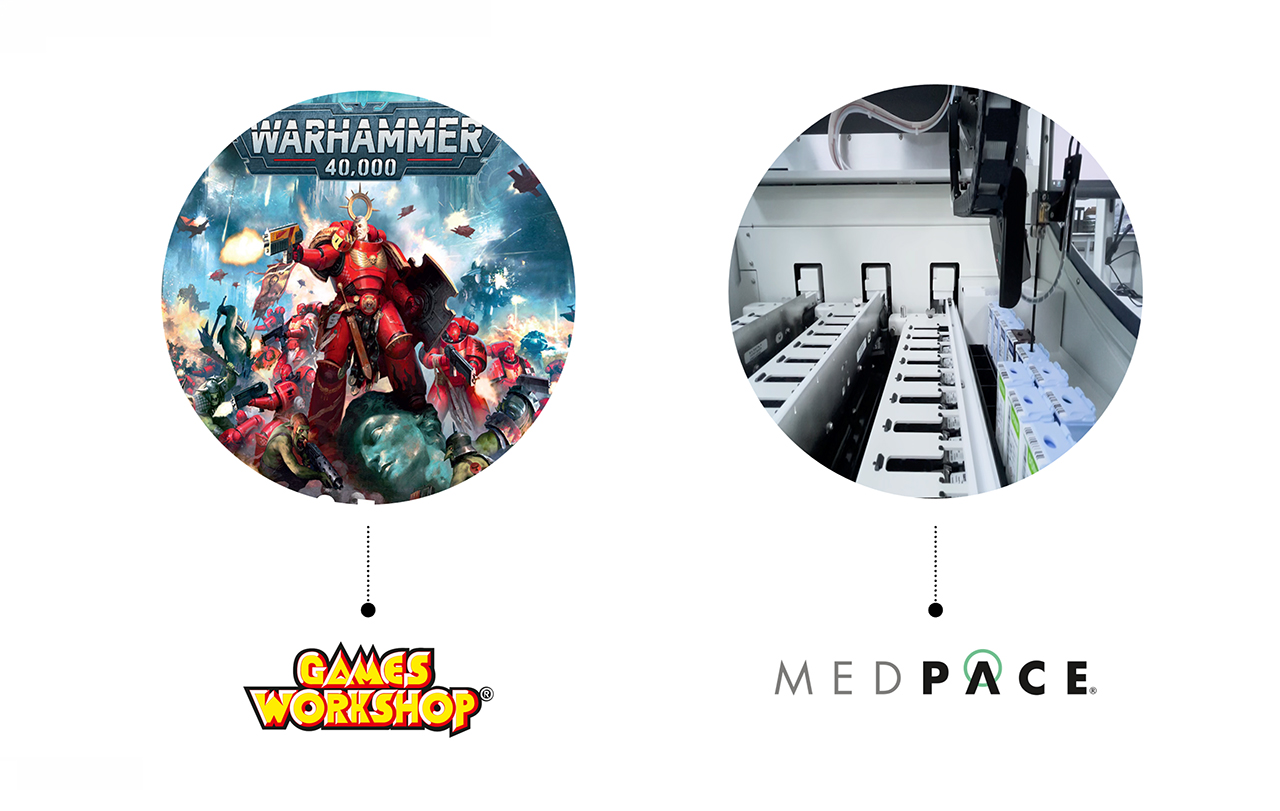
There is also a third category: idiosyncratic bottlenecks, company-specific forms of scarcity that follow their own dynamics.
Idiosyncratic bottlenecks
Logos courtesy of companies
Games Workshop owns Warhammer, an intellectual property and fan community that cannot be replicated simply by throwing capital at it.
Medpace runs clinical trials for biotech companies, with specialist expertise, relationships and a vertical focus that its competitors do not replicate.
Mike used these examples to convey that growth comes in many forms and Global Alpha is a diversified growth portfolio.
For the past five years, being diversified has been a cost. Markets have become increasingly narrow, breadth has been a handicap, and a handful of stocks and themes have done much of the work.
Mike’s argument was that this changes from here. If markets broaden, a portfolio spanning different types of growth opportunities across the physical and digital worlds should be well placed, particularly if it combines growth, quality, diversity and attractive valuations.
Three portfolio angles, one message
The forum reiterated that Global Alpha’s current portfolio is built so that stock-specific insights – “the uncommon understanding” – drive outcomes, rather than unintended exposures to themes, factors or flows.
That has required adaptation. It has required more portfolio-level awareness and analytical capability, a broader view of where growth can be found and a sharper understanding of the market environment.
The team believes the portfolio is in a stronger position, with broader sources of growth, better risk characteristics and unusually strong support from quality and valuation.
The past five years have been challenging. However, the decisions the team is making today are those it believes give Global Alpha the right to win over the years ahead.
- Active share is a metric that measures the percentage of a portfolio's holdings that differ from its benchmark index.
- Earnings per share (EPS) is a financial metric that indicates how much profit a company makes for each outstanding share of its stock. It is calculated by dividing a company's net income (minus preferred dividends) by its total number of outstanding shares.
Risk factors
The views expressed should not be considered as advice or a recommendation to buy, sell or hold a particular investment. They reflect opinion and should not be taken as statements of fact nor should any reliance be placed on them when making investment decisions.
This communication was produced and approved in June 2026 and has not been updated subsequently. It represents views held at the time of writing and may not reflect current thinking.
Potential for profit and loss
All investment strategies have the potential for profit and loss, your or your clients’ capital may be at risk. Past performance is not a guide to future returns.
This communication contains information on investments which does not constitute independent research. Accordingly, it is not subject to the protections afforded to independent research, but is classified as advertising under Art 68 of the Financial Services Act (‘FinSA’) and Baillie Gifford and its staff may have dealt in the investments concerned.
All information is sourced from Baillie Gifford & Co and is current unless otherwise stated.
The images used in this communication are for illustrative purposes only.