

Your capital may be at risk.
Introduction: Japan’s 1980s moment
Just as 1980s America saw corporate raiders, buying large company stakes to push for break-ups or asset sales, and activist investors reshape bloated conglomerates into leaner, shareholder-focused enterprises, Japan is undergoing a corporate awakening today. This shift – from stakeholder to shareholder capitalism – marks perhaps the most significant transformation in Japanese corporate behaviour since the post-war dissolution of the zaibatsu, the industrial and financial conglomerates that once dominated its economy.
Yet the path to unlocking value in Japan is far from straightforward. While attitudes are evolving, decades of cultural tradition and a corporate philosophy built on fundamentally different foundations from those in the west require investors to recalibrate expectations and approach. The opportunity is compelling for those able to navigate this cultural choreography with patience, insight and respect.
Japan’s best companies are beginning to release decades of trapped value while preserving their distinctive edge in quality, innovation and long-term vision.
Ten years after the introduction of Japan’s Corporate Governance Code, the reform journey remains incomplete – but the direction of travel is unmistakable. What sets us apart is not just the longevity of our exposure to Japan, but our method: we have embraced the slow and subtle dance of Japanese corporate reform, combining cultural fluency with focused, persistent engagement. We understand that progress in Japan doesn't always come through headlines or hostile tactics, but through trust-based relationships, grounded expectations and a shared view of long-term value. That is why we are well-positioned to benefit from this moment – not simply because we are invested in the right companies, but because we know how to work with them.
Understanding the system: what makes Japan different
Japan’s hermetically sealed corporate culture has been driven by multiple cultural and historical factors prioritising stability and longevity over pure profit maximisation. Their origins can be traced back to traditional merchant philosophies – such as Sanpo-yoshi, which emphasised positive outcomes for all stakeholders – to the post-World War II dissolution of the zaibatsu and the national project of reconstruction, which prioritised collective recovery and group harmony over individual interests. The paternalistic state and concepts of social contracts that emerged were built around a lattice work of:
- ‘main-bank financing’, where a company’s primary bank didn’t just lend money, but also sat on the board and stepped in to offer support during challenging times,
- defensive capital structures of kabushiki mochiai (reciprocal cross-shareholdings),
- cartels and keiretsu (connected networks built around a core bank or trading house),
- and ‘lifetime employment’ (coined by anthropologist James Abegglen in his seminal 1958 work, The Japanese Factory, to describe the commonplace practice of continuous employment at one firm for the length of the individual’s career).
These gave Japanese companies the strategic flexibility to pursue long-term growth without pressure from outside shareholders, effectively insulating them from market pressures and hostile takeovers.
Although the Japanese model appears antithetical to American-style individualistic capitalism, it has global parallels – most notably in Nordic ’cuddly capitalism,’ which blends capitalism with collective welfare, and in China’s state-led authoritarian capitalism, which prioritises collective interests over individual profit-seeking.
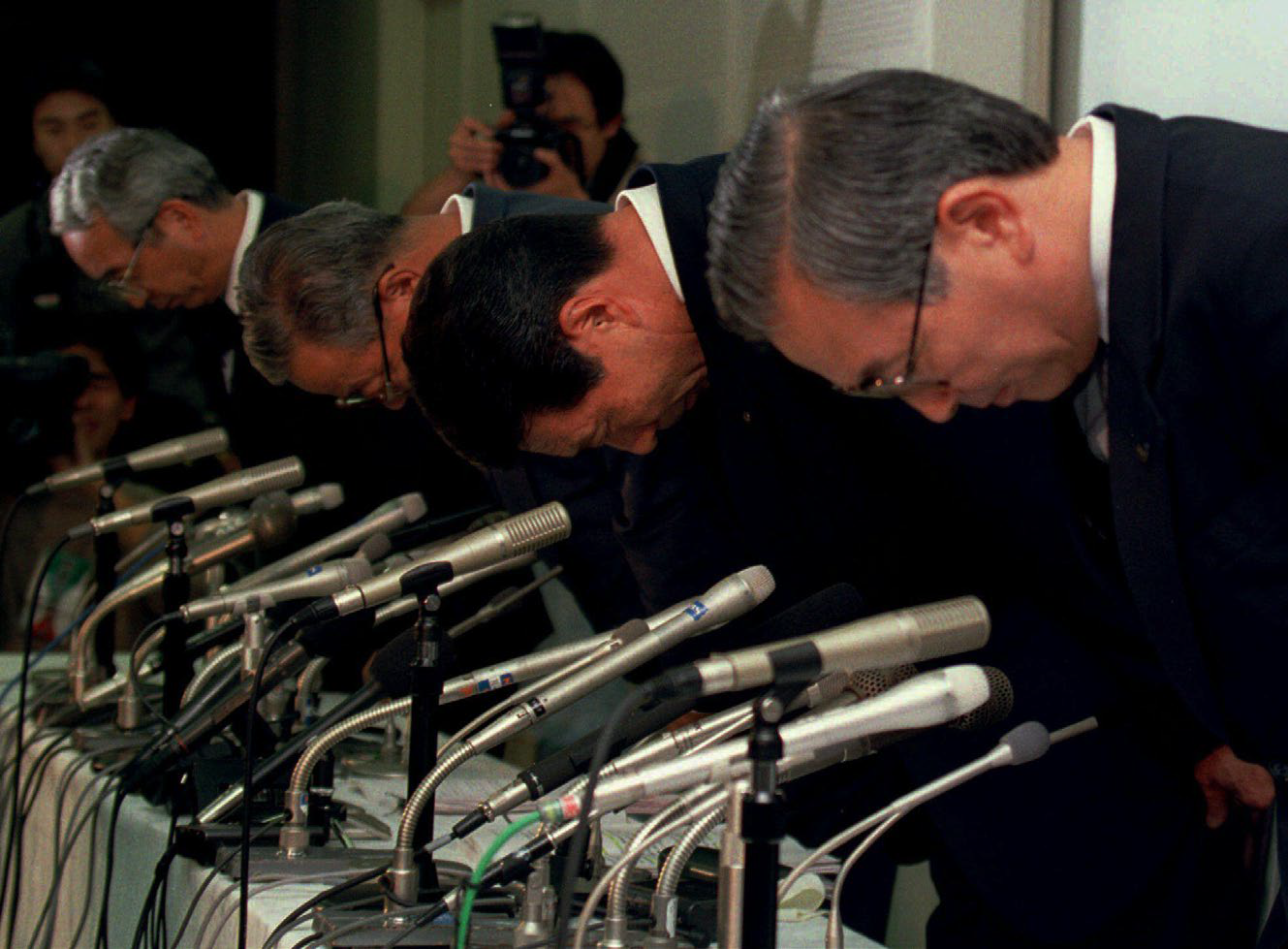
President Katsuhiko Kondo, second from right, and Chaiman Tadashi Okuda, second from left, of the Dai-ichi Kangyo Bank Ltd. bow deeply prior to a news conference its headquarters in Tokyo May 1997. The top executives announced their resignations to take responsibility for a loan scandal
© Credit: Associated Press/Alamy Stock Photo.
This corporate insularity was so extreme that it inspired equally extreme measures to ward off outside interference or criticism. The system's dysfunctional crescendo arguably arrived with the emergence of sokaiya, which were yakuza-connected men hired to shield managers by suppressing questions from ‘activists’ (known tellingly at the time as monoiu toshika or speaking investors). After acquiring shares, these same mobsters would extort companies by making public protests or threats – as happened at Japan Airlines' annual general meetings (AGMs) in the 1970s or the threats made against the president of Janome. By 1982, the practice was so widespread that it had to be outlawed. Companies also sought to silence investors by tactically concentrating their AGMs on the same day, creating a ’June Jam’ that made it impossible for investors to attend multiple meetings.
This practice peaked with up to 95 per cent of Tokyo Stock Exchange-listed companies eventually adopting this practice.
An article in The New York Times on 6 December 1992 highlights the ongoing relationships between corporate Japan and gangsters.
America’s attempt to challenge this impasse and import (in black ship fashion - a nod to Commodore Matthew Perry, whose coal-fired ‘Black Ships’ forced Japan to open its ports to US trade in 1853, ending more than two centuries of self-imposed isolation) its own form of activism also failed. At the end of the 1980s Bubble, American financier T Boone Pickens launched the first foreign activist campaign, acquiring a 26 per cent interest in auto parts maker Koito Manufacturing, and challenging what he perceived as a disadvantageous relationship with Toyota Motor.
The colourful episode exposed to the international eye some of the greenmailing practices – acquiring a significant stake in a company and then threatening a takeover to force the company to repurchase them at a premium – prevalent at the time, the influence of the racketeers and the opacity of Japanese accounting. It ultimately proved an unsuccessful attempt to take on Japan’s keiretsu system of interlinked business affiliations and, to a great extent, cast a shadow over corporate takeovers for decades.
Two more landmark cases followed in the early 2000s. In a watershed moment, the Japanese courts supported the first-ever use of a poison pill, when US hedge fund Steel Partners attempted a hostile acquisition of Bull-Dog Sauce and the company responded by issuing new shares to dilute the would-be acquirer’s stake. Another significant precedent was set when the government stepped in on grounds of national security to block Christopher Hohn's The Children's Investment Fund (TCI)’s attempted acquisition of utility company J-Power. These rulings set a clear precedent, leading to Japanese companies’ widespread adoption of poison pill defences, which peaked at 574 companies in 2008.
Japan should not be surprised at the frustration much of the world has with its cloistered system
Our experience of investing in Japan since the early 1980s has given us a deep appreciation for the sensitivities that still surround perceptions of activism and vocal shareholders. The legacy of past episodes — often associated with short-termism, disruption or even coercion — continues to cast a long shadow, and the term ’activist’ still carries negative connotations in many Japanese boardrooms. While the landscape has evolved and international investors increasingly recognise these cultural undercurrents, this historical context has long shaped our approach. We have learned that successful engagement in Japan demands more than conviction – it requires cultural fluency, patience and trust. Rather than emulate confrontational models, we pursue long-term activism through deep, relationship-driven engagement, built on a clear investment rationale and mutual respect. We seek and support enduring change through this lens, not through moments of noise or public disruption.
Our current and long-standing relationship with Japan Exchange Group (JPX), now widely regarded as the leading flag bearer for corporate reform in Japan, dates back to before its formation through the 2013 merger of the Osaka and Tokyo Stock Exchanges. The length of our relationship gives us a deeply-informed view of how it sees its current role in shaping the behaviour of listed companies. While ensuring market integrity is standard among most exchanges, JPX’s active emphasis on governance, capital efficiency (how well it puts its cash to work), and valuation sets it apart. Our depth of familiarity allows us to engage with clarity and purpose. Our ongoing dialogue with the chief executive (CEO), Hiromi Yamaji, informs our understanding of JPX itself and offers a forward-looking view into the trajectory of corporate reform across Japan.
The catalyst effect: shareholder activism comes of age
Like Japan’s cloistered corporate system, pre-1980s America featured equally insulated companies with friendly boards, minimal external pressure, and low stock-based compensation (20 per cent versus today’s 75 per cent). The 1980s ’deal decade’ shook up this system, with takeover bids targeting almost half of America’s major corporations. Today, Japan’s wave of shareholder activism is serving a similarly catalytic function.
This activist wave is coinciding with broader regulatory reforms, as well as economic pressures to improve efficiency. Together, these forces are pushing Japanese corporations away from their traditional post-war, bank-dominated model toward a more modern, shareholder-oriented approach focused on transparency and value creation. As such, today’s corporate scene feels much more fluid: mergers and acquisitions (M&A) and private equity activity are surging, and shareholder demands are exploding: the number of activist investors targeting Japanese companies has surged from just eight investors ten years ago to 73 by 2024, making it the second largest market for shareholder activism globally.
While the nature of activism in Japan has evolved significantly from its early, more aggressive incarnations, cultural wariness remains. The legacy of smash-and-grab asset-stripping tactics continues to colour perceptions, making many companies cautious, if not sceptical, of shareholder intervention, despite its increasingly constructive intent – focused on dismantling sprawling, unfocused conglomerates, driving consolidation in fragmented industries, strengthening board governance and promoting more disciplined capital allocation. Nonetheless, overcoming ingrained scepticism increasingly requires a thoughtful, culturally attuned approach.
Japan is full of opportunities. Today’s Japan reminds me of the United States in the 1980s when companies transformed and shifted to growth
Importance of cultural choreography, navigating this new landscape
Form versus substance: In 2023, Canon’s Chairman and President/CEO, Fujio Mitarai, received an approval rating of just 50.6 per cent (a strikingly low figure in Japan, where such votes typically exceed 90 per cent). When I met the company last year, management attributed this to a lack of board diversity – and they likely felt vindicated when his rating subsequently jumped to 90.9 per cent at the AGM following the appointment of Canon’s first female non-executive director (despite the fact they immediately doubled the size of the otherwise male board, thereby halving the benefit of her inclusion!).
I believe the issue runs deeper. Canon’s board is one of the most entrenched in Japan, with Mitarai holding top roles for much of the past 30 years. Alongside falling margins and returns, Canon’s sales have contracted approximately 2 per cent per annum in US dollars over the past decade. This reflects a broader pattern: while many companies now meet the formal requirements of governance reform, substance often lags form, with insider-dominated appointments and cosmetic diversity masking a lack of genuine change (although 98 per cent of Topix 500 companies have at least one female board member, 76 per cent still comprise only Japanese nationals).
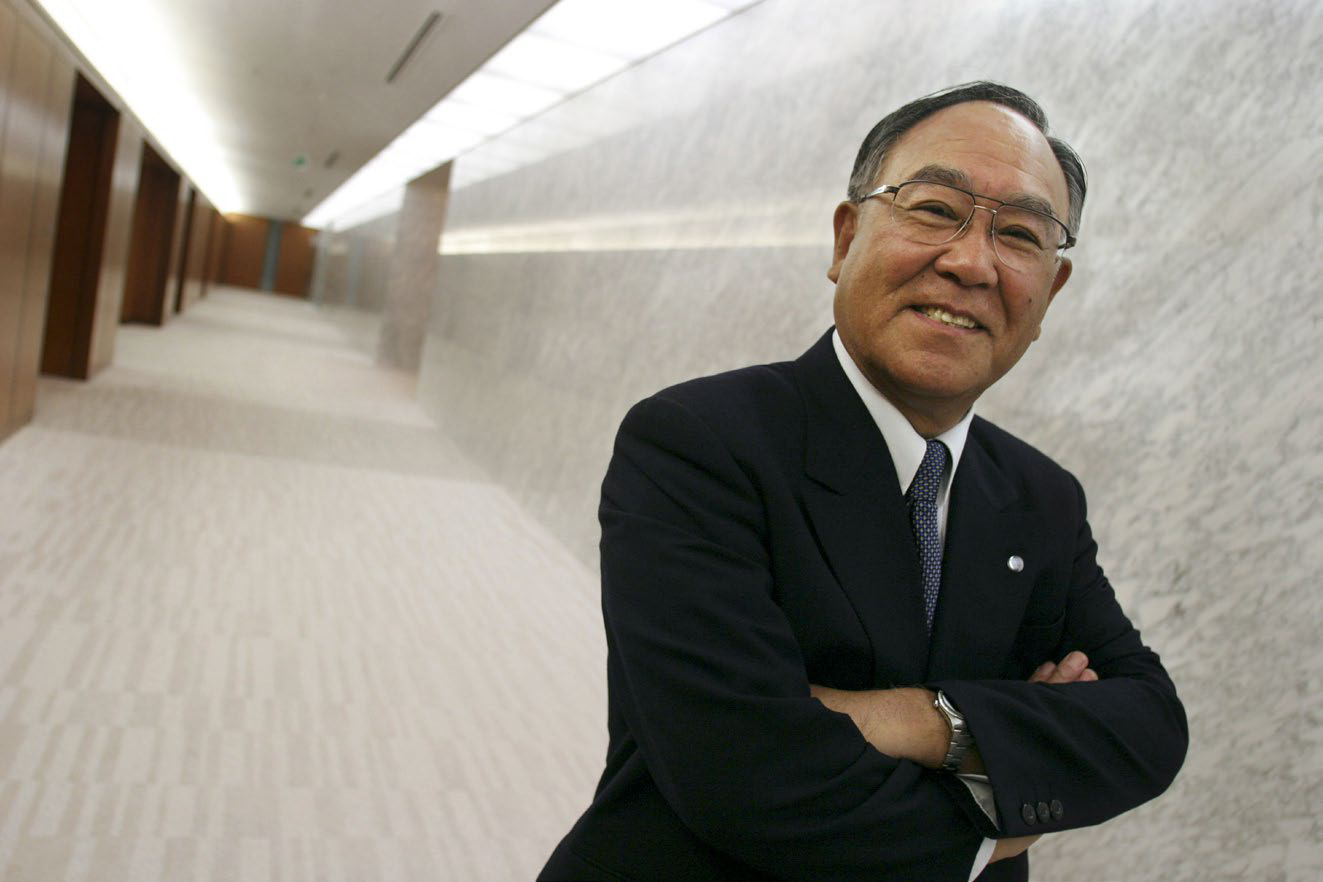
Fujio Mitarai, Chairman, CEO and President of Canon Inc, one of the leading Japanese electronics and camera manufacturing companies
© Jeremy Sutton-Hibbert/ lamy Stock Photo.
Pressure versus partnership: In Japan, pressure alone rarely leads to lasting change. What may appear from the outside as inefficient capital management – notably, persistent cash hoarding – is often deeply embedded in a corporate philosophy shaped by decades of risk aversion, crisis preparedness and an emphasis on continuity. For many companies, particularly those more vulnerable, excess cash is not simply a balance sheet issue; it represents a buffer against these risks and a means of self-preservation. Challenging it without sensitivity can feel like an attack on a carefully maintained and justifiable equilibrium to management.
Although activism may be creating a healthy anxiety in many Japanese boardrooms, other boards are reacting defensively. For example, we saw a temporary setback in AGM dispersion in 2023, when some companies reverted to clustering meeting dates, falling back on that familiar ’80s tactic to limit scrutiny. Encouragingly, this year has marked a return to the longer-term positive trend, with further improvements in dispersion pointing to a growing openness to shareholder engagement. The gradual nature of this progress reinforces a broader lesson: in Japan, meaningful change is far more likely to emerge through steady, respectful pressure than through confrontational tactics.
Concentration of AGMs onpeak day
Hover over the coloured sections of the graph to reveal each era's name.
Excess cash is a common phenomenon: The presumption that the activist opportunity exists only among low-rated or underperforming companies is misplaced. While it’s true that the most operationally fragile firms are often the most reluctant to part with their cash reserves, they are by no means the only ones sitting on substantial balances. Japan’s strongest performers hold a significant share of the more than ¥300tn in non-financial corporate cash and short-term deposits sitting on the balance sheets of Japanese companies. Keyence, for example, holds a striking ¥2.4tn on its balance sheet alone.
Despite being exceptionally well run – it operates an asset-light, consultancy-style model where it owns few factories and relies on its engineering know-how, and generating about ¥260bn in annual free cash flow over the past five years – like many of Japan’s best-managed companies, it has struggled to reinvest and has shown little inclination to optimise returns. We continue to engage with management, reminding them that fully deploying the company’s excess cash in repurchasing its shares (buybacks) would virtually double return on invested capital (ROIC), the profit generated for every yen invested in the business.
This pattern plays out across our portfolio, with varying degrees of success, in companies such as MS&AD Insurance, SMC and Mitsubishi Estate – all of which have executed sizeable buybacks in recent years in response to sustained engagement.
Real, lasting change in Japan doesn't come from blunt demands but from long-term engagement grounded in trust, insight, and cultural awareness. By taking the time to understand management priorities, team dynamics, and strategic intent, we’ve been able to cut through superficial signals and help drive tangible improvements in governance, capital allocation and shareholder returns.
Practical applications from 40 years of lessons learnt
Factoring for intangibles: Our research process focuses on three core investment pillars:
- the scale of the business opportunity;
- a company’s dynamic resilience, ie, its ability to adapt to changing circumstances;
- and the potential upside.
However, a fourth, often overlooked, factor critically shapes the realisation of the other three: the quality of governance and alignment with long-term sustainability principles.
Unlike many investors who treat environmental, social and governance (ESG) as a standalone screen, we embed it directly into our investment cases – not as a checklist, but as a lens through which to understand long-term success, implicitly asking:
- What business practice considerations are material to the business case? (Opportunity)
- What cultural traits will enable outperformance in the long run? (Resilience)
- How will this company benefit from ESG opportunities? What is our insight? (Upside)
In Japan, we believe that ESG analysis is best seen as an analytical framework to uncover blind spots in governance, capital allocation or organisational structure. It also helps identify positive traits, such as how well companies are positioned to harness structural shifts in sustainability and governance. In addition, it assesses alignment, adaptability and leadership depth – the building blocks of long-term growth.
Long-termism: Japan continues to present a compelling opportunity for long-term investors not through quick fix activism or opportunistic ad hoc plays on poorly run companies, but by encouraging good companies to be bolder in realising their full potential. Knowing when to press and setting clear priorities and benchmarks is key to achieving success, not engaging in quick-fix activism or opportunistic ad hoc plays on poorly run companies.
- Sony presents a perfect example of how a well-thought-out and culturally-sensitive engagement approach that doesn’t seek to prioritise short-term gains can pay off. In 2020, Sony went against the demands of an activist investor to sell its financial services business and instead bought out the minorities and made Sony Financial a wholly-owned subsidiary. We supported the company. Our decision was based on two insights: the competence of management and the likelihood of the company achieving a better valuation. Both have proven correct and, with a spin-off imminent, shareholders could realise a 50 per cent gain on the last price (the company) paid. And Sony’s share price has risen over eightfold over our ownership period.
- Success may result through generational change, as we learned from our investment in another cash-rich company, SMC, a leader in pneumatic engineering, when control passed from father to son. In just four years, the dividend has tripled and the share count has fallen by 5 per cent.
- Engaging only on what is most important to the investment case helps set priorities. For example, pressing MS&AD Insurance to sell down its crossholdings, which represented more than the company’s entire market capitalisation, has proven far more fruitful than engaging on a wide set of issues.
- We set clear dividend expectations tied to the company’s surplus cash and oppose low payout ratios. Doing so has introduced a degree of helpful objectivity. It also provides a useful challenge on broader capital management. Automotive components company Denso is one of several examples where we have encouraged much more progressive returns and have been complimented by management for doing so.

“Baillie Gifford has been engaging on rich balance sheets, poison pills, dividend payout ratios, introduction of independent board members and board diversity for nearly 20 years.
When I first went to Japan in 2007, we couldn’t translate my business card as no word for corporate governance existed.”
Marianne Harper-Gow
Head of Asia Corporate Governance, Baillie Gifford & Co
The fog is lifting: What has changed most in the past 30 years – and most radically in the past five – is the level of corporate transparency. Better governance and disclosure have played a role. But just as significant is the unwinding of crossholdings, which is disrupting longstanding corporate relationships and creating space for new, long-term, committed shareholders to engage more meaningfully. In the same way we look for management to be aligned with the business’s success, a management team will also seek alignment with shareholders capable of supporting its strategic ambitions. Our ability to assess risk appetite and the probability of success has dramatically improved thanks to these shifts in the Japanese corporate landscape. The strength of SHIFT’s management – a highly ambitious, founder-led IT company that has successfully drawn senior talent from Keyence (factory automation) and Recruit (global recruitment) – is one example of favourably skewed odds created by a management team that is willing to engage more openly with trusted, long-term shareholders.
Knowing when and how to engage: One unique facet of our engagement with our Japanese holdings is the level of detail we apply to our voting decisions, before and after the AGM. Before the AGM, we aim to be both supportive and constructive, setting clear benchmarks where necessary, with our expectations around shareholder returns being one such measure. Providing a post-AGM voting rationale is rare within Baillie Gifford and the Japanese market more broadly. However, companies are reaching out more frequently after voting deadlines have passed and are increasingly receptive to understanding our future expectations. This post-AGM period has become an especially valuable window to assess – and, where needed, challenge – the level of management ambition. While shareholder proposals in Japan rarely succeed, they are often quietly implemented over time. We believe that a combination of constructive support and clearly communicated expectations is increasingly likely to drive tangible outcomes.
Conclusion: the realisable ambition
Japan is undergoing its 1980s moment, but with a distinctly Japanese twist. The opportunity lies in patient, culturally-informed engagement, not confrontation. Working with management, acting independently of proxy advisors recommending how shareholders should vote at meetings, and using our proprietary insight is increasingly delivering real change. The most underexploited part of Japanese investing is understanding the limits – and potential – of realisable ambition. Never before has long-term activism been so well-positioned to skew the odds in favour of success for long-term, committed investors, such as Baillie Gifford.
Annual past performance to 30 June each year (net %)
| 2021 | 2022 | 2023 | 2024 | 2025 | |
| Japanese Equities All Cap Composite (gross) | 33.2 | -27.6 | 10.8 | 6.9 | 14.1 |
| Japanese Equities All Cap Composite (net) | 32.4 | -28.0 | 10.1 | 6.2 | 13.4 |
| Japanese Equities Growth Composite (gross) | 29.9 | -33.8 | 13.2 | 6.0 | 9.3 |
| Japanese Equities Growth Composite (net) | 29.1 | -34.2 | 12.5 | 5.4 | 8.7 |
| TOPIX Index | 23.8 | -19.5 | 18.1 | 12.8 | 15.9 |
Annualised returns to 30 June 2025 (%)
| 1 year | 5 years | 10 years | |
| Japanese Equities All Cap Composite (gross) | 14.1 | 5.4 | 6.6 |
| Japanese Equities All Cap Composite (net) | 13.4 | 4.8 | 5.9 |
| Japanese Equities Growth Composite (gross) | 9.3 | 2.4 | 5.1 |
| Japanese Equities Growth Composite (net) | 8.7 | 1.8 | 4.4 |
| TOPIX Index | 15.9 | 9.0 | 6.5 |
Source: Revolution, Japan Exchange Group. US dollars. Returns have been calculated by reducing the gross return by the highest annual management fee for the composite. 1 year figures are not annualised.
Past performance is not a guide to future returns.
Legal notice: The TOPIX Index Value and the TOPIX Marks are subject to the proprietary rights owned by Tokyo Stock Exchange, Inc. and Tokyo Stock Exchange, Inc. owns all rights and know-how relating to the TOPIX such as calculation, publication and use of the TOPIX Index Value and relating to the TOPIX Marks. No Product is in any way sponsored, endorsed or promoted by Tokyo Stock Exchange, Inc.
Important information
The views expressed should not be considered as advice or a recommendation to buy, sell or hold a particular investment. They reflect opinion and should not be taken as statements of fact nor should any reliance be placed on them when making investment decisions.
This communication was produced and approved in September 2025 and has not been updated subsequently. It represents views held at the time of writing and may not reflect current thinking.
Potential for profit and loss
All investment strategies have the potential for profit and loss, your or your clients’ capital may be at risk. Past performance is not a guide to future returns.
This communication contains information on investments which does not constitute independent research. Accordingly, it is not subject to the protections afforded to independent research, but is classified as advertising under Art 68 of the Financial Services Act (‘FinSA’) and Baillie Gifford and its staff may have dealt in the investments concerned.
All information is sourced from Baillie Gifford & Co and is current unless otherwise stated.
The images used in this communication are for illustrative purposes only.
Baillie Gifford & Co and Baillie Gifford & Co Limited are authorised and regulated by the Financial Conduct Authority (FCA). Baillie Gifford & Co Limited is an Authorised Corporate Director of OEICs.
Baillie Gifford Overseas Limited provides investment management and advisory services to non-UK Professional/Institutional clients only. Baillie Gifford Overseas Limited is wholly owned by Baillie Gifford & Co. Baillie Gifford & Co and Baillie Gifford Overseas Limited are authorised and regulated by the FCA in the UK.
Persons resident or domiciled outside the UK should consult with their professional advisers as to whether they require any governmental or other consents in order to enable them to invest, and with their tax advisers for advice relevant to their own particular circumstances.
Financial intermediaries
This communication is suitable for use of financial intermediaries. Financial intermediaries are solely responsible for any further distribution and Baillie Gifford takes no responsibility for the reliance on this document by any other person who did not receive this document directly from Baillie Gifford.
Europe
Baillie Gifford Investment Management (Europe) Ltd (BGE) is authorised by the Central Bank of Ireland as an AIFM under the AIFM Regulations and as a UCITS management company under the UCITS Regulation. BGE also has regulatory permissions to perform Individual Portfolio Management activities. BGE provides investment management and advisory services to European (excluding UK) segregated clients. BGE has been appointed as UCITS management company to the following UCITS umbrella company; Baillie Gifford Worldwide Funds plc. BGE is a wholly owned subsidiary of Baillie Gifford Overseas Limited, which is wholly owned by Baillie Gifford & Co. Baillie Gifford Overseas Limited and Baillie Gifford & Co are authorised and regulated in the UK by the Financial Conduct Authority.
Hong Kong
Baillie Gifford Asia (Hong Kong) Limited 柏基亞洲(香港)有限公司 is wholly owned by Baillie Gifford Overseas Limited and holds a Type 1 license from the Securities & Futures Commission of Hong Kong to market and distribute Baillie Gifford’s range of collective investment schemes to professional investors in Hong Kong. Baillie Gifford Asia (Hong Kong) Limited 柏基亞洲(香港)有限公司 can be contacted at Suites 2713-2715, Two International Finance Centre, 8 Finance Street, Central, Hong Kong. Telephone +852 3756 5700.
South Korea
Baillie Gifford Overseas Limited is licensed with the Financial Services Commission in South Korea as a cross border Discretionary Investment Manager and Non-discretionary Investment Adviser.
Japan
Mitsubishi UFJ Baillie Gifford Asset Management Limited (‘MUBGAM’) is a joint venture company between Mitsubishi UFJ Trust & Banking Corporation and Baillie Gifford Overseas Limited. MUBGAM is authorised and regulated by the Financial Conduct Authority.
Australia
Baillie Gifford Overseas Limited (ARBN 118 567 178) is registered as a foreign company under the Corporations Act 2001 (Cth) and holds Foreign Australian Financial Services Licence No 528911. This material is provided to you on the basis that you are a “wholesale client” within the meaning of section 761G of the Corporations Act 2001 (Cth) (“Corporations Act”). Please advise Baillie Gifford Overseas Limited immediately if you are not a wholesale client. In no circumstances may this material be made available to a “retail client” within the meaning of section 761G of the Corporations Act.
This material contains general information only. It does not take into account any person’s objectives, financial situation or needs.
South Africa
Baillie Gifford Overseas Limited is registered as a Foreign Financial Services Provider with the Financial Sector Conduct Authority in South Africa.
North America
Baillie Gifford International LLC is wholly owned by Baillie Gifford Overseas Limited; it was formed in Delaware in 2005 and is registered with the SEC. It is the legal entity through which Baillie Gifford Overseas Limited provides client service and marketing functions in North America. Baillie Gifford Overseas Limited is registered with the SEC in the United States of America.
The Manager is not resident in Canada, its head office and principal place of business is in Edinburgh, Scotland. Baillie Gifford Overseas Limited is regulated in Canada as a portfolio manager and exempt market dealer with the Ontario Securities Commission (‘OSC’). Its portfolio manager licence is currently passported into Alberta, Quebec, Saskatchewan, Manitoba and Newfoundland & Labrador whereas the exempt market dealer licence is passported across all Canadian provinces and territories. Baillie Gifford International LLC is regulated by the OSC as an exempt market and its licence is passported across all Canadian provinces and territories. Baillie Gifford Investment Management (Europe) Limited (‘BGE’) relies on the International Investment Fund Manager Exemption in the provinces of Ontario and Quebec.
Israel
Baillie Gifford Overseas Limited is not licensed under Israel’s Regulation of Investment Advising, Investment Marketing and Portfolio Management Law, 5755–1995 (the Advice Law) and does not carry insurance pursuant to the Advice Law. This material is only intended for those categories of Israeli residents who are qualified clients listed on the First Addendum to the Advice Law.
Singapore
Baillie Gifford Asia (Singapore) Private Limited is wholly owned by Baillie Gifford Overseas Limited and is regulated by the Monetary Authority of Singapore as a holder of a capital markets services licence to conduct fund management activities for institutional investors and accredited investors in Singapore. Baillie Gifford Overseas Limited, as a foreign related corporation of Baillie Gifford Asia (Singapore) Private Limited, has entered into a cross-border business arrangement with Baillie Gifford Asia (Singapore) Private Limited, and shall be relying upon the exemption under regulation 4 of the Securities and Futures (Exemption for Cross-Border Arrangements) (Foreign Related Corporations) Regulations 2021 which enables both Baillie Gifford Overseas Limited and Baillie Gifford Asia (Singapore) Private Limited to market the full range of segregated mandate services to institutional investors and accredited investors in Singapore.
172513 10057678