

Overview
Why Duolingo is a beneficiary of AI, not a victim – and why for the long-term investor, patience is a virtue.

Image courtesy of Duolingo
As with any investment, your capital is at risk.
"When you see a good move – wait – look for a better one."
– Emanuel Lasker, six-time World Chess Champion
The game of chess has much to teach the long-term investor. Above all, it requires patience, adaptability, and a knowledge that every move should be made with the endgame in mind. Beginners react to what’s on the board. Masters play for the position they want in twenty moves' time.
This is also the case at LTGG, where we deliberately set ourselves against the short-term horizons of the market, in the hope that by stepping back, we can consider opportunities that barely register on today’s share price.
And as any player will tell you, the game of chess is also highly addictive. The latest addition to the LTGG portfolio, Duolingo, knows this well. The app that turned language-learning into a game has also just launched a new chess feature.
Playfulness is at the core of Duolingo’s runaway success. And it is through chess that we can see the outlines of its compelling investment case.
Controlling the centre
Even amateur players know the key to any chess match is gaining control of the centre. Duolingo sits squarely in the centre of the language learning market.
Within a year of launch in 2012, it shot to the top of the education app charts, where it has remained as the most downloaded education app in the world. Over the last 5 years, the number of monthly active users has increased by 30 per cent a year, to more than 130 million. The company’s closest competitors are about one-tenth of the size.
And yet, there is plenty more space on the board to play for. There are an estimated 1.5 billion language learners worldwide, and the global digital learning market is projected to be worth over $100bn by 2030.
The key to Duolingo’s success has been making learning fun: turning it into a game and tapping users’ competitive instincts with “streaks” – rewards for returning day after day.
That stickiness is crucial for the app’s ability to convert free users into paying subscribers. As the overall number of users shot up, the proportion who chose to pay also rose markedly, from 4 per cent in 2020 to over 8 per cent today.
Adaptability
Adaptability is as vital in business as it is in chess, and Duolingo has demonstrated this repeatedly. Its early expansion into different languages has been followed by new ventures in maths, music (and yes, chess!) all of which could one day contribute meaningfully to revenues.
It’s worth noting that the chess feature grew to 1 million daily active users in just a month – something it took other offerings like maths a year to achieve. And when it comes to adaptability and planning for the future, a company’s culture is critical.
Duolingo is mission-driven. Many employees turned down higher-paying roles elsewhere for the opportunity to help make education accessible to all.
We’ve engaged extensively with founder and CEO Luis von Ahn, who recently shared with us his “biggest fear”: that one day the company would prioritise its share price over its mission. Long-term thinking is central to Duolingo’s identity, and they are willing to trade short-term optics for a durable advantage.
Beneficiary of AI, not a victim
In 1997, IBM’s Deep Blue defeated world chess champion Garry Kasparov, seemingly settling the question of man versus machine. The lasting lesson came afterwards: players embraced AI not as a replacement but as a training partner, using engines to improve faster and play better. Far from diminishing the game, AI elevated it.
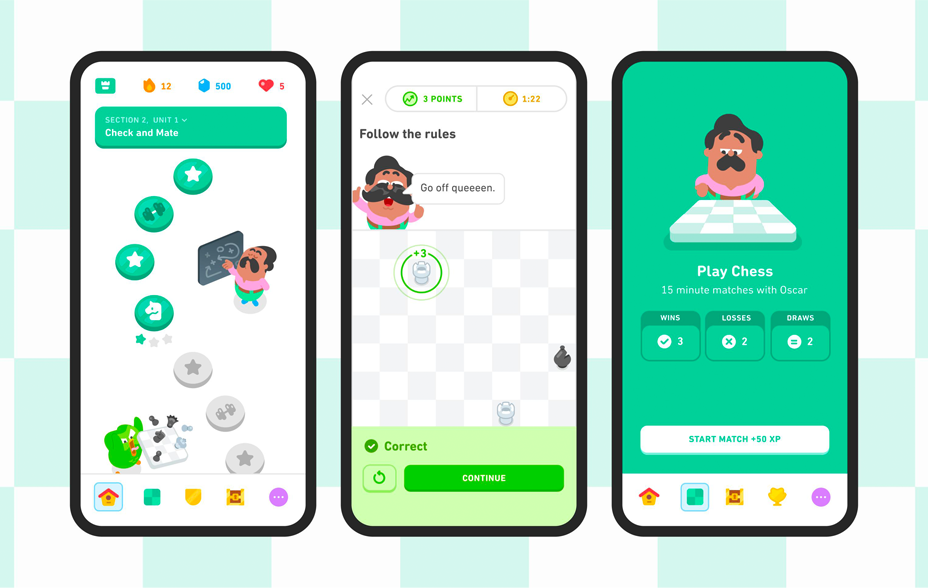
Image courtesy of Duolingo
We see a similar dynamic at play with Duolingo. Since its peak in May, the share price has fallen sharply, partly due to fears that AI translation will make language learning obsolete. But what if such fears are misplaced?
Ever since it launched in 2012, there has always been a perceived threat to Duolingo’s business model from ever-improving translation tools. But the app’s value lies in learning and retention, rather than just comprehension and translation.
Most of Duolingo’s paid users are learning a language for practical reasons: to integrate into a culture, to get a job, or simply for the pure enjoyment and achievement it brings. These use cases are unlikely to be fatally undermined by AI.
And Duolingo is effectively harnessing AI to become a coach, not a substitute. The Duolingo Max subscription tier now includes an AI assistant who can hone your new conversational skills over a video call, as well as provide individual feedback on your progress. It is proving very popular. It is also opening doors in traditionally hard-to-reach markets.
Until now, most of Duolingo’s subscription revenue has come from developed nations. In many emerging markets, ad-supported usage has been the dominant trend. But give people something worth paying for, as Max is now doing (where it might make the difference in someone getting a job), and they may come in droves.
Moreover, Duolingo’s user base has thus far tended to consist of beginner and intermediate users. As its AI functions improve, they could also begin to capture more serious learners.
Upside
Even if we were to assume user growth slows from around 30 per cent to 25 per cent a year by 2030, we can envision a plausible scenario where Duolingo reaches around 400 million users – about a quarter of the estimated number of language learners worldwide.
If we suppose Max reaches its full potential, the number of paid subscribers could feasibly more than double to reach 20 to 25 per cent of total users (it’s already growing over 40 per cent per year). Even if the average revenue per user were to decrease to reflect a more diverse international subscriber base, it is feasible that total revenues reach $6-7bn a year by 2030, and margins continue to expand.
In such a scenario, we wouldn’t need exuberant valuation multiples to reach a 5x case. And that’s without factoring in any extra revenue for the more nascent functions of maths, music and chess.
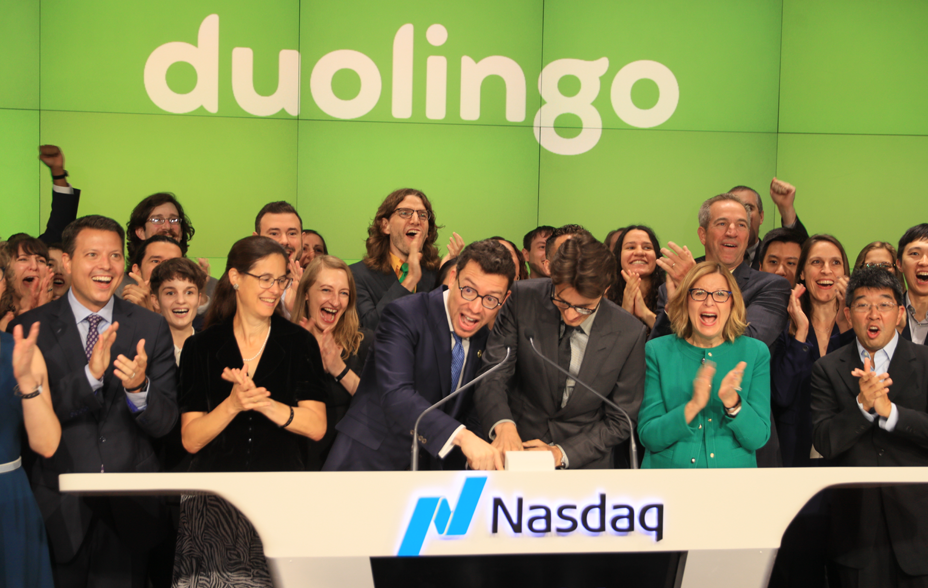
Duolingo’s Nasdaq IPO Opening Bell ceremony, July 28, 2021—opened by Co-founder and CEO Luis von Ahn. Image courtesy of Duolingo
Returning to the wisdom of the great chess grandmaster Emanuel Lasker above, at LTGG, we had been interested in Duolingo for some time. It has been held elsewhere at Baillie Gifford since its IPO in 2021. But as recently as January this year, it had struggled to clear the high hurdle for entry into the portfolio.
So, we waited. Our conviction in the strength of the company’s long-term fundamentals has since increased, while the market’s view has grown more fearful. Unhurried, we made our move.
Risk factors
The views expressed should not be considered as advice or a recommendation to buy, sell or hold a particular investment. They reflect opinion and should not be taken as statements of fact nor should any reliance be placed on them when making investment decisions.
This communication was originally produced and approved in November 2025 and has not been updated subsequently.
All investment strategies have the potential for profit and loss, your or your clients’ capital may be at risk. Past performance is not a guide to future returns.
This communication contains information on investments which does not constitute independent research. Accordingly, it is not subject to the protections afforded to independent research, but is classified as advertising under Art 68 of the Financial Services Act (‘FinSA’) and Baillie Gifford and its staff may have dealt in the investments concerned.
All information is sourced from Baillie Gifford & Co and is current unless otherwise stated.
The images used in this communication are for illustrative purposes only.
Important information
Baillie Gifford & Co and Baillie Gifford & Co Limited are authorised and regulated by the Financial Conduct Authority (FCA). Baillie Gifford & Co Limited is an Authorised Corporate Director of OEICs.
Baillie Gifford Overseas Limited provides investment management and advisory services to non-UK Professional/Institutional clients only. Baillie Gifford Overseas Limited is wholly owned by Baillie Gifford & Co. Baillie Gifford & Co and Baillie Gifford Overseas Limited are authorised and regulated by the FCA in the UK.
Persons resident or domiciled outside the UK should consult with their professional advisers as to whether they require any governmental or other consents in order to enable them to invest, and with their tax advisers for advice relevant to their own particular circumstances.
Financial intermediaries
This communication is suitable for use of financial intermediaries. Financial intermediaries are solely responsible for any further distribution and Baillie Gifford takes no responsibility for the reliance on this document by any other person who did not receive this document directly from Baillie Gifford.
Europe
Baillie Gifford Investment Management (Europe) Ltd (BGE) is authorised by the Central Bank of Ireland as an AIFM under the AIFM Regulations and as a UCITS management company under the UCITS Regulation. BGE also has regulatory permissions to perform Individual Portfolio Management activities. BGE provides investment management and advisory services to European (excluding UK) segregated clients. BGE has been appointed as UCITS management company to the following UCITS umbrella company; Baillie Gifford Worldwide Funds plc. BGE is a wholly owned subsidiary of Baillie Gifford Overseas Limited, which is wholly owned by Baillie Gifford & Co. Baillie Gifford Overseas Limited and Baillie Gifford & Co are authorised and regulated in the UK by the Financial Conduct Authority.
Hong Kong
Baillie Gifford Asia (Hong Kong) Limited 柏基亞洲(香港)有限公司 is wholly owned by Baillie Gifford Overseas Limited and holds a Type 1 license from the Securities & Futures Commission of Hong Kong to market and distribute Baillie Gifford’s range of collective investment schemes to professional investors in Hong Kong. Baillie Gifford Asia (Hong Kong) Limited 柏基亞洲(香港)有限公司 can be contacted at Suites 2713–2715, Two International Finance Centre, 8 Finance Street, Central, Hong Kong. Telephone +852 3756 5700.
South Korea
Baillie Gifford Overseas Limited is licensed with the Financial Services Commission in South Korea as a cross border Discretionary Investment Manager and Non-discretionary Investment Adviser.
Japan
Mitsubishi UFJ Baillie Gifford Asset Management Limited (‘MUBGAM’) is a joint venture company between Mitsubishi UFJ Trust & Banking Corporation and Baillie Gifford Overseas Limited. MUBGAM is authorised and regulated by the Financial Conduct Authority.
Australia
Baillie Gifford Overseas Limited (ARBN 118 567 178) is registered as a foreign company under the Corporations Act 2001 (Cth) and holds Foreign Australian Financial Services Licence No 528911. This material is provided to you on the basis that you are a “wholesale client” within the meaning of section 761G of the Corporations Act 2001 (Cth) (“Corporations Act”). Please advise Baillie Gifford Overseas Limited immediately if you are not a wholesale client. In no circumstances may this material be made available to a “retail client” within the meaning of section 761G of the Corporations Act.
This material contains general information only. It does not take into account any person’s objectives, financial situation or needs.
South Africa
Baillie Gifford Overseas Limited is registered as a Foreign Financial Services Provider with the Financial Sector Conduct Authority in South Africa.
North America
Baillie Gifford International LLC is wholly owned by Baillie Gifford Overseas Limited; it was formed in Delaware in 2005 and is registered with the SEC. It is the legal entity through which Baillie Gifford Overseas Limited provides client service and marketing functions in North America. Baillie Gifford Overseas Limited is registered with the SEC in the United States of America.
The Manager is not resident in Canada, its head office and principal place of business is in Edinburgh, Scotland. Baillie Gifford Overseas Limited is regulated in Canada as a portfolio manager and exempt market dealer with the Ontario Securities Commission ('OSC'). Its portfolio manager licence is currently passported into Alberta, Quebec, Saskatchewan, Manitoba and Newfoundland & Labrador whereas the exempt market dealer licence is passported across all Canadian provinces and territories.
Israel
Baillie Gifford Overseas Limited is not licensed under Israel’s Regulation of Investment Advising, Investment Marketing and Portfolio Management Law, 5755–1995 (the Advice Law) and does not carry insurance pursuant to the Advice Law. This material is only intended for those categories of Israeli residents who are qualified clients listed on the First Addendum to the Advice Law.
Singapore
Baillie Gifford Asia (Singapore) Private Limited is wholly owned by Baillie Gifford Overseas Limited and is regulated by the Monetary Authority of Singapore as a holder of a capital markets services licence to conduct fund management activities for institutional investors and accredited investors in Singapore. Baillie Gifford Overseas Limited, as a foreign related corporation of Baillie Gifford Asia(Singapore) Private Limited, has entered into a cross-border business arrangement with Baillie Gifford Asia (Singapore) Private Limited, and shall be relying upon the exemption under regulation 4 of the Securities and Futures (Exemption for Cross-Border Arrangements) (Foreign Related Corporations) Regulations 2021 which enables both Baillie Gifford Overseas Limited and Baillie Gifford Asia (Singapore) Private Limited to market the full range of segregated mandate services to institutional investors and accredited investors in Singapore.
170703 10057365